
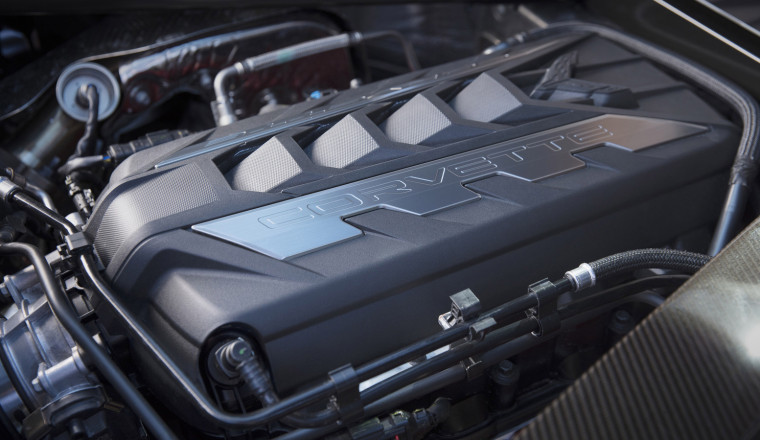

The current Chevrolet Corvette is knocking out Nürburgring records left and right, butremember, the previous generation's model was no slouch either. At its heart was an LT1 V8 engine that GM Authority called "the most significant redesign in the [Chevrolet] small block's nearly 60-year history." Of course, that was in 2014, and when the 2020 Corvette was being developed, it seemed the best way to ratchet up performance was to follow what had become a Corvette tradition: Introducing a brand-new engine to go with the brand-new car.
It began back in 1998, when the fifth-generation Corvette welcomed the first Chevy LS1 V8. The next generation upgraded to the LS2, and the LT1 was later introduced in the seventh-gen Corvette. These Corvettes all had a front-mid-engine configuration, with the engine between the driver and front wheels.
For the eighth-generation Corvette — and the first with a rear mid-engine set up — the LT2 was born. Sure, it had some similarities with the LT1. But it was a whole different beast thanks to its many upgrades, including ones needed to mount the motor behind the driver. To be clear, this engine is also different from the twin-turbo LT7 in the ZR1, which happens to have a similar setup. That one recently went up against the Porsche 911 GT3 RS and Mustang GTD, but that doesn't diminish the LT2's own impressive performance.
 Darren Brode/Shutterstock
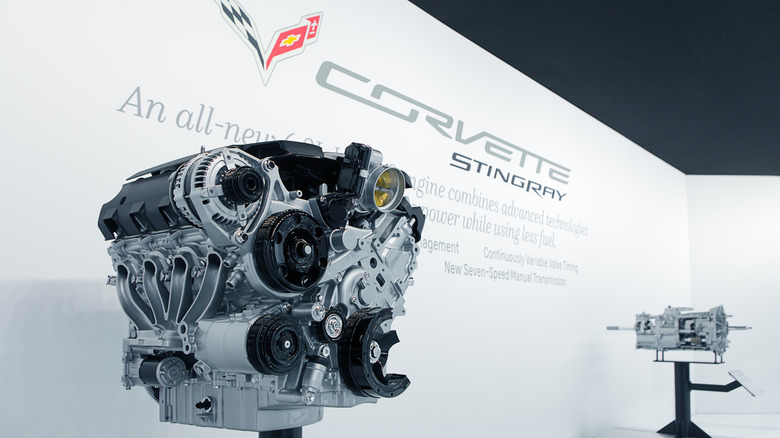
The LT1 and LT2 are both members of GM's Gen V small-block engine family, which traces its roots back to the iconic line of Chevrolet small-block V8s introduced in the 1950s (here are five of the most powerful choices from the past). The LT1 and LT2 show their common origins with the same 6.2-liter displacement –- a bit over 378 cubic inches –- and both are naturally aspirated. They also feature the classic small-block architecture backed by a 90-degree cylinder angle, the same 4.06-inch bore and 3.62-inch stroke, and the same 11.5:1 compression ratio, for instance.
An important difference, however, is the LT2's dry-sump oil system. Mounted on the engine, the system helps keep it well-lubricated even during aggressive handling and acceleration, when physics could otherwise keep oil from getting where it needs to go. It's so effective that Chevrolet reduced how much oil was needed for the system, cutting 3.7 pounds from the car's weight.
Other new additions include a low-profile lightweight oil pan and scavenge pumps meant to improve oil flow.The capacity of the oil cooler grows by 25% as well. Meanwhile, the engine marks another innovation by sealing off the "valley" –- the space between the two cylinder banks. That way, if (or when) oil drains from the heads and lifters, it won't find its way into the crankcase.
Further performance improvements came by way of upgrades to the engine's camshafts, a taller intake system, and positioning that lowers the car's overall center of gravity. Thanks in part to a new setup for managing crankcase pressure — the block and vent system — the centerline of the crankshaft sits an inch lower than in the LT1.
The tale of the tape for the two motors indicates the real-world results. The 2014 Chevrolet Corvette Stingray fitted with the standard LT1 V8 rewarded owners with 450 horsepower and a matching number of pound-feet of torque. It could also scoot to 60 mph in fewer than four seconds. Flash-forward to the 2020 Stingray, and its standard LT2 mill makes 45 more horses and 20 more pound-feet of torque, with output jumping to 495/470. With the optional Z51 exhaust system, the Stingray's 0-60 sprint time slips below three seconds.
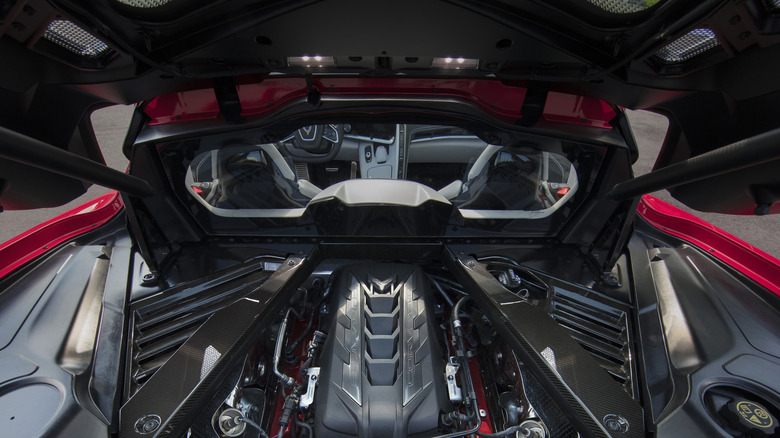
The LT2 gets a glow-up, too. Peek through the glass panel covering this mighty motor and you'll discover red valve covers and a variety of visual details meant to drive up your pulse rate. As Chevrolet put it, "Every part, including the exhaust system's wires, tubes, routing fasteners, coolant hoses, exhaust manifold and even the bolts and fasteners, is built with appearance in mind." With style and substance like that, it's no surprise used C8 Corvettes are still $55,000 cars.