
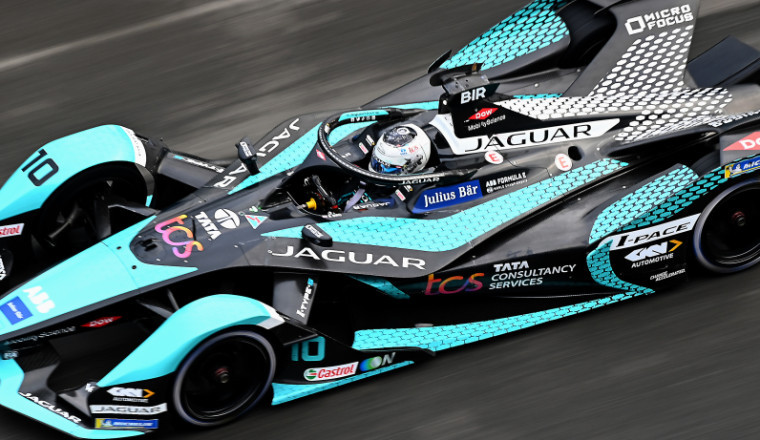

Think of the first time you ever tried left foot braking in your road car and consider how close your head came to slamming into the steering wheel. I had a similar feeling as I first thought about testing out the brake pedal. Then I hit it hard and found that I could no longer see where I was going as my head was flung forwards. That's the immediate reality of Formula E. The braking doesn't care about your neck muscles or your willingness to participate. It happens whether you're ready or not.
The Gen3 Evo is capable of 0-60mph in 1.82 seconds, 30% faster than a current F1 car. Read that again. Faster than Formula 1. Remember that scene in Star Wars when the Millenium Falcon goes into lightspeed? The stars blur, blackness turns to bright light: the world around me went backwards and the first braking zone arrived up ahead as if life were on fast forward. That's not hyperbole. That's what happens when you release the launch paddle.
Foot on the brake, hold down a paddle behind the steering wheel to engage the launch mode, foot off the brake, and put the throttle to the floor. Then sit in that odd silence and wait for your own body to pluck up the courage to release the launch paddle. I remember giving myself a countdown of three… two… one. The silence is unnerving. No engine roar to prepare your nervous system for violence. Just quiet, then acceleration that rewrites your understanding of what cars can do.
It's mind bending acceleration, 0-62mph in this car takes less than 2.8 seconds, but it kept on going far beyond that threshold. Looking back at the footage I think I kept my foot planted for about four seconds and I'm fairly sure I'd have reached somewhere very close to 100mph by then. When it comes to the experience of driving I've never felt anything like it and, in all likelihood, I never will again.
The Physics of Organ Compression
Formula 1 drivers experience around 5G during cornering and up to 6G under braking. Formula E delivers similar forces but in different circumstances. The regenerative braking system harvests energy by turning kinetic motion back into electrical charge, creating deceleration forces that would make conventional brake systems look gentle. Up to 600 kW can be recuperated, 350 kW on the rear axle, 250 with the standardized front motor. That's not just stopping. That's converting your forward momentum into battery charge while your internal organs try to understand why they're suddenly closer to the steering wheel than they were a moment ago.
There is a physicality to these cars that simply needs to be felt to be understood. For what should have been an entirely alien environment, that one lap was enough for me to feel entirely at home is probably the highest praise I could ever give to a car. I've never felt so confident behind the wheel. What I was expecting to be a nerve wracking, challenging and terrifying experience was instead filled with the most stunning feeling of exhilaration and overwhelming confidence.
The confidence lasts right up until it doesn't. Before I knew it, I was backwards in the gravel on the outside of turn one. I'd pushed my luck, and the car had bitten back. Hard. The speed that the car snapped meant I had very little time to react, or indeed understand what had happened. It essentially boiled down to carrying too much speed into a corner on what were still relatively cold tyres.
The Mental Game
Formula E cars are notoriously difficult to drive and require some pretty extreme skill to be able to race them. The difficulty isn't just physical. The recovery process in the braking zones through lift and coast is one of the most complex tasks for drivers during a Formula E race. You're not just driving. You're managing energy consumption, regeneration rates, attack mode timing, and racing strategy while simultaneously dealing with forces trying to separate your skeleton from your muscles.
To conserve energy, drivers focus on maintaining high minimum cornering speeds. A geometric racing line, featuring smoother arcs and less aggressive steering angles, helps achieve this. Drivers also employ techniques like lift and coast to delay braking and regenerate energy during deceleration. All while racing wheel to wheel at speeds approaching 200mph through street circuits with concrete walls close enough to count rivets.
Anybody who has watched a race, or even half of one, will have noticed a top driver locking up, or spinning, or hitting the wall. Mistakes are commonplace, and it's not because the field is lacking talent. The cars are simply operating at the edge of what's physically controllable. The Formula E grid features former Formula 1 drivers, Le Mans winners, FIA World Endurance champions, GT, DTM, Super Formula, Formula 2 winners and champions. These aren't amateurs. They're the best drivers in the world, and they're all struggling with machines that demand perfection.
All Wheel Drive Changes Everything
AWD will only be used during the later rounds of qualifying, the race start and when a driver has activated Attack Mode during the race. Besides the boost to acceleration, drivers should have better control and more grip when AWD is active. When you have 22 cars that are all capable of 0 to 60 mph in under two seconds barreling towards turn one, that makes for a high jeopardy, exciting start of a race.
Imagine standing at the traffic lights in your road car. Now imagine 21 other vehicles, all capable of reaching 60mph before you've finished reading this sentence, all trying to occupy the same piece of tarmac at turn one. That's the Formula E race start. Your organs haven't recovered from launch acceleration before you're braking harder than physics should allow, then accelerating again through the corner while your competitors try to occupy the space your car currently inhabits.
The Silence Makes It Worse
Combustion engines scream. They warn you. The escalating noise prepares your nervous system for what's coming. Formula E cars accelerate in near silence. With a motor efficiency of over 90% compared to the roughly 50% of internal combustion engines, the Gen3 Evo is all about efficiency. That efficiency means no wasted energy as sound. Which means your first indication that you're experiencing forces normally reserved for fighter pilots is when your vision starts to blur and your neck muscles realize they're inadequate for the job.
The brake by wire system adds another layer of complexity. Drivers have been supported by the vehicle's software since 2018 with the brake by wire system. With good recuperation work during the race, a driver can extend the range of their battery by almost 20 percent. You're not just pressing a pedal. You're managing a computer system that's deciding how much mechanical braking versus regenerative braking to apply based on battery charge state, energy strategy, and corner requirements. All while your body is experiencing forces trying to relocate your internal organs forward through your ribcage.