
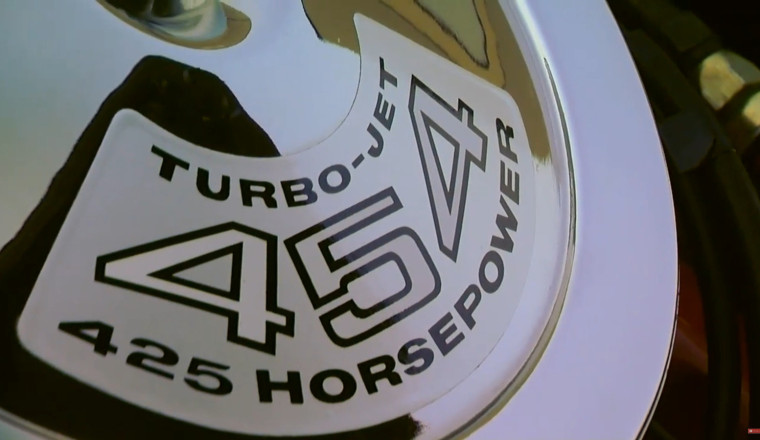

Oooh, two General Motors V8s within a cubic inch of each other! They have to be nearly the same engine, right? After all, the Chevrolet 454 and Pontiac 455 come from the same corporate parent, and every auto manufacturer engages in parts, powertrain, and platform sharing. That's how we got the Cadillac Cimarron, for Pete's sake. Surely these engines are just different bores and strokes for different folks.
Well, parts sharing is quite common these days. For example, Ford and GM made a 10-speed transmission together. But it wasn't always like this. Back in the 1960s and 1970s, each of GM's divisions made its own engines that featured few interchangeable parts, if any. And the Chevy 454 and Pontiac 455 are fantastic examples of how two large-displacement pushrod V8s from the same auto manufacturer can be as different as Star Wars and Star Trek.
Despite their differences, though, the top dog versions were dang close in performance. In 1970, Hot Rod magazine managed a 13.44-second quarter mile in an LS6 454 Chevelle. When Car and Driver took another LS6 454-powered car to the track, a 1971 Corvette, the testers ran a 13.8-second quarter thanks to '71 LS6s having lower compression than '70 models. Meanwhile, Supercar Annual magazine took a '71 Pontiac Trans Am with the 455 HO (High Output) through the quarter in 13.7, and Car and Driver got 13.751 out of a '73 Pontiac Trans Am Super Duty 455.
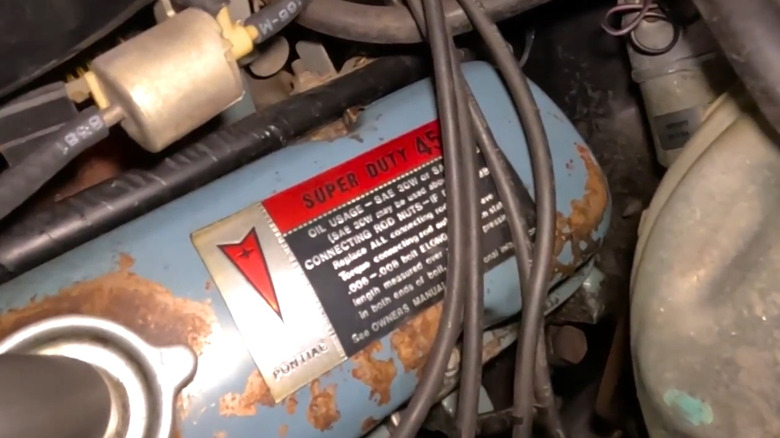 Lafontaine Classic Cars/YouTube
It'd be easy to compare these engines to the Oldsmobile and Buick 455s, but then this article would become a novella. Focusing on just Chevy for now, the 454 features a bore of 4.25 inches and a stroke of four inches. This makes it oversquare, which is the term for when the bore exceeds the stroke. Pontiac's 455, on the other hand, is undersquare thanks to its 4.151 inch bore and 4.210 inch stroke.
Oversquare engines tend to rev higher and make their torque at loftier RPM, while undersquare engines are the opposite. This reflects in the two engines we're looking at; while both make 320 pound-feet of torque at the rear wheels, the Chevy makes its peak torque at 3,600 RPM, while the Pontiac's peak torque comes about at 3,100 RPM. As for horsepower, the 1970 LS6 454 pumped out 450 gross horsepower at 5,600 RPM and the Pontiac 455 maxed at 370 gross hp at 4,600 RPM.
Up until this point we've avoided the term "big-block" because this is another drastic difference between these engines. The 454 is certainly a "big-block," but the 455 is not. That's because most Pontiac V8s are practically identical — albeit in varying states of displacement — sharing the same 4.620 inch bore center spacing. Meanwhile, the big block 454 features a 4.840 inch bore center spacing.
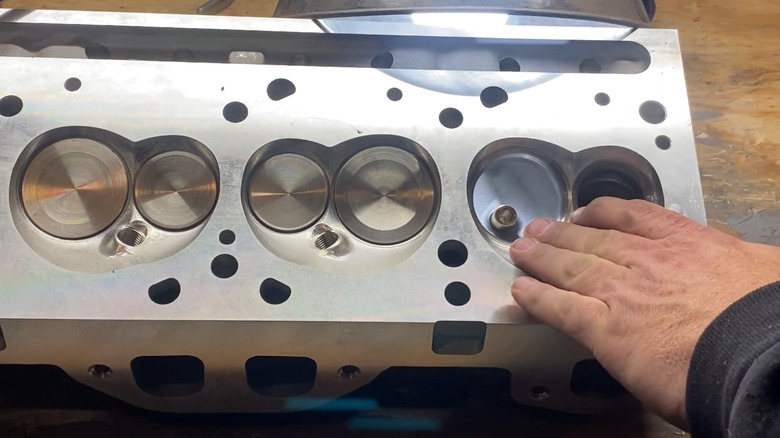
So far, it might sound like 454s are beefier than 455s. But hold your horses, amigo. Let's look at the main journals, which are the points on the crankshaft that let it spin in the block. Main journal diameters on the Chevy 454 are 2.75 inches, which is decently stout, but main journals on the Pontiac 455 are a hockey-puck-like 3.25 inches. This — along with expense — might be one reason why Pontiac kept the hefty cast crank in the 455 Super Duty. However, small journals generally translate to higher revs. And if the crank is already forged, as in an LS6 454, a half-inch journal-diameter reduction isn't really a big deal.
Then there's weight. A Chevy big block 454 weighs about 685 pounds, while a Pontiac 455 is around 640. Both engines typically featured an iron block and iron heads, with performance-oriented models getting aluminum intakes. 454-powered Corvettes also got a set of rare aluminum heads in 1971. These heads were light enough to knock 40 pounds off of a car's weight.
Honestly, covering every difference between Chevy 454s and Pontiac 455s could fill an ever more abstruse list of design differences, such as how Pontiac 455 intake manifolds don't seal the lifter valleys. In terms of legacy, 454 performance deflated in 1972 when the hottest option was the 270 net-hp LS5. Conversely, Pontiac's 455 extended the muscle car era with the 310/290-hp Super Duty 455 in 1973 and 1974. But while Pontiac's 455 disappeared after 1976, Chevrolet's 454 lived on in trucks. It lasted until the '90s, which was when it powered the 1500 454 SS — one of the most criminally forgotten Chevy pickup trucks.