
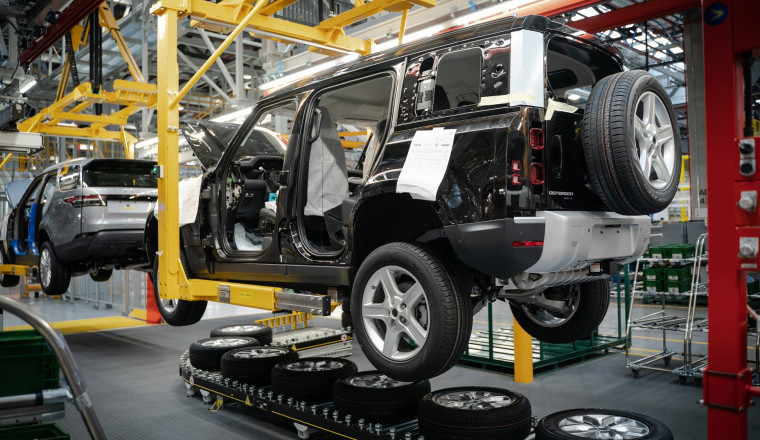

► US announces trade deal with UK
► Deal reduces tariffs on car industry
► Global trade will still be affected as tariffs bite
US President Donald Trump’s ongoing tariffs on trade are continuing to have worldwide effects, even as the United Kingdom and the US announce a trade deal.
The UK-US deal crucially includes details surrounding the automotive industry, including a drop in tariff from 27.5 per cent to 10 per cent, which will apply to a quota of 100,000 UK cars. The deal also includes a reduction in the 25 per cent tariff on steel and aluminium down to zero – a boon for the UK’s ailing metals industry.
‘My government has put Britain at the front of the queue because we want to work constructively with allies for mutual benefit rather than turning our back on the world,’ says Prime Minister Kier Starmer. ‘I am delighted that eight decades on, under President Trump the special relationship remains a force for economic and national security.’
Adrian Mardell, CEO of JLR, added: ‘The car industry is vital to the UK’s economic prosperity, sustaining 250,000 jobs. We warmly welcome this deal which secures greater certainty for our sector and the communities it supports.’
However, the news hasn’t gone down well elsewhere. American Automotive Policy Council president, Governor Matt Blunt, issued a statement saying: ‘The U.S. automotive industry is highly integrated with Canada and Mexico; the same is not true for the U.S. and UK. We are disappointed that the administration prioritized the UK ahead of our North American partners.
‘Under this deal, it will now be cheaper to import a UK vehicle with very little U.S. content than a USMCA compliant vehicle from Mexico or Canada that is half American parts. This hurts American automakers, suppliers, and auto workers. We hope this preferential access for UK vehicles over North American ones does not set a precedent for future negotiations with Asian and European competitors.’
‘What we are going to be doing is a 25 per cent tariff on all cars that aren’t made in the United States,’ Trump said while at his desk in the Oval Office when initially announcing the measures in February 2025. ‘We started off with a 2.5 per cent base – that’s where we’re at – and we’ll go to 25 per cent.’
Trump says enacting these tariffs will mean ‘incentivising companies – and even countries – to come into America and build.’
On top of that, the President announces that his government intends to offer interest relief on those looking to buy a new car that’s US-made. ‘If you borrow money to buy a car, you will be allowed to deduct interest payments for the purposes of income tax, but only if the car is made in America.’
Not well, to put it mildly.
Some car makers ended up temporarily halting deliveries of cars to the US, including Audi and JLR. Production of other models like the Lotus Emira slowed due to ‘globally sourced parts’ and many car makers are still undecided as to how the tariff cost additions will be passed on.
A Bentley spokesperson said the company had ‘no plans to pause imports’ to the carmaker’s largest market, but that it was ‘still undecided’ as to whether to absorb the 25 per cent tariff itself or pass this on to customers through the cost of the car.
While Morgan’s sports car sales are small fry compared to others on this list, the US is still one of its biggest export markets. The British firm said it wasn’t planning on pausing shipments, but that it had a ‘number of cars on the water already that will land and be subject to the tariffs’.
A spokesperson added that it was talking to its dealers and customers about ‘sharing the tariffs’ but that the Morgan Motor Company (MMC) was ‘taking the burden’.
‘For customers going forwards, we have changed margin structures and price of options to help mitigate the full tariff cost, sharing it between MMC, dealers and some burden to the customer.’ they added.
Hyundai’s president and CEO Jose Munoz (above) last week said at the Seoul Mobility Show that the company had ‘no plans to raise prices in the United States’ and that its car prices would ‘always remain competitive’.
The UK government has also softened its ZEV mandate and subsequent electric vehicle targets in response to Trump’s tariffs. Fines for non-compliant vehicles have been reduced, while full hybrid vehicles, including the UK-built Toyota Corolla, can now be sold in the period between 2030 and 2035.
Prime Minister Keir Starmer said: ‘Global trade is being transformed so we must go further and faster in reshaping our economy and our country through our Plan for Change.
‘This will help ensure home-grown firms can export British cars built by British workers around the world and the industry can look forward with confidence, as well as back with pride.’
Senior staff writer, car reviewer, news hound, avid car detailer.
With contributions from
Jake Groves News Editor
By Ted Welford and Jake Groves