

by Thanos Pappas
- Toyota autonomous towing tractors begin baggage runs at Haneda.
- Obstacle detection and self positioning guide runs via remote ops.
- Autonomous speed capped at 15 km/h while towing up to 13 tons.
Airport ground vehicles often come across as quirky and a bit outdated, but Toyota’s latest tug introduces a far more forward-looking approach. Now entering service at Tokyo’s Haneda Airport, the driverless model is equipped with Level 4 autonomous driving capabilities, technology that typically stays well clear of the tarmac.
The project was first announced in March 2021, with trial operations beginning that October. Development has continued under Toyota Industries Corporation, working in partnership with All Nippon Airways (ANA), and the tractor went on to win an iF Design Award in 2022.
More: VW Built A Car That Doesn’t Want You To Touch Anything
Starting in December 2025, three autonomous towing tractors will be put to work handling baggage and cargo for domestic flights. Another three are scheduled to join the lineup by the end of March 2026.
According to the company, this marks the first practical application of Level 4 autonomous driving within a Japanese airport’s restricted area. Though Level 3 systems have been tested at various domestic airports since 2019, this is a big step up in both scope and capability.
These vehicles are built to tow container dollies between aircraft and terminals, using onboard systems for localization and obstacle detection. A remote monitoring setup supports the autonomous system by handling more complex conditions that might arise near active runways and busy airport lanes.
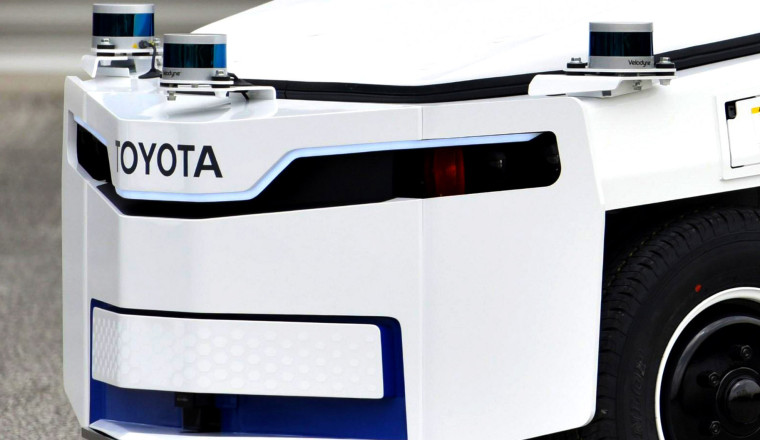
Visually, the tractor hasn’t strayed far from earlier prototypes. The front bumper and side sills have been subtly updated, but the overall structure remains the same. A Toyota badge sits up front, flanked by car-like headlights, and there’s seating for two in the cabin, even if no human is expected to spend time behind the wheel.
More: Hyundai’s Latest Robots May Be Eyeing Your Job
Multiple sensors, including a LiDAR unit, are positioned on the fenders, the vehicle’s nose, and along the sides. Together, they give the system a full read of its surroundings.
How It Handles the Haul
Toyota hasn’t published specs for the electric motor or battery system just yet. What we do know is that the vehicle’s performance varies depending on whether it’s driving itself or being operated manually.
In autonomous mode, the tractor tops out at 15 km/h (9 mph) and can tow up to 13 tons (28,700 pounds). With a human driver at the wheel, those limits jump to 25 km/h (16 mph) and 27 tons (59,500 pounds).
The primary route these vehicles will cover is about 1.5 km (just under a mile), connecting terminal areas with the cargo shed. Along the way, they’ll pass two traffic signals, which the system is designed to recognize and respond to in coordination with the new management platform.
Alongside the vehicle rollout, Toyota and ANA are introducing a Fleet Management System (FMS). This platform issues dispatch instructions, assigns lanes for departures and arrivals, and integrates with the airfield’s traffic light system to smooth out vehicle movement and minimize delays.