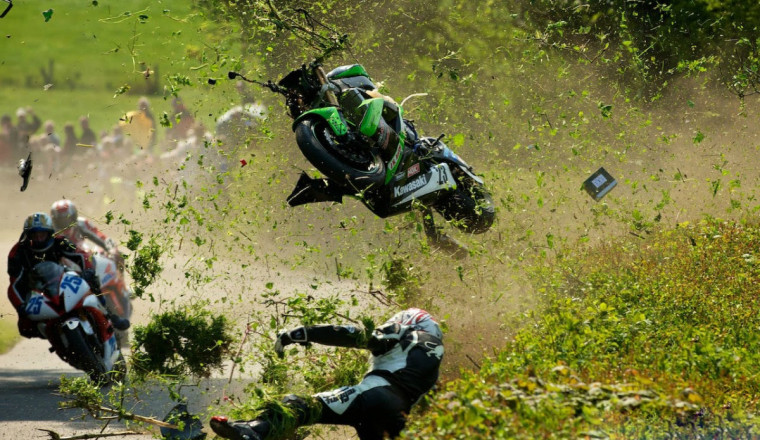

That sentence requires some unpacking.
What the TT actually is
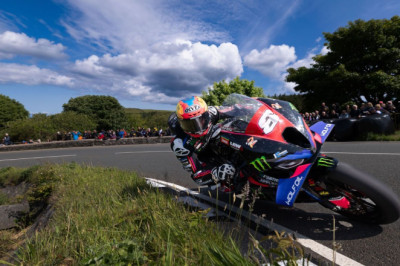
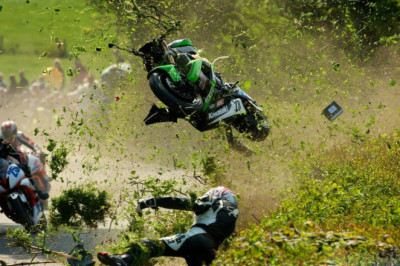
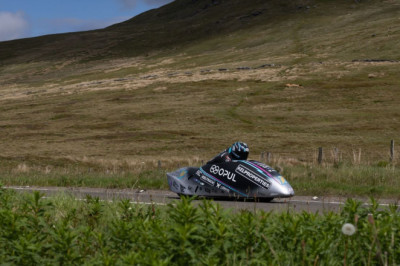
The Snaefell Mountain Course is 37.73 miles of public road on a small island in the Irish Sea. It is not a circuit designed for racing. It is a loop of ordinary tarmac that passes through the capital Douglas, through villages and farmland, climbs the exposed flank of Snaefell mountain, and returns to the start. It has 219 corners, many of which are named because the riders needed names for them to memorise the course: Ballacraine, Kirkmichael, Ramsey Hairpin, the Gooseneck, Kate's Cottage, the Bungalow, Windy Corner, the Verandah, Creg ny Baa, Brandish. Most corners have stone walls, hedges, kerbs or telegraph poles on their exits. There is no gravel trap. There is nowhere to go. When something goes wrong at the TT, it goes wrong at full speed into a fixed object.
The fastest lap ever recorded around this course was set by Peter Hickman on a BMW M1000RR in 2023: 16 minutes 36 seconds, an average of 136.358 mph over 37.73 miles of public road. That average includes the slower sections. The fast straights and the extended open mountain sections are considerably faster than 136 mph. Speeds approaching 200 mph are reached in multiple places on every lap.
The F1 race at Spa-Francorchamps, widely considered one of the most demanding circuits on the Formula 1 calendar, covers a single lap of 4.352 miles. A single TT lap is 37.73 miles. The full Senior TT is six laps, a total race distance of over 226 miles. All of it on public roads with nowhere to go when things stop going right.
The numbers
Between 1907 and the present, more than 269 people have died at the Isle of Man TT across all categories: competitors, sidecars, officials, marshals, mechanics and spectators. Of those, 156 deaths occurred during official practices or races on the Mountain Course between 1907 and 2023. No single motorsport event in history has a comparable casualty record.
The statistical average works out at approximately one death per year of racing, but the distribution is anything but even. The deadliest single season was 2005, when ten people died across the TT and the Manx Grand Prix. The deadliest recent year was 2022, when six competitors were killed, equalling the 1970 record and producing calls for the event's cancellation that came from outside the sport almost entirely. The 2024 TT and the 2025 TT both ended without a fatality on the Mountain Course, which are now among the rare exceptions in the event's history. The only year since 1937 in which neither the TT nor the Manx Grand Prix claimed a life was 1982.
The 2026 edition has already opened with the death of Alan Oversby, 68, in the Classic races held before the TT at Billown, and the hospitalisation of eight spectators at Parliament Square when a crashed motorcycle breached the spectator area during free practice. Maria Costello MBE, an icon of the event and holder of the women's lap record, is in serious but stable condition following a sidecar accident at Brandish during qualifying. The races have not yet started.
Why it is so dangerous
The danger at the TT has several distinct sources, and understanding them separately matters.
The course itself is the starting point. Road racing on closed public roads means the surface, the furniture and the geography were not designed with motorcycle speeds in mind. Drain covers sit flush with the tarmac or slightly proud of it. Kerbs are built to define the road edge for traffic, not to deflect sliding motorcycles. Walls built two centuries ago to separate fields from lanes stand three feet from the racing line through dozens of corners. The course cannot be altered significantly without changing what it is, because what it is is a loop of a real island, not an approximation of one.
The speed compounds everything. At 150 mph, a motorcycle covers roughly 220 feet per second. The margin between a clean exit and a fatal one at those speeds is not measured in distance but in microseconds. A patch of dampness under a tree, a moment of turbulence from a slower competitor, a mechanical failure at the wrong point in the wrong corner: any of these can produce a consequence that no amount of protective equipment fully mitigates.
The memory load is extraordinary. Riders must commit 37.73 miles of road to memory in sufficient detail to navigate it at racing speeds without reference to circuit markers or familiar runoff zones. This takes years. Newcomers to the event are required to complete supervised laps before they are allowed to qualify, and the qualification process involves multiple timed sessions over the course of a week. Even experienced riders, some with decades of TT participation, have been killed at corners they had taken thousands of times before.
The weather adds a dimension that circuit racing does not have to manage. The Mountain Course climbs to over 1,300 feet above sea level. The conditions at sea level in Douglas can be entirely different from the conditions at the Bungalow or across the exposed mountain section. Rain can be falling in one sector while the rest of the course is dry. Fog can descend on the mountain while the lower sections remain clear. Riders commit to a lap without knowing what the conditions will be at the other end of it.
Like this? Get the app: iOS | Android
Why it continues
The TT has been banned, threatened with abolition, and condemned with regularity since the 1970s. It continues for several reasons that have remained consistent across those decades.
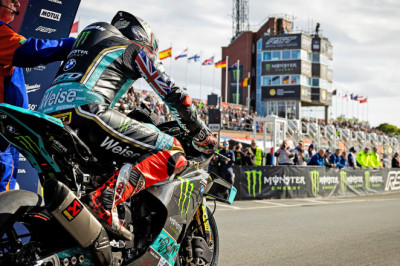
The first is that it is not compulsory. Every rider who lines up at the Grandstand in Douglas has made a considered decision to be there, with full knowledge of the statistical record. The freedom to make that decision, with informed consent and genuine understanding of the consequences, is the ethical foundation on which the event rests. The riders themselves are its most consistent defenders. They do not need to be reminded of the danger. They have attended funerals.
The second is that the Isle of Man's economy is substantially dependent on TT week. Tens of thousands of visitors arrive annually. Hotels, ferries, hospitality businesses and the island's government rely on the revenue. This is not a morally clean argument for continuing a race that kills people, but it is a real one.
The third is that the TT is something that does not exist anywhere else in the world. The Mountain Course, all 37.73 miles of it, cannot be replicated. The combination of speed, distance, geography and history is unique, and the riders who pursue it, from the household names to the privateers doing it on their holidays, are pursuing something that cannot be found on a circuit. The Nürburgring Nordschleife, the other venue most often cited in comparisons, is 12.9 miles long. By comparison, it is a gentle introduction.
Safety improvements have been real and ongoing. GPS tracking is now mandatory for all competing vehicles, giving Race Control a continuous position feed rather than relying on marshal observation. Medical response times have been reduced. The qualification process is more structured than it was. Parliament Square will be closed to spectators for the rest of 2026 following the incident on Monday. The event learns from its worst days, even if it cannot eliminate the fundamental conditions that make those days possible.
The honest accounting
The 2026 TT will kill someone. The statistical probability, based on 119 years of recorded data, is close to certainty. It may have already done so by the time these words reach a reader. The races begin on Saturday.
That fact does not make it wrong to hold the event, but it demands an honest acknowledgement rather than the ambient excitement that surrounds race week. The riders accept the risk, and they accept it with full information. The sport owes them at minimum the honesty of saying clearly what that risk is: not the greatest motorsport challenge in the world, not the ultimate test of bravery, though it is those things too, but a race on an island where the odds, across a long enough career, are not in your favour.
Victor Surridge, killed at Glen Helen during practice in 1911, was the first. The list runs to over 260 names since. The 2026 edition adds to it before the races have started.
Sources
- The SportsGrail — Isle of Man TT: Total List of Deaths, Accidents and Fatalities Per Year
- Wikipedia — List of Isle of Man TT Mountain Course fatalities
- Hagerty Media — 4 stats that show the insanity of the Isle of Man TT
- Official Isle of Man TT Races — How long does it take to do a lap of the TT?
- Wikipedia — Isle of Man TT Mountain Course
- Crash.net — New safety measures after TT's most lethal year
- Crash.net — Isle of Man TT issues fresh update after crash involving spectators (2026)
- Motorcyclesports.net — Eight spectators hospitalised at 2026 Isle of Man TT
- Crash.net — Maria Costello serious but stable after qualifying accident
- Steam Packet — Isle of Man TT Course Explained
- journee-mondiale.com — This deadly 37-mile road claimed 269 lives since 1907, yet thousands apply annually