
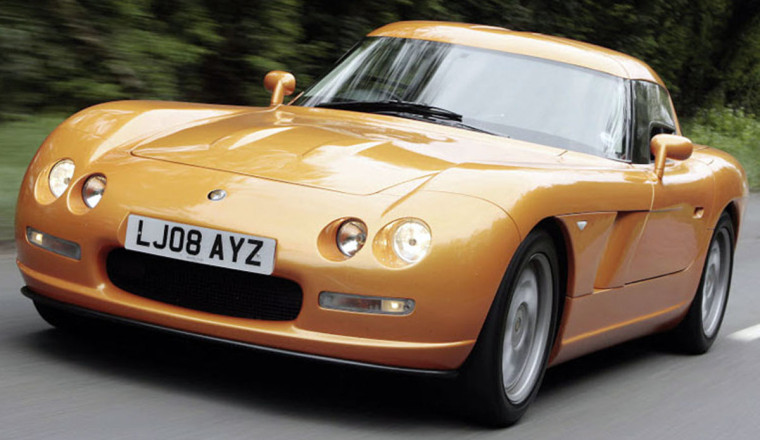

In 2004, a company most people had never heard of built a car that humiliated BMW's finest. The Bristol Fighter packed an 8.0 liter V10 engine into a carbon fiber body that weighed less than a Honda Civic. While the E60 M5 was making headlines with its 507 horsepower, Bristol was quietly assembling 525 horsepower monsters in a shed in Filton. Then they disappeared forever.
Bristol Cars had been building eccentric luxury machines since 1946, selling perhaps a dozen cars per year to millionaires who wanted something nobody else had. The Fighter changed everything. Where previous Bristol models whispered wealth, the Fighter screamed violence. Its Dodge Viper derived V10 engine produced more torque than a freight train, launching the car from standstill to 60 mph in 4.0 seconds and on to a top speed of 210 mph.
The numbers told only part of the story. Road tests revealed a car that demolished the contemporary M5 in every meaningful metric. Autocar magazine reported the Fighter completing 0 to 100 mph in 9.5 seconds, a full second quicker than the BMW. More shocking was the top speed differential. Where the M5 hit its electronic limiter at 155 mph, the Bristol kept pulling until physics intervened.
Bristol built the Fighter like they were planning for war. The chassis used aircraft grade aluminum construction techniques learned from building planes during World War II. The body panels were hand laid carbon fiber, each one taking craftsmen days to perfect. Inside, the cockpit featured toggle switches borrowed from RAF fighters and leather seats that cost more than most people's cars.
Only around 20 Fighters ever left the factory. Each one cost approximately £229,000 in 2004 money, making it more expensive than a Ferrari 360 Modena. Bristol didn't advertise. They didn't court journalists. They simply built cars for clients who found them through word of mouth or decades long relationships with the company.
Like this? Get the app: iOS | Android
The Fighter's performance advantage over the M5 extended beyond straight line speed. PistonHeads testing revealed superior braking distances and cornering capabilities despite the Bristol's old school approach to chassis tuning. While BMW loaded the M5 with electronic aids, Bristol relied on mechanical precision and driver skill.
Behind the Fighter's success stood Tony Crook, Bristol's enigmatic owner who had run the company since 1960. Crook treated Bristol more like a private hobby than a business, refusing to modernize production methods or chase volume sales. He preferred building a handful of perfect cars rather than hundreds of adequate ones. This philosophy created the Fighter but also doomed Bristol Cars.
Financial pressures mounted through the 2000s. Bristol's tiny production volumes couldn't support modern safety and emissions requirements. The 2008 financial crisis devastated the ultra luxury car market. By 2011, Bristol Cars entered administration, taking the Fighter's secrets with it.
The Fighter's engineering drawings, tooling, and manufacturing knowledge vanished when Bristol collapsed. New owners acquired the Bristol name in 2011 but lacked access to the Fighter's technical specifications. They launched electric concepts and made grand promises, but the original Fighter's DNA was lost forever.
Today, surviving Fighters change hands for astronomical sums when they appear at auction. Bonhams sold one in 2019 for £485,000, more than double its original price. Collectors recognize what automotive journalists missed at the time. The Fighter represented peak analog performance, a 525 horsepower middle finger to German efficiency.
BMW built 20,548 E60 M5s between 2005 and 2010. Bristol built perhaps 20 Fighters total. One became a footnote in German luxury sedan evolution. The other became automotive mythology, proof that British madness could still humble Bavarian precision when nobody was paying attention.
Sources: Autocar Bristol Fighter Review | PistonHeads Bristol Cars History | Bonhams Auction Records