

The market for personal submersibles has been building quietly for two decades. U-Boat Worx, the Dutch company founded in 2005 when its founder discovered there was simply no such thing as a private submarine, has now delivered more than 100 vessels. Its Super Yacht Sub 3, a compact submarine for three, designed to be launched from a superyacht's deck, dives to 300 metres. Its Super Sub is the fastest personal submersible on the market at nine knots. Both are sold as standard superyacht accessories for owners who consider a helipad insufficient.
The next step — the yacht that becomes the submarine — is what U-Boat Worx unveiled with the Nautilus. At 42 metres and listed at €37 million, it is the world's first production submersible superyacht: a vessel that functions on the surface with a sundeck, freshwater pool and beach club, retracts all of that into itself, and dives to 150 metres where the circular viewports, each nearly four metres across, open the ocean floor to the dining room. It can stay submerged for up to 55 hours. It carries ten guests and seven crew. The engineering certification is by DNV, to the same standard as research and commercial submersibles. It is built. It exists. It is looking for a buyer.
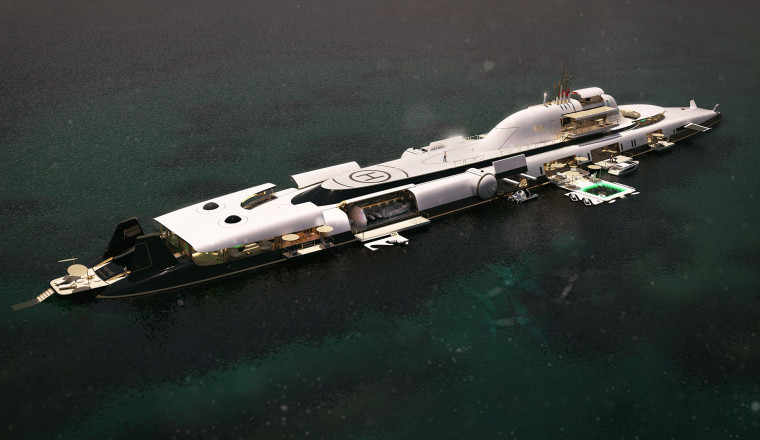
The Migaloo M5 is a different conversation entirely. The Austrian company's flagship concept runs to 165 metres, carries 20 passengers and 40 crew, submerges to 250 metres and can remain there for four weeks. It costs in the region of $2 billion before the options are added. The options include a helipad, two pools, a cinema, a gym, a wine room, a library, a station for feeding sharks and a garage for two of its own smaller submarines. The asking price exceeds the net worth of approximately half the world's billionaires. Christian Gumpold, Migaloo's CEO, has described his target buyers as "visionary billionaires," which may be the most precise piece of market segmentation in the history of luxury goods. The M5 has not yet secured a confirmed order.
Gumpold has told interviewers he believes submersible superyachts will become an additional category of private vessel alongside motor yachts and sailing boats. He is probably right about the category. The timing of a confirmed first order remains an open question.
Like this? Get the app: iOS | Android
The commercial logic operates on several levels. Privacy is the most candid. A vessel that can leave a controversial jurisdiction below the waterline is a genuine operational asset for certain categories of very wealthy person. The second argument is exclusivity. A superyacht is now almost attainable for a billionaire at the lower end of the wealth scale. A submersible superyacht is not attainable for almost anyone. The third argument is exploration, and it is probably the one most likely to close actual orders. The ocean covers 71 per cent of the planet's surface and roughly 80 per cent of it has never been mapped. The people buying Triton personal submarines are not primarily motivated by privacy. They are motivated by the fact that the places accessible to a vessel diving to 3,000 metres are places no human being has visited in living memory, or at all.
Triton, the US manufacturer that has built more personal submarines capable of deep dives than any competitor, delivered the Limiting Factor to Victor Vescovo's Five Deeps Expedition, which completed the first descents to the deepest point of all five oceans between 2018 and 2019. Triton is also behind Project Neptune, a collaboration with Aston Martin to build a personal submersible for three with proportions drawn from the car company's design language. It remains a concept, but a serious one.
The Titan disaster in June 2023, in which OceanGate's experimental submersible imploded on a dive toward the Titanic and killed all five people aboard, produced an immediate chill. U-Boat Worx emphasised its certification by independent bodies. Triton ran communications about its engineering standards. The industry's position was that the Titan was an uncertified vessel operated outside any regulatory framework, and that its fate had nothing to say about vessels that were. The personal submarine market has continued to grow.
What the next five years produce depends on whether the Nautilus finds its buyer, whether the Migaloo M5 finds its visionary billionaire, and whether the growing fleet of vessels launched from carrier yachts generates appetite for the full conversion. The hardware exists. The certification exists. The market is real, if concentrated. The number of people who can afford one of these vessels is finite and documented precisely, and the manufacturers know exactly who they are.
The question is not whether submersible superyachts will be sold. It is whether the people buying them prefer the ocean floor to the headlines.
Sources
- U-Boat Worx official — Nautilus and Super Yacht Sub 3
- New Atlas — U-Boat Worx floats $25-million submersible superyacht
- Smart Yachts — Nautilus: Discover the First Superyacht Submarine
- Robb Report — Migaloo M5: $2 Billion Submersible Superyacht
- CNN — Submersible superyachts for billionaires
- Dmarge — Migaloo M5 has yet to secure any orders
- AutoEvolution — The $2 Billion Migaloo M5
- Ocean Independence — Top 5 Superyacht Submarines & Submersibles in 2026
- Boat International — Superyachts with submarines