

In January 2026, Tesla registered 8,075 vehicles across the EU, UK, and EFTA region. That was a 17 percent decline on the same month a year earlier, giving it a 0.8 percent market share, down from 1.0 percent twelve months before. It was Tesla's thirteenth consecutive month of falling European sales. According to data from industry body ACEA, a run that long is not bad luck. It is a trend with structural causes.
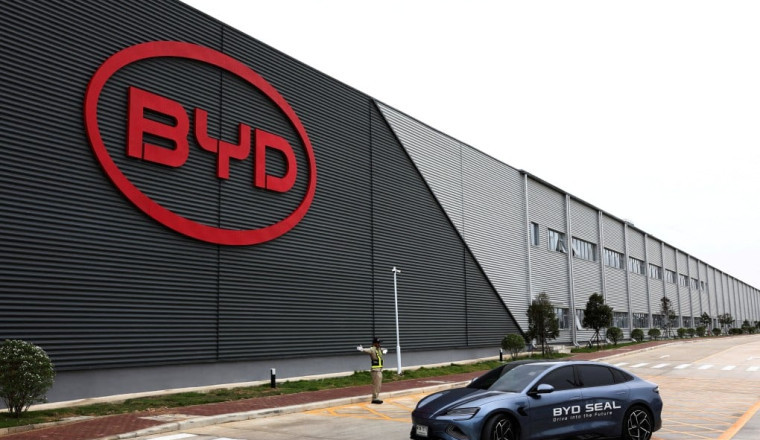
BYD registered 18,242 vehicles across the same region in the same month. That was up 165 percent year on year, 175 percent in the EU alone. Its market share reached 1.9 percent. For the first time, a Chinese manufacturer outsold the company that invented the modern mass market electric car in Europe, in a month the overall market contracted 3.5 percent, against a headwind of EU tariffs specifically designed to make Chinese EVs more expensive.
That last detail matters. The EU imposed additional tariffs on Chinese made EVs following an anti-subsidy investigation, applying a further 17 percent levy on BYD vehicles on top of the standard 10 percent import tariff. BYD grew 165 percent despite being taxed specifically to stop it doing that.
The Numbers Behind the Numbers
To understand what is happening, it helps to separate Europe from the global picture, and then put both in context.
For the full year of 2025, BYD delivered 2,254,714 all-electric vehicles worldwide, a 27.9 percent increase year on year. Tesla delivered 1,636,129, a decline of approximately 9 percent, marking a second consecutive annual drop. BYD outsold Tesla in pure battery electric vehicles by more than 600,000 units. A gap that few serious analysts predicted at the start of 2025.
Tesla's global sales fell about 1 percent in 2024 and 9 percent last year. BYD recently dethroned Tesla as the world's biggest EV seller. The crossing point happened in May 2025, when BYD registered more battery electric vehicles in Europe than Tesla in a single month for the first time. January 2026 was not an aberration. It was confirmation.
The January European picture was not uniform across brands. Dacia fell 35 percent. BMW dropped 8.7 percent. The Volkswagen brand slid 11.2 percent. The overall market was genuinely weak, down 3.5 percent, with Germany and France both off 6.6 percent. In that environment, growing 165 percent is extraordinary.
Why Tesla Is Sliding
The causes are multiple and they compound each other. None of them are temporary.
Tesla's challenges stem less from technological stagnation and more from strategic focus. The Model 3 and Model Y continue to account for the vast majority of Tesla's volume. The Cybertruck has struggled with limited availability and declining demand, while long-promised vehicles such as the next-generation Roadster remain delayed. Tesla entered the EV decade with two cars that defined the category. In 2026 it is still largely selling those same two cars to a market that now has dozens of alternatives.
The Elon Musk factor cannot be dismissed. CEO Musk's increasingly visible political positions sparked boycotts and protests in multiple regions, particularly in Europe and North America. Protests outside Tesla showrooms in Germany, Norway, and the UK became a regular occurrence through 2025. Whether that translates into lost sales is hard to quantify with precision, but the timing of the decline's steepening with Musk's public political activity is not coincidental.
In the United States, the expiration of the $7,500 federal EV tax credit removed a significant purchase incentive. Tesla, more dependent than almost any rival on that subsidy as a closing argument for borderline buyers, felt the removal acutely. European buyers never had that credit, but they have watched the brand's cultural position shift from aspirational technology pioneer to something considerably more complicated.
Like this? Get more MotorBuzz delivered to your browser. Click here to add MotorBuzz as a preferred news source on Google.
Why BYD Is Winning
BYD was founded in Shenzhen in 1995 as a battery manufacturer. Warren Buffett invested $232 million for a 10 percent stake in 2008, a bet that looked eccentric for years and now looks prescient. The company's vertical integration, making its own batteries, its own chips, its own motors, and assembling its own vehicles, is the foundation of everything that follows commercially.
BYD's Blade Battery, a lithium iron phosphate design, carries a cost advantage of approximately €10 per kWh compared with the nickel cobalt batteries used by many rivals. The new second-generation Blade Battery targets 200 Wh per kg of energy density, and with five minutes of charging, it will add 400 kilometres of range. Charging anxiety, the primary psychological barrier to EV adoption in Europe, becomes significantly harder to sustain when five minutes provides the same range as a motorway petrol stop.
In the UK, BYD's Dolphin Surf starts at £18,650, less than half the cost of a Tesla Model 3 at around £39,000. That price gap is structural, not promotional. It reflects a fundamentally different cost base, built over decades of battery manufacturing before BYD ever sold a consumer car. BYD's executive vice president Stella Li, voted World Car Person of the Year in 2025, described it simply at the World Government Summit in Dubai: "Our dream was always to produce electric cars. While continuing to grow, we had the chance to buy a car company. Then we started a family."
The product range is now vast. From the Seagull city car at the bottom to the Han and Seal luxury sedans at the top, BYD covers segments Tesla has never addressed. While Tesla relies on two models for roughly 95 percent of its volume, BYD covers the market floor to ceiling, with both full electric and plug-in hybrid options appealing to buyers not yet ready for a single powertrain commitment.
BYD is building a factory in Hungary at a reported cost of €4 billion, with operations expected to start in mid 2026. That European production base eliminates much of the tariff exposure that has constrained its growth and removes the "it's a Chinese car" hesitation that still lingers in some markets. Once BYD is assembling cars in Hungary, the tariff argument and the provenance argument both collapse simultaneously.
The Broader Market Shift
January's European data confirmed something the monthly numbers have been suggesting for most of 2025: the powertrain transition is accelerating, but not in the direction anyone cleanly predicted.
Sales of battery electric vehicles in Europe grew nearly 14 percent year on year in January. Plug-in hybrid models grew 32 percent. Petrol registrations fell sharply and diesel continued its long retreat. Hybrids are currently the single most popular vehicle type in Europe, a fact that neither the pure EV advocates nor the internal combustion holdouts entirely anticipated. Buyers want electrification on their own terms and their own timeline, which is why BYD's decision to offer both full electric and plug-in hybrid vehicles in every segment has proven commercially astute.
Norway, always the EV bellwether and the market that reached 90 percent EV penetration first, saw overall registrations collapse 76 percent in January following the end of government incentives. That data point is worth holding when evaluating how much of the broader European EV growth is organic versus policy-driven.
What Comes Next
Tesla is not going away. It retains technology advantages in software, autonomous driving capability, and the Supercharger network, which remains the best charging infrastructure in the world for the cars it serves. Its average selling price is considerably higher than BYD's, meaning that in revenue terms the gap between the two companies looks different from the volume gap. Tesla's gross margin per vehicle remains stronger than BYD's.
But the volume trend matters because volume funds research, development, and future platform investment. A company selling 1.6 million vehicles a year and declining competes differently in the market for engineering talent, supplier contracts, and battery raw material commitments than one selling 2.3 million and growing. Scale advantages compound in automotive manufacturing in ways that are very difficult to reverse.
BYD is opening in Europe with pricing, range, and charging technology that addresses every objection buyers in 2022 had about Chinese EVs. It is building European factories to eliminate tariff exposure. It is expanding its model range into segments Tesla has never addressed. And it is doing all of this while the brand it is displacing is managing an identity crisis as much as a product one.
Thirteen straight months of Tesla declines did not happen in isolation. They happened while a competitor added 165 percent. The two facts are not unrelated.