

Marcus & Manuela's Saab Channel/YouTube
When we talk about Saab, you might think of the carmaker's "Born from jets" marketing era or its slow, tragic demise at the hands of General Motors. But long before Saab was the eccentric's favorite, it was a company filled with mad scientists. These were aircraft engineers who were tasked with building a car, and they went about it in a way that would have OSHA scream, "They did what?!" It was the 1950s when this collective madness culminated in a project so terrifying that even its creators were afraid of it. It was called the Saab 93 "Monstret" (Swedish for Monster), and it was the greatest example of Swedish overkill ever conceived — even crazier than almost having one of the worst V8s go into a Saab.
To truly understand the "Monster," you have to get under the skin of the Saab 93. Launched in 1955, it was the evolution of the original Saab 92 two-door coupe. It retained the iconic, aerodynamic teardrop shape, a byproduct of the carmaker's aviation heritage, but it swapped the old two-cylinder engine for a three-cylinder two-stroke mill. It was a charming little car that punched above its weight in the rallying world. In the hands of legendary rallyist Erik Carlsson, the Saab 93 was beginning to shake things up in the gravel stages.
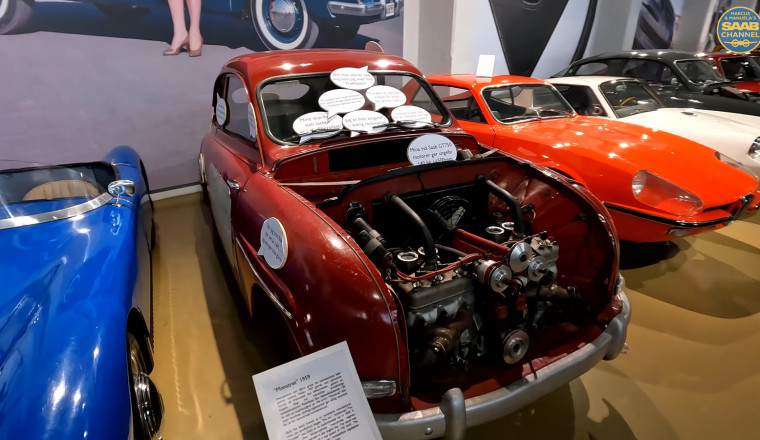
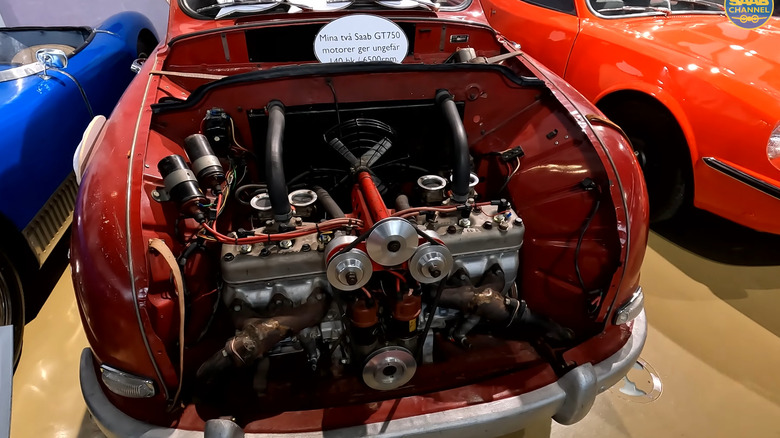
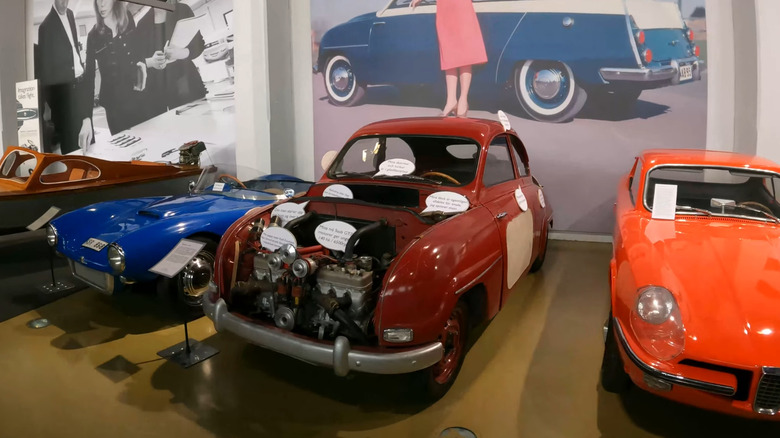
But charming wasn't good enough; racers wanted a car that would dominate the high-speed rally circuits of the world. Ergo, the Monster. It was never intended to be a production car; it was purely a laboratory experiment rat. From the outside, it looked like a buff 93. Inside, it had two 748 cc three-cylinder two-stroke engines bolted together into the front of a car barely designed to hold one.
The 144-horsepower Frankenstein
Marcus & Manuela's Saab Channel/YouTube
Why take a perfectly functional car and turn it into a twin-engined monster? Simple: rallying. In the late 1950s, Saab was an emerging force in rallying with the 93, but it had hit a glass ceiling. The small-displacement engines shone in the technical sections, but they fell short in competing with the big boys on the long straights and high-speed rally stages. Saab engineers wanted to see if they could create a powerhouse that retained the 93's front-wheel-drive advantage but also delivered the raw speed of a much larger GT car.
Instead of putting an engine in the back and front like the Citroen 2CV Sahara and other twin-engined cars, Saab engineers mounted two 93 three-cylinder engines transversely in the front. The engines were coupled together, effectively creating a 1.5-liter six-cylinder two-stroke Frankenstein motor. In an era where family cars barely put out 50 horsepower, the Monster was pushing around 138 horsepower. It might not sound like much, but back in 1959, and in a car weighing just below 1,500 pounds, it felt like a rocket ship.
The specs were genuinely unhinged for the era. The Monster got a modified three-speed gearbox, though engineers quickly realized that the sheer torque from the twin engines was enough to reduce the transmission into metal shavings if the driver was not careful. The radiator was moved to the rear of the engine, in front of the firewall. To save even more weight, the steel panels were replaced with aluminum and fiberglass, and the interior was stripped of all comfort. What was left was a vibrating, screaming, blue-smoke-belching monster that sounded like nothing on the road — a high-pitched six-cylinder two-stroke wail that could be heard from miles away.
Death by understeer
Marcus & Manuela's Saab Channel/YouTube
By all accounts, driving the Monster was a near-death experience. While the car was fast, clocking a staggering 122 miles per hour during testing at the Såtenäs airfield, it was a nightmare to handle. The weight of the two engines hanging over the front axle created massive amounts of understeer. Despite turning the steering wheel, the car would continue in a straight line, in the direction of the nearest tree. The Monster also had legendary torque steer; when the two engines hit their power band, the steering wheel would try to rip itself out of the driver's hand.
Despite its terrifying nature, the Monster succeeded in serving its purpose. It showed Saab the limits of the 93 chassis. The project was ultimately canned because the engineering hurdles were becoming insurmountable. The gearbox couldn't handle the power, and the weight distribution issues meant that the car could never be as agile as the other single-engined rally cars out there. And, more importantly, the Monster was too dangerous for competitive racing.
By the mid-'60s, the carmaker realized that the two-stroke engine's days were numbered, leading it to adopt the Ford-sourced V4 engine for the Saab 96, making it a part of the oddball V4 car club. That block delivered the power without the complexity and oil mixing troubles associated with two-stroke engines. The Monster eventually retired, and today, it sits in the Saab Car Museum in Tröllhattan. It didn't lead to a production twin-engined car, but its influence made Saab willing to push the boundaries of performance and turbocharging in the decade that followed. It remains the ultimate "what if" in Saab history.
Context:
The twin-engined Saab 93 Monster packed 138 horsepower in 1959 when family cars had just 50.
Context:
This engineering madness shows how far automakers pushed boundaries before modern safety regulations.
Context:
The Monster's two-stroke engines created so much torque they could shred the transmission into metal shavings.