

► The petrol-powered Fiat 500 is back
► Based on adapted 500e EV platform
► Not likely to be very hybrid at all
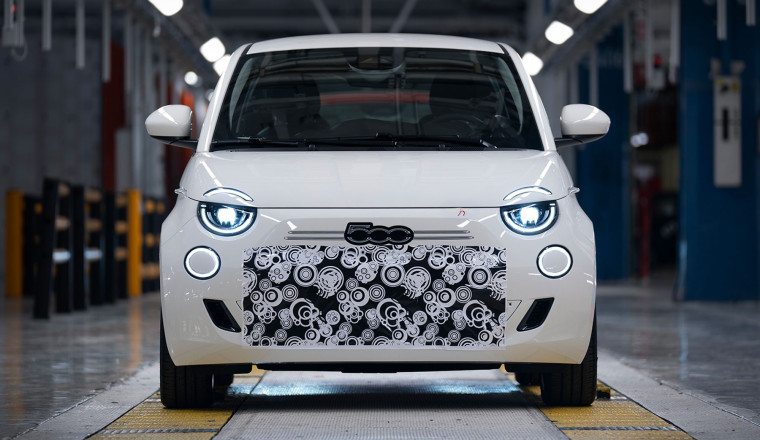
The first pre-production examples of the new Fiat 500 Hybrid have left the assembly line at the Mirafiori factory in Italy, and these are the first official images of the new, more affordable version of this iconic city car. Proof of ‘the brand’s social relevance and its strong connection to Italy and its people’ according to Fiat, it also marks another interesting bump in the road towards full electrification.
For the new 500 Hybrid is an ICE conversion of a car that was only ever intended to be an EV. And when it was launched, the Fiat 500e was one of the best electric cars you could buy. But as countries throughout Europe began dropping EV incentives, it quickly became clear to Fiat that the electric 500 was too expensive for many of its customers, and the firm has been forced to re-engineer its all-electric halo car with an internal combustion engine.
And as it turns out, a close look at the cabin suggests that ‘Hybrid’ label might be over-selling the electrification of this new model as well…
Fiat CEO and chief marketing officer, Olivier Francois, confirmed that a ‘hybrid’ version of the Fiat 500 would be back in production before the end of 2025 during the press conference at the Fiat Grande Panda Electric launch earlier this year. These new images show that process is on track, with full production start targeted for November.
When Fiat found itself with little choice but to remove the old 500 Hybrid from sale in 2024 – it was first introduced in 2007, and it had become out of step with the very latest safety regulations – it hadn’t anticipated ever needing another petrol model to replace it.
However, as with many other car manufacturers, Fiat has discovered that not all of its customers are ready for an EV. Some of this is lifestyle and infrastructure related – Italy is particularly behind the curve when it comes to supporting fully electric vehicles – but much of it is down to cost.
As Francois explained to us in a round table interview, the 500 Electric is just too expensive for many existing 500 customers to seriously consider. The new 500 Hybrid will be offered at a more affordable price.
As has been widely reported, Fiat has been forced to cut back on 500 Electric production – galling for a car built at the firm’s famous Mirafiori factory in its home city of Turin – and in December 2024 it was halted completed, only restarting in January 2025.
Francois says that this is almost entirely a pricing issue related to most European governments ending the EV incentives and grants that were commonplace until a couple of years ago. The cancelation of the EV subsidies in Germany at the end of 2023 had a particularly big impact on the 500 Electric’s customer base, with sales drying up practically overnight.
Until this point, the car had been considered ‘a huge success’ inside Fiat, with ‘incredible’ market share when EV sales were booming. Fiat is clearly proud of the fundamental design and the quality of the car, and Francois stated ‘it will be a very bright day for us’ when the 500 Hybrid model based on the same underpinnings is introduced.
According to the latest official information, Mirafiori has the capacity to produce over 100,000 Fiat 500 Hybrids every year.
‘With the 500 Hybrid,’ says Francois, ‘we are strengthening production at Mirafiori to ensure the plant’s productivity and meet the demand. Our roots are in Italy and it’s no coincidence that the two most iconic FIAT are made here: the Panda in Pomigliano and the 500 in Mirafiori.’
Some of us had initially been expecting it to use same trick 1.2-litre mild-hybrid system as the Fiat 600 Hybrid that will also be going into cheaper versions of the Grande Panda. However, these official images have thrown a rod in that thinking because you can quite clearly see there’s a manual gearbox thanks to the shift-patterned knob sticking out of the centre console.
The 1.2-litre system is exclusively offered with a six-speed dual-clutch that’s operated by buttons and paddles. The appearance of an actual gearlever strongly suggests Fiat has resurrected the 1.0-litre mild hybrid from the old model. It’s even the exact same knob if appearances aren’t deceiving.
If this is the case, it really is the mildest of mild-hybrid setups that’s better described as a fancy stop-start system than a really impressive eco-measure. On the plus side, the use of this older tech should help hammer down the price.
At this stage Fiat isn’t confirming anything. But a contact has suggested that one of the options could come from the current Pandino – Italy’s pet name for the regular Fiat Panda, which is still sold in Europe – and this does indeed use the 1.0-litre mild hybrid that was also deployed in the previous 500. Options, on the other hand, suggests there may be more than one petrol powertrain on the way for the new 500. So we might still see the 1.2-litre auto as well, after all.
The new car won’t go on sale until the end of 2025, so no-one’s putting an official figure on anything just yet. But Fiat has been extremely bullish about competitive pricing in recent months, with the Grande Panda undercutting all rivals and still delivering a very appealing product.
As such, we’ve been told to expect the new 500 Hybrid to be priced as close to the cost of the old one as possible, which started at under £17,000 when it was still available in 2024. However, Francois warned us March it will be ‘slightly more expensive’ due to the additional cost of the necessary safety equipment. And, very frankly, because it is being built in Italy, rather than Poland (where the old Fiat 500 hybrid was assembled).
The Fiat 500e is currently priced from £25,035. If the new 500 Hybrid is using the old 1.0-litre engine then we strongly believe Fiat will be aiming to bring it in at under £20k.
CJ is a former Associate Editor of CAR, and now runs parent company Bauer Media’s Digital Automotive Hub – the in-house team that provides much of the online content for CAR and sister site Parkers.co.uk as well as helping out with CAR magazine. He’s been writing about cars professionally (if that's the right word) for nearly two decades, though attempts to hide this fact with an extensive moisturising routine.
By CJ Hubbard
Head of the Bauer Digital Automotive Hub and former Associate Editor of CAR. Road tester, organiser, reporter and professional enthusiast, putting the driver first