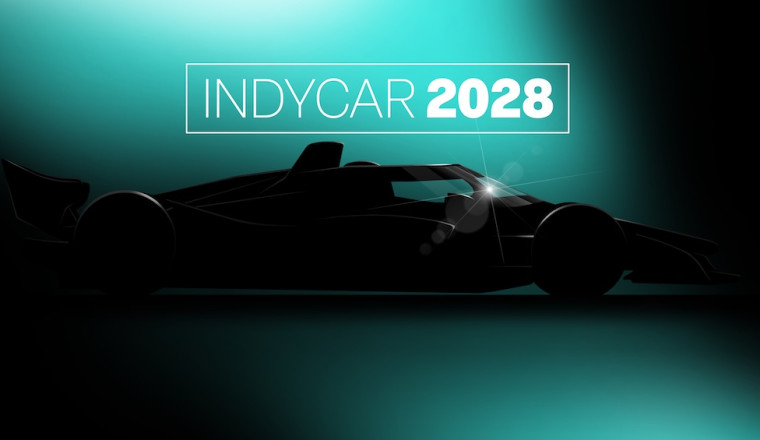

If IndyCar’s 2025 season has been about governance and broadcast optics, its real long game is being written elsewhere. Behind closed doors, work continues on the series’ next chassis and engine regulations, aimed squarely at 2028. Marshall Pruett, writing for RACER, has spent the past year following those threads as they slowly converge.
The headline figures are evolutionary rather than revolutionary. A new chassis, but not a philosophical departure. Revised aerodynamics, but still rooted in the series’ low downforce, high consequence identity. Hybridisation remains central, building on the current energy recovery system rather than tearing it out. The objective, as Pruett outlines, is refinement and relevance, not reinvention.
Crucially, cost control remains the fixed point. IndyCar’s commercial reality demands stability for existing teams while remaining attractive to potential manufacturers. That tension defines every technical decision. Weight targets are being scrutinised. Installation complexity is under review. Lessons from the current hybrid rollout, both positive and painful, are shaping how aggressively the next engine formula will be specified.
Pruett’s reporting suggests the chassis itself is expected to deliver more mechanical grip and cleaner airflow rather than chasing peak downforce numbers. This aligns with IndyCar’s long standing emphasis on raceability across ovals, road courses and street circuits, a balancing act few series even attempt anymore. Any gains must work everywhere, or they are discarded.
On the powertrain side, the picture is more cautious than some fans might hope. Electrification will increase, but incrementally. IndyCar is not positioning itself as a laboratory for extreme technology. Instead, it is aiming to remain credible, durable and understandable, with hybrid systems that reward efficiency without overwhelming strategy or reliability.
What Pruett captures particularly well is the pace of the process. This is not Formula One, able to pivot on vast budgets or political leverage. IndyCar moves deliberately, sometimes frustratingly so, because survival depends on consensus. Manufacturers must agree. Teams must afford it. Promoters must sell it.
That makes 2028 less about spectacle and more about sustainability. If the next package succeeds, it will not be because it shocks the paddock, but because it quietly removes friction that has built up over a decade. Better racing. Lower operational strain. A platform stable enough to attract new investment without destabilising the grid.
Pruett’s year of tracking points to a series trying to modernise without forgetting what it is. IndyCar’s future will not arrive with a bang. If the plan holds, it will arrive with a car that looks familiar, drives better, and finally aligns technology, cost and competition in a way the series has been chasing for years.