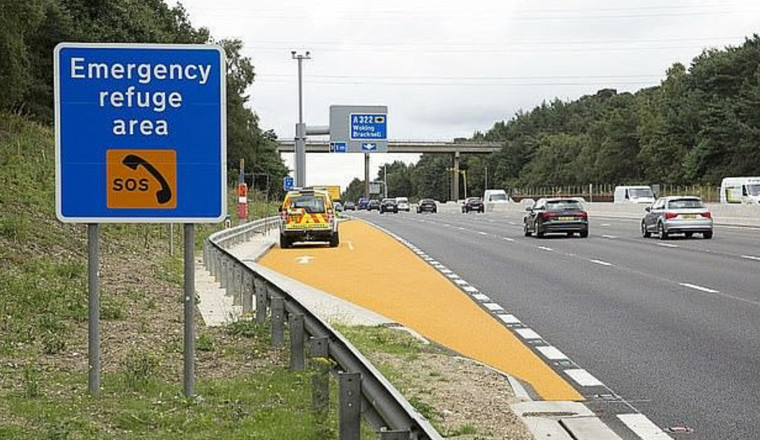

Emergency refuge areas provide a safe haven for stranded vehicles on a smart motorway. Located on stretches of UK motorways where there is no hard shoulder – or where the hard shoulder is sometimes opened as a live lane – emergency refuge areas look similar to a layby.
They are usually signposted and highlighted with bright orange tarmac (see the photo above). Emergency refuge areas are only meant to be used in an emergency, such as a puncture or breakdown.
A survey of 2,000 drivers by the RAC found only 1.5 percent had ever used an emergency refuge area. However, looking out for them could prevent an accident if your car develops a problem on the motorway and you need to stop.
If the hard shoulder is operating as a running lane, you should contact Highways England before leaving the refuge area to rejoin the motorway.
Didn’t know this? You’re not alone: just one respondent in the RAC’s survey did. “It is essential that motorists understand how and when to use an emergency refuge area so they do not put their own safety and that of other road users at risk,” said the RAC’s former chief engineer, David Bizley.
“Vehicles should pull up to the indicated mark on the tarmac or the emergency telephone and then the occupants should leave the vehicle from the passenger side. Everyone should stand behind the barriers and should use the emergency roadside telephone provided to speak to a Highways England representative.”
There are 375 miles of smart motorway across the UK, including the M25 and sections of the M6 and M1.
Traffic flow is controlled using variable speed limits displayed in red circles on the overhead gantries. Cameras monitor the motorways and lanes can be closed remotely if required – if a vehicle breaks down, for example.
Emergency refuge areas are located on smart motorways and should be positioned every 1.5 miles, with an emergency roadside phone available to request assistance.
Smart motorways allow the hard shoulder to be opened as a live lane during busy periods to ease congestion. However, after a number of fatalities, expansion of the UK’s smart motorway network was halted in 2022. Then-prime minister Rishi Sunak cited a lack of public confidence in smart motorways as one reason for his decision.
ALSO READ:
How to use your car’s life-saving emergency eCall system
How to drive safely with dogs in your car
The best new cars to buy in 2025
New Toyota bZ4X prices now start from under £40k
Rolls-Royce Phantom Centenary celebrates 100 years of luxury
Yangwang U9 Xtreme sets another EV lap record at the Nurburgring