
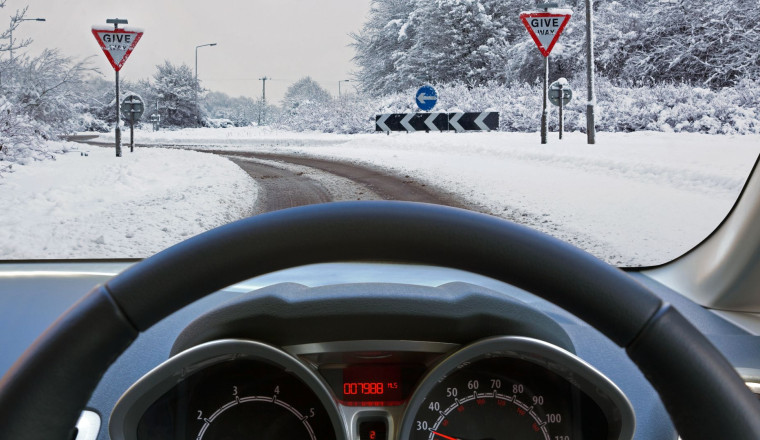

British winters may be getting warmer, but there is still a widespread risk of ice and snow on the roads, particularly in higher altitude areas and across Scotland.
If and when such conditions arise, travel can be dangerous, so you should limit driving to necessary journeys only.
We have pulled together advice on driving in snow and ice from National Highways and professional racing driver Jordi Gené. Read on for how to stay safe when the going gets slippery.
The first rule of driving in the snow is one you should apply to driving as a whole: look far ahead to anticipate what is coming up. It’s all the more pertinent in low-grip conditions, however, given that it takes so much longer to slow down or even steer the car.
Snow can delay drivers’ reaction times by 34 percent, while National Highways says it can take up to 10 times longer to stop in icy conditions.
The slower you drive, and the more distance you allow to the vehicle in front, the more time you have to react. “Anticipate what’s ahead and take it easy, that’s the basic rule for driving in harsh conditions,” says Jordi Gené.
A useful technique for steep descents is called engine braking. In a car with an automatic gearbox, you simply release the accelerator. In a manual, you can select a lower gear that sees the engine revs rise higher (e.g. shifting from third down to second).
While using your foot brake could easily cause the wheels to lock up and skid – or activate the anti-lock braking system (ABS) – engine braking will slow and control the wheels without grabbing at them like brake pads.
Engine braking should thus limit the risk of accelerating or skidding. Then you can start to carefully apply the brakes. “Driving downhill in low gears will help you stay in control and takes a lighter toll on the brakes,” adds Gené.
You should keep a careful eye out for dark patches of black ice on the road. Once in a low-grip area, it’s important not to make sudden adjustments to the car’s controls. Yanking the wheel or stomping on the brake pedal will only increase your likelihood of losing grip. The goal should be to pass over or through ice and snow as smoothly as possible.
Overtaking is rarely worth the risk in these conditions, even if the temptation is there with gritters out on the roads.
“It’s important to stay calm and avoid making sudden manoeuvres,” says Jordi. “You have to turn the wheel gently and lightly step on the brake until you’ve passed the ice patch and the wheels begin to grip again.”
This is for the benefit of other road users. Fog lights are only for when fog, rain or snow is particularly dense, such that it could prevent other drivers from seeing you.
Fog lights, particularly at the rear of the car, are not fitted to help you see outwards. They are for other road users to see you more easily.
Read Motoring Research’s guide to how and when to use your car fog lights here.
Phew, you’ve arrived. Time to lift the wipers up so they don’t stick to your windscreen and rear window. Also, make sure you leave the car in first gear (with a manual gearbox) or Park (with an automatic). This will increase the likelihood of it still being there when you return.
Other than that? Winter tyres are a game-changer for driving in cold weather, although few drivers in the UK use them. Our guide to winter tyres explains the pros and cons.
Snow chains are also an option in the most extreme circumstances. However, if the weather warrants them, perhaps it’s best not to make the journey at all. Remember, if other drivers slip and slide to a halt, you could get stuck behind them.
READ MORE:
Should you use a dehumidifier for your classic car this winter?
14 easy ways to save money on fuel
Your EV questions answered on Motoring Electric
How to de-ice your car’s windscreen and protect frozen wipers
Half of drivers risk damaging their car when de-icing