
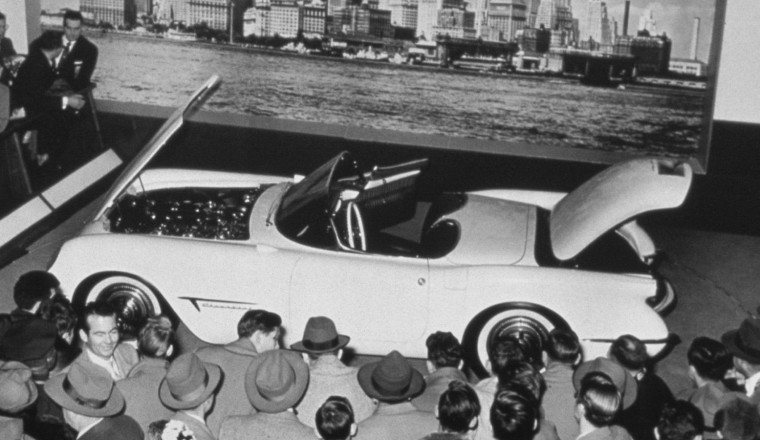

In January 1953, General Motors' annual Motorama show enjoyed swarms of onlookers trying to glimpse the stunning polo white sports car called the "Chevrolet Corvette." A few years earlier, GM Styling chief Harley Earl had wanted to steal the youth market from the European sports car brands with a domestic competitor that would cost $1,300 to $1,800. After seeing Naugatuck Chemical's Alembic-1 fiberglass sports car beauty, he was on an inspired warpath. The resulting "Project Opel" became the Corvette we know and love.
Ex-Rolls-Royce engineer Maurice Olley designed the Corvette's independent front suspension. Legendary chief Chevrolet engineer Ed Cole modifed Chevrolet's ubiquitous "stove-bolt" inline-6 engine into something interesting. Novice designer Bob McLean designed the rest of the car (his first!). The final product was a swooping, low-slung beauty with glass-reinforced plastic bodywork.
But, as exciting as the "plastic fantastic" looked, its body was writing checks its performance couldn't cash. First, it only came with a two-speed automatic transmission. Can you imagine Corvettes being automatic-only? Also, though its "Blue Flame Six" was blessed with higher compression, a hotter cam, and triple sidedraft carbs, it still only made 150 hp. Even worse, the sole body style available was a convertible.
Perhaps most tragically, the 1953 Corvette cost $3,498. The public that had been excited about this American sports car suddenly didn't know what to make of it. Was it a sporty-ish cruiser for wealthy execs? And so, the 300 1953 Corvettes Chevy built were a tough sell. So tough, that less than 200 were sold between its introduction in June and the end of 1953. But saviors can come from unlikely places, even competitors. If it hadn't been for the Ford Thunderbird, GM would likely have put the Corvette out to pasture.
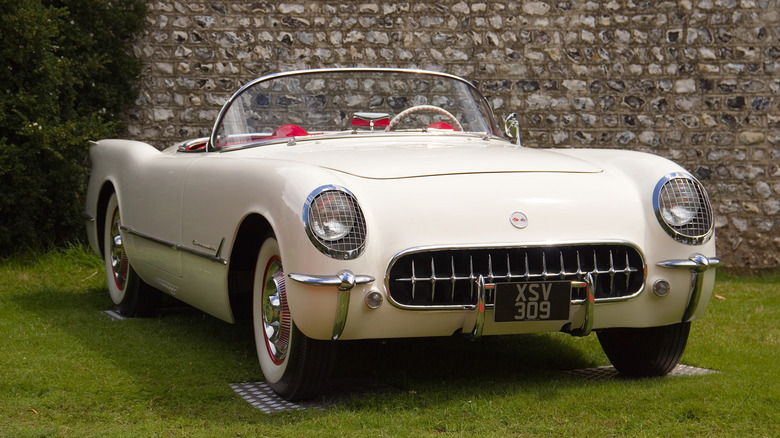 chrisjj/Shutterstock
The term "Corvette" refers to a small, fast fighting naval vessel, and at first, GM might have had an easier time selling navy warships than its less-than-sporty sports car. Sales did pick up in 1954, when Chevrolet added new color options, including Sportsman Red, Pennant Blue, and Black, managing a 1,290% increase to 2,780 buyers. This was, however, out of 3,265 built, which was just over a quarter of the 12,000 Chevrolet had hoped to build.
Fortunately for GM, Zora Arkus-Duntov joined Chevrolet R&D in May 1953. This Belgian-born Russian engineer already had a history of making cars go faster thanks to his ingenious ARDUN (from ARkus-DUNtov) hemi conversion heads for Ford flathead V8s. When he arrived, he found that Chevrolet was at work on a new engine to replace the stupendously dull six-cylinder: the mighty mouse itself, the 265 small-block Chevy V8. In addition to revamping the front suspension, Duntov pushed for the Corvette to become a "halo car" worthy of such a title, championing the addition of the V8 and, bless his soul, a manual transmission.
But, even with the addition of a 195-hp V8 and three-speed manual for the 1955 model year, sales still weren't climbing. GM saw that Chevrolet only made 700 Corvettes for that model year and was ready to pull the plug. Meanwhile, in September 1954, the first 1955 Ford Thunderbirds rolled off the line at Ford's Dearborn Assembly Plant. Their 292-cubic-inch Y-block V8 made almost 200 hp and buyers could choose between a three-speed manual (with optional overdrive) or, to increase blandness, a three-speed automatic. T-Birds outsold Corvettes 23-to-1.
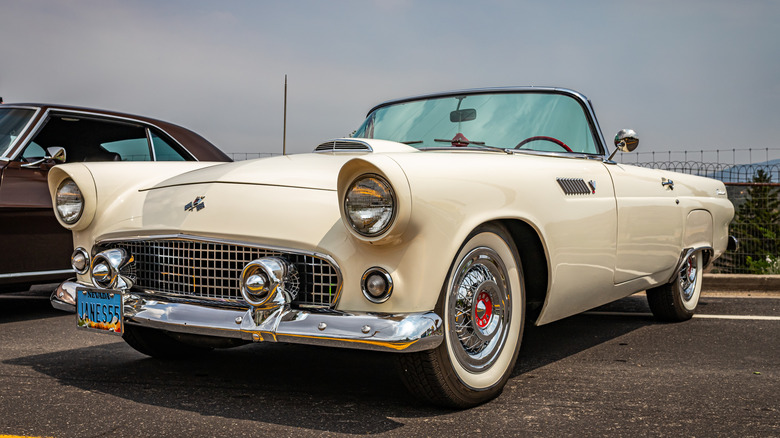 Different_brian/Getty Images
Saying the Thunderbird lit a fire under GM is like saying Bitcoin got a little pricey. There was no way GM was going to cede ground to Ford, and dang it, there was going to be a GM sports car. But ironically, the man who had originally spearheaded the Corvette switched his interests to another GM sports car concept. As the sales numbers for 1954 Corvettes were arriving, Earl was wringing his hands over Ford's Thunderbird, worried the Corvette wouldn't be competitive. So he pushed for the Oldsmobile F-88 to become GM's sports car offering with its 270-hp V8.
This is the first and only time I'll ever say this, but thank goodness for bean counters. GM may continually sell its soul to the cost-cutting devil at the crossroads, but by taking the cheaper and arguably lazier route, accountants saved the Corvette. It was already in production and getting approved upgrades, and there just wasn't room in the lineup for two sports cars, so the Olds F-88 was out, and the Corvette stayed. As for the Corvette's Valiumed-sloth performance, Arkus-Duntov was hard at work roiding it up. His 1954/1955 EX87 test mule was the first Corvette to get a V8, and in 1955, NASCAR legend Smokey Yunick took it to 163 mph at GM's Arizona Proving Grounds.
Fortunately for the Corvette, Thunderbirds quickly became luxo-barge four-seaters, leaving 'Vettes as America's de facto sports car. Still, the Corvette had to fight for its existence. '56 models picked up sales over the '55s with 3,467 sold, but it wasn't until 1957 (when Corvettes got fuel-injected 283s and four-speed manuals) that sales nearly doubled to 6,339 and the Corvette's future was finally secure.