

by Chris Chilton
- A Ford master technician earned $160K last year, per the WSJ.
- Flat-rate pay rewards speed and skill, not hours on the clock.
- Jim Farley says Ford’s struggling to fill 5,000 tech jobs at $120K.
Most people still imagine auto technicians as underpaid laborers, elbow-deep in grease, barely scraping by on hourly wages. So the idea that a dealership technician for a non-premium brand can earn $160,000 a year sounds like a typo. But that’s exactly what’s happening if you’re good enough, fast enough, and stubborn enough to stick with the job long term.
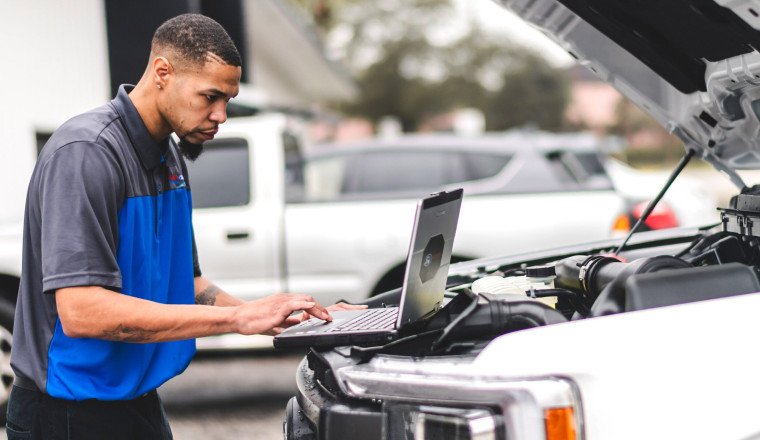
Ted Hummel is a senior master technician at Klaben Ford, a dealer in Kent, Ohio, and he specializes in transmissions, the heavy awkward parts that many techs hate touching. Ford says a transmission swap should take about 10 hours but Hummel’s done so many he can do it in about half that time, he told the Wall Street Journal.
Related: Subaru Owner Gets $8,500 Quote For Repairs Mechanic Says Don’t Even Exist
“I wish we could clone Ted,” his boss told WSJ. So does Jim Farley. the Ford CEO recently lamented that the automaker was struggling to find enough capable, qualified technicians to fill 5,000 vacancies for roles paying over $120,000, but they take around five years to learn.
“We are in trouble in our country,” Farley said. “A bay with a lift and tools and no one to work in it.”
How Flat Rate Rewards the Fast and Fearless
The system that helps Hummel make bank is called flat rate, and it’s basically piecework for cars. Finish the job quicker than the book says and you still get paid the full amount. Do that all day, every day, and your paycheck balloons. But only a tiny fraction of techs ever reach that level, because the path there is long, expensive, and physically punishing.
Hummel started out making less than $10 an hour, having shelled out $30k to get through college, and then thousands of dollars more on tools, which dealerships expect their techs to supply. Specialized torque wrenches alone can cost $800 each. It took him a decade to break six figures, the WSJ reports, and that was without injuries slowing him down.
“They always advertised back then, you could make six figures,” he said. “As I was doing it, it was like, ‘This isn’t happening.’ It took a long time.”
The Next Generation
Besides his speed, a big part of Hummel’s income now comes from training younger techs, which the dealer pays him extra for. Ford says it has thousands of open technician roles nationwide, and it takes about five years before someone becomes truly productive.
Read: Your Repair Could Take A Lot Longer Because Auto Shops Are Struggling To Find Mechanics
Not everyone makes it. The work is hard on your body, and missing time means missing pay. Some techs burn out or get hurt before they ever reach the high-earning tier, meaning for every Hummel raking in $160k, there must be dozens of other mechanics earning one half, or even a third as much, while the shortage of good techs is pushing up the cost of repairs.
Rising Maintenance Costs
In fact, maintenance prices are climbing faster than inflation. In November, they were up 6.9 percent compared to the previous year. Over the past decade, those costs have ballooned by 59 percent. Mechanic wages, by contrast, have risen just 34 percent.
So while drivers are paying more to keep their cars on the road, the people doing the work aren’t seeing paychecks grow at the same pace, though, to be fair, that’s been the case for a lot of folks, especially in the post-Covid economy.
According to Hummel, Ford is set to pay 14.6 labor hours for the F-150 he was working on at the time of the interview, even if he finishes in under seven. That efficiency is what makes flat rate lucrative for him, but it’s also what makes it risky for others.
Russell Wickham knows the other side of the coin. A technician at a Chevrolet dealership in Indiana, he’s spent around a decade moving between stores in three different states. At his peak, he told the WSJ, he topped out at $89,000 in 2022.
“There’s no guarantee,” he told the outlet. “If the customers aren’t coming in, they don’t have a problem letting you sit around because you’re not costing them anything.”