

The Breakdown
- The new Purosangue version is said to retain the naturally aspirated V12.
- It could be one of the five new models confirmed to debut in 2026.
- Production is expected to commence in the second half of the year.
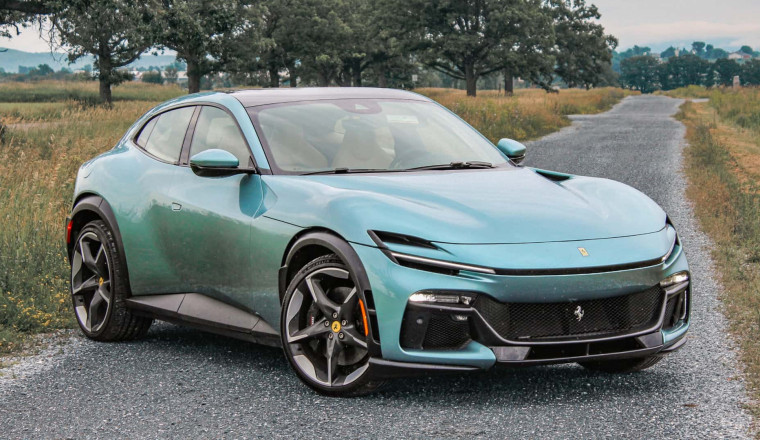
While we wait for Maranello to launch its first electric vehicle, the previously most controversial model is reportedly getting an update. Ferrari is looking to introduce a performance version of its Purosangue SUV later this year. It’s claimed to retain the naturally aspirated V12 engine, although it's unclear whether more power is on the way.
In its current form, the 6.5-liter powerhouse is good for 715 hp. However, we know from other models carrying the Prancing Horse badge that the twelve-cylinder mill can unleash even more Italian stallions. The 12Cilindri has 819 hp on tap, whereas the ultra-exclusive Daytona SP3 is the king of the V12 hill with as much as 829 hp.
According to Bloomberg, the hotter Purosangue will enter production during the second half of the year. It would make the SUV one of the five new models Ferrari has confirmed it will introduce this year. We had been assuming it would be a plug-in hybrid version with a smaller combustion engine, but it looks as though the company is about to level up its venerable V12.
Further details are scarce, but company insiders cited by the news agency claim the big engine is staying. Ferrari is apparently tweaking the Purosangue to sharpen up handling. As you can imagine, the exotic brand refused to comment on future models when asked by Bloomberg whether the SUV would receive upgrades.
If the V12 remains untouched, Ferrari could develop an optional Assetto Fiorano package by following a recipe repeatedly used on the firm’s two-door supercars. The kit typically shaves off a marginal amount of weight by using more extensive carbon fiber. Named after the company’s track in Italy, the pack also features revised suspension and aerodynamics.
Even if Ferrari is looking to expand the Purosangue lineup, it’s sticking to its promise to limit annual production so as not to flood the market with SUVs. Ever since the model launched nearly four years ago, production has been limited to 20 percent of the company’s annual output.
Its domestic nemesis, Lamborghini, is doing things differently by building as many Urus units as possible each year, without worrying about brand dilution. Other ultra-luxury SUVs such as the Aston Martin DBX, Rolls-Royce Cullinan, and Bentley Bentayga are also free from any artificial production restrictions.
A new version of the V12 SUV wouldn’t necessarily come as a surprise. Ferrari projects that 40 percent of its models will still be pure ICE vehicles by 2030. Plug-in hybrids are estimated to hold an identical share by the end of the decade, leaving electric vehicles with the remaining 20 percent. In just four years, the company intends to roll out 20 new models.
Traditionalists will be happy to hear the twelve-cylinder engine will live on, as Ferrari has found a way to make it Euro 7 compliant. Last year, Chief Research & Development Officer Ernesto Lasalandra hinted at further developments to the V12 as well as the smaller V6 and V8 engines:
'We continue to develop our V6, V8, and V12 engines with the goal to continuously improve their performance and efficiency, and at the same time, being compliant with the new worldwide regulations. We will continue to offer thermal engines in our product portfolio and bring innovation to engines by continuing to increase specific power.'
Motor1's Take: Ferrari doesn’t really need to spice up the Purosangue. The order books for 2026 have long been closed across the lineup, and the production run for 2027 is already almost spoken for. However, deep-pocketed buyers looking for a practical car will certainly line up to buy a hotter version and happily pay the premium that comes with it.
The “base” Purosangue is already a $400,000+ model in the United States, and a new version with some options thrown in could easily cross the $500,000 mark. Ferrari would make even more money on its cash cow without a significant investment, making a performance version a no-brainer.