





We would all love to have a shiny new car that can serve us well for many years. However, life priorities, high living costs, and other financial circumstances mean that some vehicles are beyond the reach of most, especially now that the average price of a new car has soared above $50,000 for the first time ever, according to Kelley Blue Book. Many of us often turn to used vehicles over new ones, but saving money on a car purchase doesn't have to mean making a compromise.
And so, to help make things easier for those of you with a $20,000 budget, we've picked out five models from Consumer Reports' top ten picks for November 2025 so we can show you some of the best budget-friendly used cars you can buy now. To select the models, Consumer Reports looked at things like reliability, availability of key safety features, and how the various cars performed in road tests when they were new. This means that by choosing one of the listed cars, you stand a good chance of owning a vehicle that's not only cheap to buy upfront, but also unlikely to saddle you with expensive repair bills down the line.
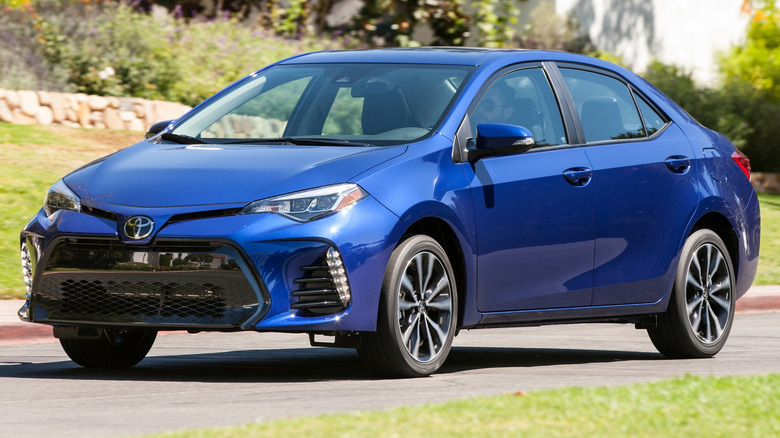
The Corolla has long been considered the king of compact family cars. In the eleventh-generation model offered between the 2014 and 2019 model years, it's as compelling today as it's ever been. While it may not have the most luxurious features, it is very reliable, meaning you won't have to deal with too many mechanical headaches in the future if you go with one of these. Safety-wise, the eleventh-gen Corolla is a huge step forward compared to the car it replaced. Coming as part of a model-year refresh for 2017, the Corolla received the Toyota Safety Sense P (TSS-P) suite, which bundles automated emergency braking with pedestrian detection, lane departure warning with lane-keeping assist, as well as forward collision warning as standard equipment.
All versions also come standard with LED headlights, adaptive cruise control, and the Toyota Entune infotainment system, which includes either a standard 6.1-inch touchscreen or a 7.0-inch unit. Many 2019 Corollas use a 1.8-liter inline four-cylinder engine that's offered in two power outputs. The L, LE, SE, XLE, and XSE trims have the version with 132 horsepower and 128 lb-ft of torque whereas the Corolla LE Eco is equipped with a 140 hp, 126 lb-ft unit. In terms of fuel economy, the Corolla LE Eco returns up to 34 mpg combined while the variant in the other Corolla models is good for about 32 mpg. If those numbers don't feel like much, consider the 2019 Toyota Camry Hybrid offers up to 52 mpg in LE guise.
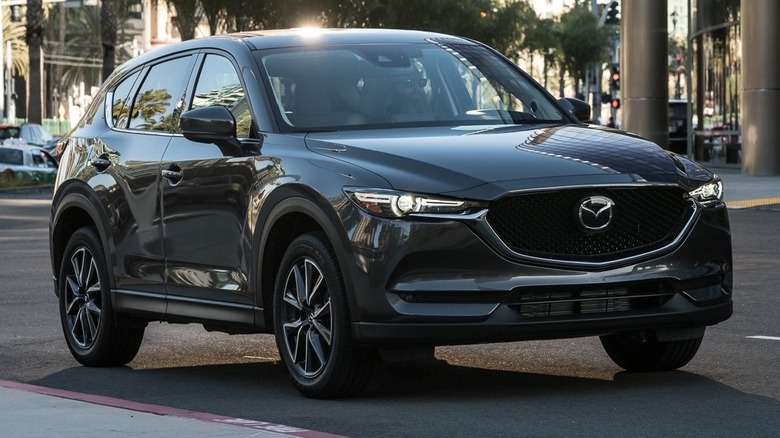
Want something engaging, premium-feeling, and a bit more jacked up? The second-generation Mazda CX-5 is an obvious choice. The compact SUV has been hailed as a smooth and refined ride, known for its style and nicely weighted and precise steering. Although it only launched for the 2017 model year, Mazda increased the scope of features on the second-gen CX-5 the following year, bringing a standard leather-wrapped steering wheel and shift knob, along with safety systems like blind-spot monitoring and rear-cross traffic alert. Those who wanted the base Sport model could also add adaptive cruise control and lane-keeping to the list of standard safety features.
Every 2018 CX-5 uses a 7.0-inch infotainment display, which predates Apple CarPlay and Android Auto support, as the feature didn't come along until the 2019 CX-5 model year. Thankfully, you can now have a retrofit CarPlay or Android Auto kit installed at a Mazda dealership for roughly $400 to $500, depending on your location. Another drawback with the CX-5 could be cargo space. With 30.9 cubic feet of cargo space behind its rear seats and 59.6 cubic feet with them folded, the CX-5's cargo is adequate. However, when you compare it to the 38.4 and 73.4 cubic feet offered by the Toyota RAV4 or the 39.2 and 75.8 cubic feet of the 2018 Honda CR-V, you'll find that the CX-5 falls short in comparison to its biggest rivals. If you want a Mazda that's a bit more spacious for under $20k, consider the CX-5's big brother, the 2020 Mazda CX-9, which is also CR-recommended and offers up to 71.2 cubic feet of room with its third and second rows folded down.
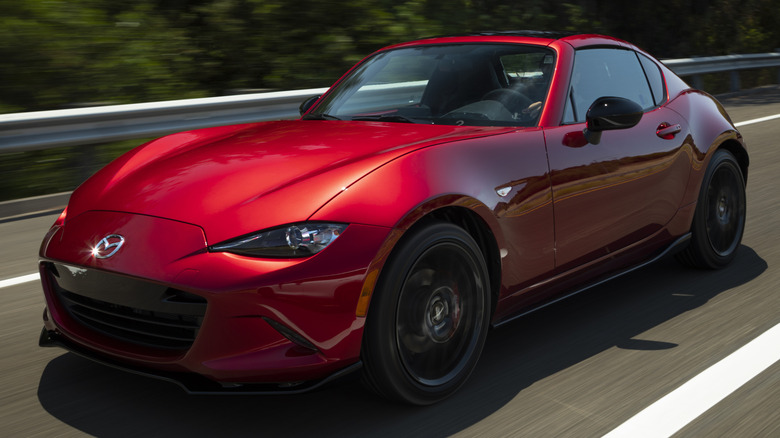
The light and agile Mazda MX-5 Miata is one of the cars you simply must drive at least once in your life, and that's for good reason. It's got well-weighted steering, along with a remarkably playful chassis, and an eager, rev-happy 2.0-liter longitudinal inline-four that's mounted behind the front axle in a bid to achieve a 50-50 weight balance. Mazda made an effort to improve performance for 2019, and the result is an engine that now generates 181 hp and 151 lb-ft of torque — up from 155 hp and 148 lb-ft — funneled to the rear wheels via a standard 6-speed manual transmission with delicious short throws and just the right heft (a 6-speed automatic transmission is available).
All these factors combine to make the MX-5 Miata one of the world's most fun cars, and that doesn't come at the expense of performance. Car and Driver's testing of the mechanically similar 2019 Mazda MX-5 Miata equipped with the manual transmission recorded a respectable 0-60 time of 5.7 seconds, with an estimated 140-mph top speed. A manual-equipped MX-5 Miata RF was quoted as completing the 0-60 run in 5.8 ticks. The Japanese automaker also fits its i-Activsense suite of driver assists to the sports car, and as a result, owners are granted access to forward-collision warning, low-speed automatic emergency braking, lane-departure warning, blind-spot monitoring, and rear cross-traffic alert.
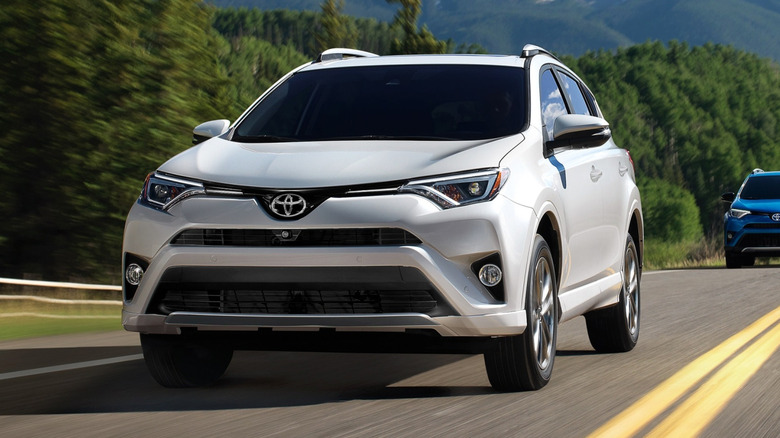
The Toyota RAV4 is a household name, and a key reason it has become so popular has to do with its very attractive combination of affordability, reliability, safety, practicality, and efficiency. The compact crossover SUV has evolved significantly from its early beginnings in the '90s, when it initially launched in two-door and four-door versions with a modest 120-hp, gas-powered 2.0-liter four-cylinder engine, to a lineup that now includes hybrid models producing up to 236 hp.
However, it wasn't until 2016 that a RAV4 Hybrid version was introduced as part of a midlife update to the fourth-generation model. The powertrain setup combines a 2.5-liter inline-four engine and an electric motor that together produce 194 hp and 206 lb-ft of torque, while averaging 32 mpg. This means it yields between 6 and 8 more mpg in addition to the performance gains over the nonhybrid RAV4, which makes 176 hp and 172 lb-ft. According to Toyota's estimates, it'll take you around 8.1 seconds to hit 60 mph from a standstill, about a second quicker than the nonhybrid car.
 Wikimedia Commons/Jacob Frey 4A/ C.C. BY 2.0
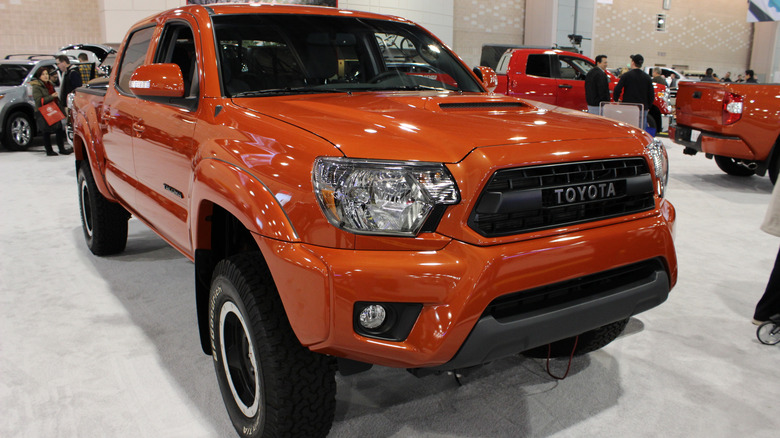
The Toyota Tacoma is a vehicle that's always felt right. It has consistently prioritized reliability and durability, and that has served it well in terms of resale value — it is one of the slowest-depreciating cars in 2025. The downside to this, of course, is that it'll take a few years post-launch before you can afford a Tacoma on a $20k budget. The other option, naturally, is to buy one that's already taken a severe depreciation hit, in which case, the 2015 Toyota Tacoma is well worth considering, according to Consumer Reports.
While the truck still averages $26,750 on CLASSIC, individual models can be had for far less, one example being a 2015 Toyota Tacoma Access Cab SR5 listed for just under $17,000 as of this writing. There's a huge list to choose from, of course, and no matter which you go for, you'll find either a 159-hp 2.7-liter inline-four or a 4.0-liter V6 that develops 236 hp. Transmission options are plentiful, too. They include a five-speed manual, six-speed manual, four-speed automatic, and five-speed automatic.
























.jpg)