

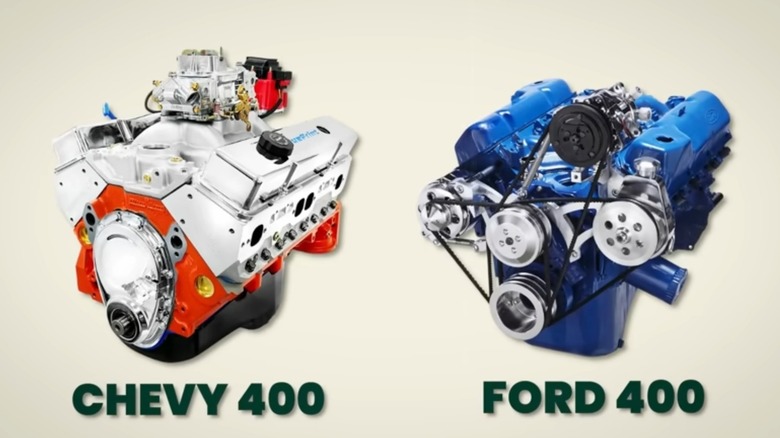
GM divisions Pontiac and Chevrolet each produced 400 cubic-inch small-block V8s with similar bore-to-stroke ratios. Ford made one as well, but its block was very different from Chevy's in nearly every way. Some may refer to the Ford 400 as a mid-block engine because its 10.3-inch deck height – the distance between the crankshaft centerline and the cylinder-head mounting surface of the block — is as tall as many Ford big-blocks. It's also much taller than the standard SBC deck height of 9.025 inches.
However, its 4.38-inch bore spacing is the same as other small block Fords of its time and shorter than the 4.40-inch bore spacing of the small-block Chevy. The 400 Ford is also within half an inch of being the same overall size as the 351 Cleveland engine.
Internally, the Ford and Chevy 400 cubic-inch engines use differing bore-to-stroke ratios. Chevrolet opted to stay with its established SBC architecture and keep the stroke at 3.75 inches. To reach 400 cubic inches, this required boring the cylinders to 4.125 inches. Both of these aspects neared the maximum amounts for traditional Chevy small-block engines.
Ford opted for a more symmetrical approach with bore and stroke measuring an even 4.0 inches. The longer stroke necessitated the increased deck height compared to other small-block Ford engines, such as the 302 with its 3.0-inch stroke and the 351 with its 3.5 inches.
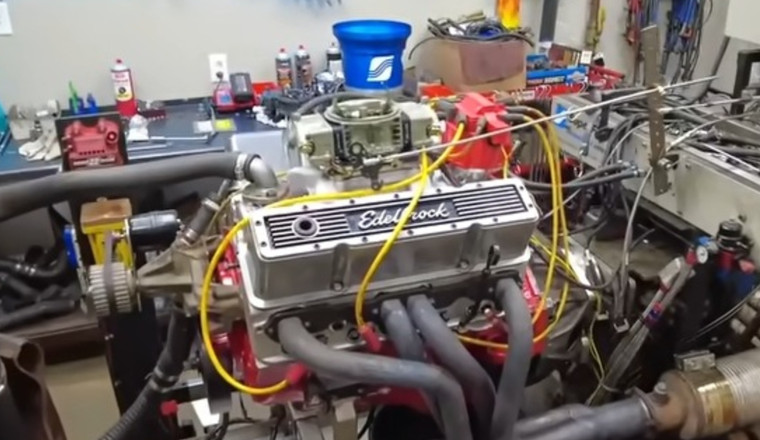
Neither of the 400 cubic-inch engines from Ford or Chevy were considered high performance engines. Although, they're among the biggest small block engines ever built. Both engines debuted in the 1970s and by the late 1970s the Ford 400 was producing 158 horsepower, according to Hot Rod. However, with some modifications, the Hot Rod team was able to coax considerably more horsepower from the Ford 400.
"This time around, the torque peaked at 565 at 4,300 rpm and the horsepower was 505 at 5,300."
Discussing the Chevy 400, Hot Rod says there was never a high-performance version from the factory. Most Chevy 400s saw duty in larger sedans and light trucks, much like the Ford 400 — except the latter was also sometimes used in the potentially-sporty Torino and Cougar.
Stock versions of the Chevy 400 were rated somewhere between 150 and 380 horsepower depending on its intended use. Hot Rod dyno'd a lightly modified Chevy 400 (a mild aftermarket cam and Vortec heads) to get 376 horsepower. Nick's Garage tested a Chevy 400 on its dyno that produced 411 horsepower. Ultimately, the power potential from either automaker's small-block depends on its build. MotorTrend proved how the Chevy 400, albeit a highly-modified aftermarket version, is capable of making in excess of 1,000 horsepower. From their respective factories, the SBC 400 provided more power than Ford's 400 cubic-inch engine.