
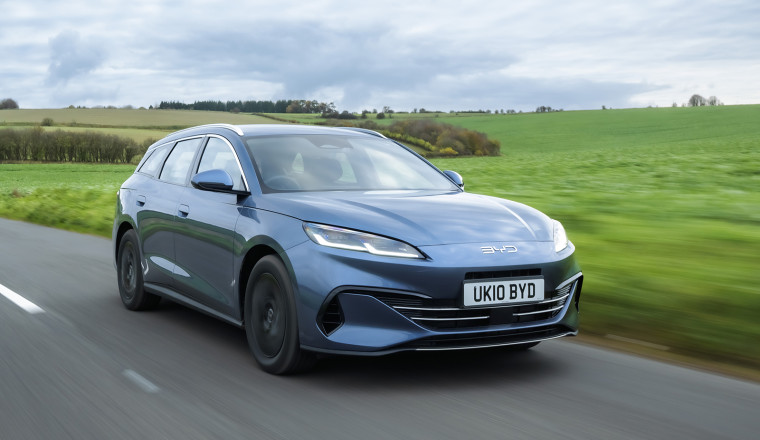

The demise of the family estate appears to have been exaggerated. Volvo, having flirted with killing the format off, is back in the game; the German premium clique, plus Peugeot and Skoda among others, can still be relied on; and now there is a new wave of wagons arriving on our shores.
One of the newbies will be the recently announced Kia K4 Sportswagon, due on sale later in 2026 at less than £30k if you opt for the three-cylinder mild hybrid. Another is the subject of this road test: the new BYD Seal 6 DM-i, which is also available as a saloon but is, we think, much more interesting as an estate that directly rivals the Skoda Superb - an Autocar five-star car.
Can the well-priced BYD score a tactical strike? We'll soon find out. Now, the nomenclature bears clarifying. BYD's line-up in the UK currently consists of two branches. On one side there are pure electric cars, and on the other plug-in hybrids that use the company's 'Dual Mode-intelligent' powertrain. While there is already a Seal that takes the form of an EV saloon, the Seal 6 DM-i is styled differently and, as the name suggests, is one of the PHEVs. The two cars are broadly unrelated but share some architecture.
The arrival of the Seal 6 DM-i takes BYD's total number of models on sale in the UK to nine. In January 2023, the figure was zero. The company's growth has been rapid, and on a global scale BYD has now overtaken Tesla to become the world's biggest electric car maker. The 2.26 million EVs it sold in 2025 marked a 28% increase on 2024. Truly the mind boggles at what the European stalwarts would give to achieve such a grand statistic.
Keen pricing, good practicality, low running costs and an array of digital amenities have helped BYD secure its sales, particularly in the taxi and fleet sectors. The Seal 6 DM-i, with its near-1000-mile range and low CO2 looks set to continue that trend, but might it also be an excellent option for private buyers with a family to cater for? Might it, in short, give the Skoda Superb Estate something to worry about?
There was a moment when it looked like range-extender technology - whereby the drive battery for an electric car is charged not only from the mains but also by a small combustion engine on the move - was the future. BMW fitted such a system to the i3 and Chevrolet to the futuristic Volt (badged the Vauxhall Ampera in the UK); owners enjoyed the smooth drivability of an EV powertrain and hydrocarbon-free transport day to day, with the security of unlimited range if the need arose. You had, if you like, two cars in one.
Rapid gains in battery density meant EVs were soon capable of driving 250 miles, diminishing the ace card of the range-extenders, which required additional servicing and attracted higher tax rates. And in any case, it was often found that, at motorway speeds, using a petrol engine to sustain electric propulsion was less efficient than simply driving the wheels, as parallel hybrids do. So it's a hard sell. Mazda has just killed off the MX-30, with fewer than 700 examples of the range-extender version sold in two years. Ouch.
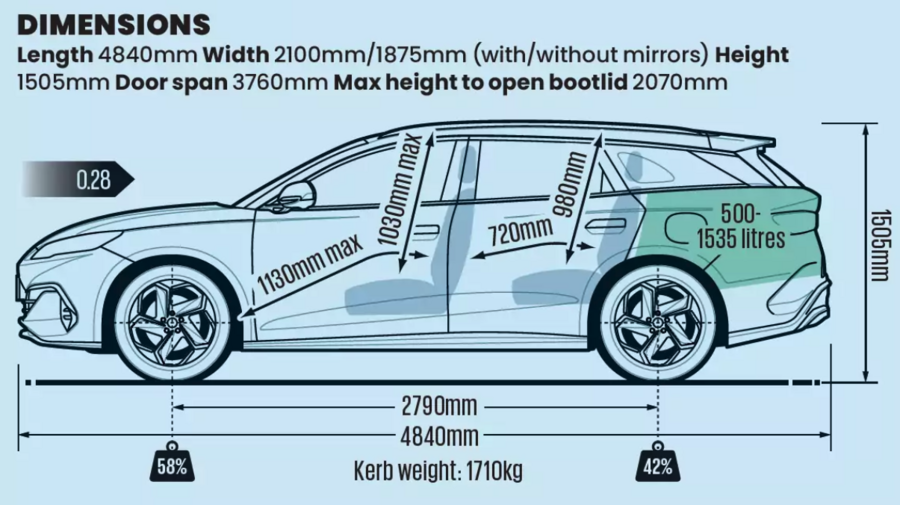
The Seal 6's size is deceptive. Even after driving it, I would have put it as a rival for the estate versions of the Skoda Octavia (4698mm length), but at 4840mm it's closer to the Skoda Superb (4902mm).Illya VerpraetRoad Tester
It is therefore with some curiosity that we test the Seal 6 DM-i, this renaissance of a technology most car makers have forgotten about. So what are we dealing with? The drive battery in the car's floor (BYD's own 'Blade' unit, so-called because of its thin, elongated cells, with lithium-iron-phosphate chemistry) is either 10.1kWh or 19.0kWh, depending on whether you opt for the Boost or Comfort version respectively. The smaller battery gives a WLTP electric range of 31 miles, while it is 62 miles with the larger unit. Skoda's Superb PHEV, by comparison, is rated at 84 miles.
Mounted transversely at the front of the car is BYD's 'Xiaoyun' 97bhp naturally aspirated 1.5-litre Atkinson-cycle petrol engine. It acts mostly as a generator for the car's permanent magnet synchronous drive motor, which can put out up to 195bhp. It is also supplied by a tank with a capacity of 65 litres, which explains the car's theoretical range of more than 900 miles.
You realise this powertrain has more about it than meets the eye when you look at the spec sheets. The Seal 6 DM-i Boost is tuned to deliver 181bhp, all said. However, the Comfort can produce as much as 209bhp. How is this possible if the car is a range-extender with an electric motor good for only 195bhp?
It's possible because the engine can, if necessary, clutch in to drive through the car's single-speed transmission and therefore drive the wheels directly. In general, that clutch is disengaged and the Seal 6 DM-i drives like an EV. It will only engage in high-load situations such as merging onto motorways, or when cruising at higher speeds. It's a more straightforward arrangement than the planetary e-CVT set-up found in Toyotas.
Elsewhere, at 4840mm long in both estate and saloon form, the Seal 6 DM-i is comparable to the Volkswagen Passat and a size up from the Peugeot 308 or Seat Leon. Our test car - a Boost model with the smaller battery - trod our scales at 1738kg, which is marginally more than the claimed 1710kg but fine for a dual-technology estate car that's nearly five metres long. As for styling, the 6 DM-i lacks the electric Seal's big-wheeled stance and subtle elegance. Its exterior design is like most BYDs in that it's wholly inoffensive but also bland and forgettable. To our eyes the Skoda Superb has far more about it.
The same sentiment applies to the interior. BYD used to offer unexpected upholstery colours, but in the Seal 6 you find a sea of synthetic-feeling faux black leather. There are a few neat touches, such as the ridged rubber material on the dash trim, and the way the door cards flow into the dash (just like on a Ferrari 550 Maranello, eh?). The steering rim is also nicely sculpted and mercifully there's next to no gloss black plastic to attract scratches and generally look tired, but nothing in here is exactly memorable. But perhaps that's as you would expect in an unambiguous value proposition.
Switchgear? BYD has a strange philosophy when it comes to buttons. There are a few sensibly chosen ones in the centre console, just ahead of the two large phone trays. There's also plenty on the steering wheel, but you still have to dive deep into the touchscreen for certain essential functions, such as the headlights and the heated seats. At least the centre touchscreen works better than in previous BYD models we have driven. It's the first one that can't rotate - a gimmick that we can't imagine many people will miss - and is sharp and low on latency. When you use Apple CarPlay, the main shortcut bars remain. There's also a configurable pull-down menu that gives you quick access to certain settings and lets you quickly disable ADAS.
The only difference between Comfort Lite and Comfort trims is the touchscreen size: 12.8in versus 15.6in. I drove the Comfort Lite and thought the screen was big enough without being too overbearing.Illya VerpraetRoad Tester
As for ergonomics, the Seal 6 is almost as big on the outside as the Superb, though it isn't as accommodating inside. Apart from seats that lack lumbar support, there isn't a lot wrong with the spacious front portion of the cabin. However, in the back, the BYD's 720mm of rear leg room is well short of the Superb Estate's 855mm. The same is true for head room. The Seal 6 is not cramped, but it is a little smaller than expected and the high floor in the back, on account of the battery, makes foot space tight. Particularly cheap-feeling floor mats also result in a taxi feel. Boot space is competitive, however, at 500 litres (compared with 510 in the Superb PHEV), and it has both a flat floor and a pair of handles to fold down the rear seats.
A quick word on specification. Both trims are well appointed at this price, but by opting for the cheaper Boost you will sacrifice the heated steering wheel, a heated and ventilated driver's seat, colourful ambient lighting (this does a lot of heavy lifting in terms of cabin ambience) and an auto-dimming rear-view mirror, not to mention the panoramic sunroof.
It's fair to say BYD's unusual powertrain is this car's greatest asset. Unlike in most PHEVs, in EV mode it really does feel like you're driving an electric car in terms of roll-on acceleration and the amount of power on offer. In fairness, the response of the right-side pedal could be sharper still (if only so you didn't have to opt for Sport mode), but in the main this powertrain makes for effortless low-load driving. It helps that, when the engine does fire up - usually when the battery reaches about 20% charge and the car enters Hybrid mode - it does so with impressively little fanfare. This hasn't always been the case with range-extender EVs or PHEVs.
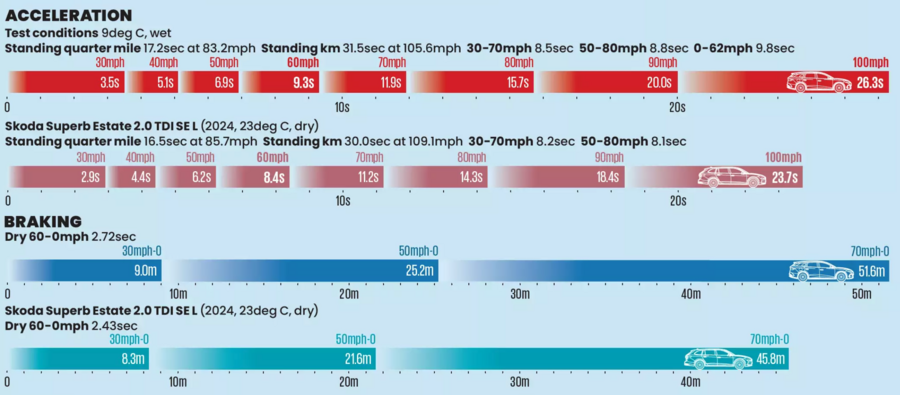
Admittedly, performance is modest. Exceedingly so. Opting for the more powerful Comfort version of the Seal 6 DM-i shaves 0.4sec off the Boost's claimed 0-62mph time of 8.9sec but neither car is quick. It was in our road test Boost model that we recorded a time of 9.8sec on a very wet day at Horiba MIRA. Factor in a passenger or two and some luggage and you would be firmly into double figures, which puts the BYD at the slower end of the class. On the move, the dash from 30-70mph took 8.5sec. Again, this is hardly enlivening but is on a par with the 2.0-litre TDI Skoda Superb we tested in 2024.
BYD calls its 1.5-litre petrol engine the Xiaoyun and claims it has a thermal efficiency of 43%, which is very good if true.Illya VerpraetRoad Tester
A surprising standout in the class of ultra-efficient petrol-electric cars costing around £35k is the current Toyota Prius PHEV. It is smaller than either the BYD or the Skoda, granted, but its 220bhp output means it will dispatch 30-70mph in 5.6sec, making overtakes less stressful. Surely BYD could have massaged a little more power from this versatile set-up, whereby the wheels can be turned by an electric motor, a petrol engine, or indeed both? It means some drivers will regularly find themselves using full throttle. Do so and the power delivery is at least reasonably natural, engine revs quietly rising with road speed. You can't quite escape that detached feeling, though. The Superb PHEV's set-up, whereby everything flows through a traditional 'box, is more intuitive.
You would be forgiven for having reasonably high expectations of the Seal 6 DM-i in terms of ride quality and basic handling. BYD has proven with some of its EVs that it understands what is required for an everyday car to carry itself with a quiet poise and easy manner. It's something VW long ago mastered. In the case of this new estate, while the powertrain is smooth and refined, the rest of the car trails class standards for relaxation. The suspension is quiet enough, but it feels leaden and lumpy over urban imperfections, while on the motorway there's constant fidget on all but the smoothest Tarmac. Meanwhile, if you hit a compression mid-corner, the body will heave and wallow.
There is nothing outright offensive here, and most of the time the car's long-wave gait is fairly well judged, but from a dynamic standpoint the Seal 6 DM-i feels engineered to be passably refined and nothing more. Elsewhere, the steering is particularly uninspiring. It is languid, at 2.7 turns between locks, but the real issue is that it is almost totally synthetic in feel. No one expects fizzing feedback in a car like this, but some sense of integrity is needed. The off-centre response is also dumbed down, presumably to give the soft suspension a chance to keep up, and the result is a car that changes direction in slightly oleaginous, recalcitrant fashion. While its steering is overly light, the Superb is much more convincing and intuitive in this respect.
It's a shame, because the BYD is actually well balanced and can carry good speed through sweeping bends without issue. Equally, on tighter, damp corners it is too easy to push the car into understeer on its Hankook tyres. This will then transition to lazy oversteer if you come off the power. In short, the car doesn't much like being hustled - again in contrast to the likes of the Skoda and especially Cupra estates. More positively, the fine response of the brake pedal gives way to good progression and stopping power. In fact, the Seal 6 DM-i stops very confidently, and even in heavy rain resisted shimmying or pulling off line during repeated emergency stops. Fade was not an issue either.
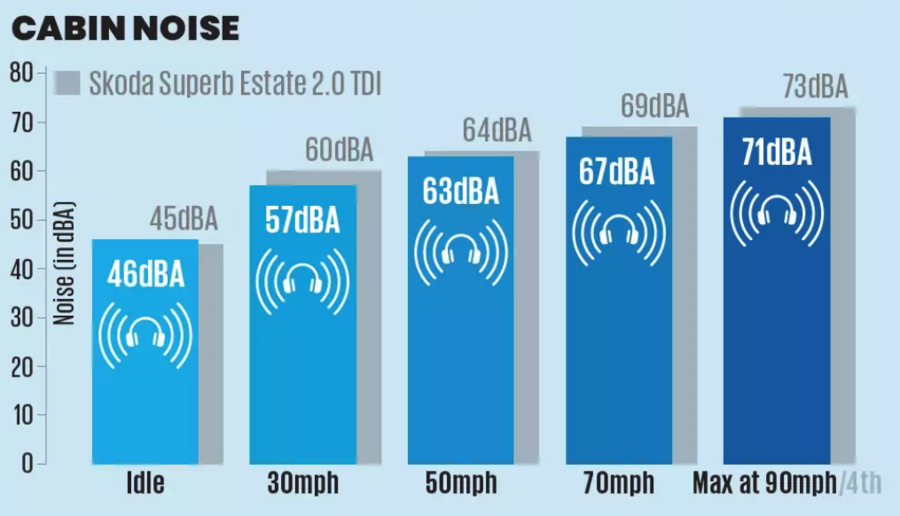
In the end, the Peugeot 308 SW and the VW Golf Estate (now only available from stock, note) are on another level of composure and cohesiveness, never mind the Superb or any of the premium German brands. Ultimately, the Seal 6 DM-i leans heavily on its quietness. And it is indeed quiet: our microphone readings shouldn't be taken at face value because of the wet track.
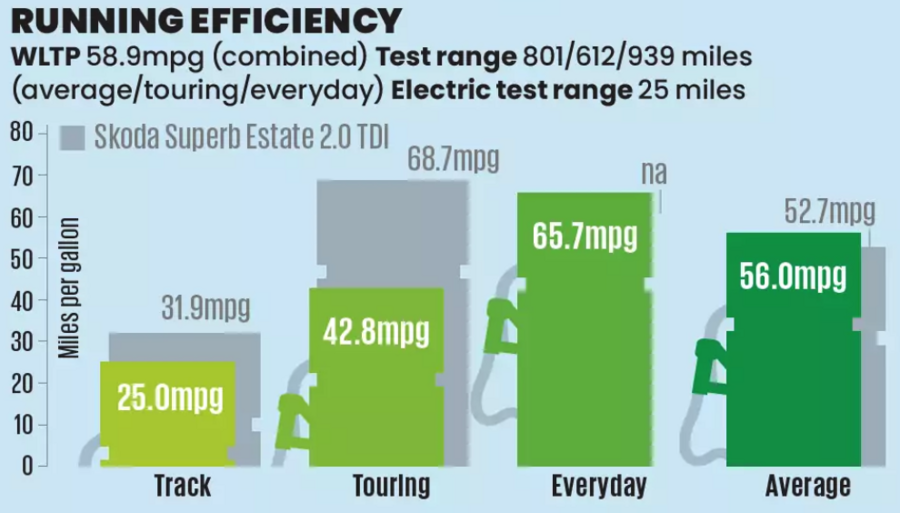
Assessing the car's efficiency isn't that straightforward. While you can set a desired level of charge for the battery via the display, which the powertrain will then use combustive energy to reach, you can't command the car to operate in range-extender/parallel hybrid mode exclusively and maintain the existing state of charge. Furthermore, attempt to run the battery clean out and the engine will fire up at around 20% charge. The following figures were therefore taken with our best efforts to keep the car in REx mode, though it did slip into pure electric running from time to time. Fortunately the car can give you an 'equivalent' economy figure in miles per gallon.
In our 'everyday' driving test, the Seal 6 DM-i returned 65.7mpg, for a range of 939 miles. For motorway cruising, that figure fell to 42.8mpg, for a still-impressive range of 612 miles. The test average of 56.0mpg translates to 801 miles. To these figures you can add the range achievable on a battery fully charged from the mains. Expect in the region of 25 miles for the Boost and 50 or so for the Comfort. In our experience, on a mile-for-mile basis the PHEV Superb is more efficient. Even so, it all adds up to make this BYD an extremely long-legged car. Again, private hire drivers will love it for the efficiency and convenience.
The version with the larger battery can charge at only 6.6kW on AC power, whereas many rivals support 11kW. It can DC fast-charge at 26kW, though.Illya VerpraetRoad Tester
As for company drivers, the Comfort, with its larger battery and lower $CO_2$ attracts just 9% tax. That rises to 18% for the Boost version, owing to its $CO_2$ rating of 60g/km. Meanwhile, charging is a mixed bag. The larger-battery model can hit only 6.6kW from an AC source, compared with the 11kW most rivals can manage. However, it can DC fast charge at 26kW, which is a surprising trick for a car of this ilk, if also one that will rarely be deployed. The 10.1kWh Boost has no DC charging capability and tops out at 3.3kW. Mind you, that is still enough to get an overnight charge:15-100% takes only three hours.
Prices start at £34,990 for the Boost, rising to £36,990 for the Comfort. For a car of comparable size and powertrain versatility, there is no alternative at this price, and in many ways this will represent a mission accomplished for BYD. The Skoda Superb 1.5 TSI iV starts at £41,575 while Peugeot's PHEV 308 estate is more closely matched on price but is smaller.
Despite its somewhat bland appearance, the Seal 6 Touring is one of the more interesting cars we will test this year. Here is a large estate that can be driven as an EV day to day, and indeed feels like an EV to drive, yet has an ultimate autonomy of around 900 miles because of its pseudo-range-extender powertrain. It also costs considerably less than the Skoda Superb Estate - its most obvious rival - in an equivalent spec and even undercuts cars in the class below.
This BYD might not be an obvious choice, but it is one worth considering. It isn't without caveats, however. While free of major irritations (driver monitoring ADAS aside), it has neither the ride comfort nor the intuitive drivability of alternatives from the VW Group and elsewhere. For our liking, the performance is also a bit too steady given the potential of the EV motor.
As a road tester, Illya drives everything from superminis to supercars, and writes reviews and comparison tests, while also managing the magazine’s Drives section. Much of his time is spent wrangling the data logger and wielding the tape measure to gather the data for Autocar’s in-depth instrumented road tests.
He loves cars that are fun and usable on the road – whether piston-powered or electric – or just cars that are very fit for purpose. When not in test cars, he drives an R53-generation Mini Cooper S or a 1990 BMW 325i Touring.
James is a special correspondent for Autocar, which means he turns his hand to pretty much anything, including delivering first drive verdicts, gathering together group tests, formulating features and keeping Autocar.co.uk topped-up with the latest news and reviews. He also co-hosts the odd podcast and occasional video with Autocar’s esteemed Editor-at-large, Matt Prior.
For more than a decade and a half James has been writing about cars, in which time he has driven pretty much everything from humble hatchbacks to the highest of high performance machines. Having started his automotive career on, ahem, another weekly automotive magazine, he rose through the ranks and spent many years running that title’s road test desk. This was followed by a stint doing the same job for monthly title, evo, before starting a freelance career in 2019. The less said about his wilderness, post-university years selling mobile phones and insurance, the better.
Richard is Autocar's deputy road test editor. He previously worked at Evo magazine. His role involves travelling far and wide to be among the first to drive new cars. That or heading up to Nuneaton, to fix telemetry gear to test cars at MIRA proving ground and see how faithfully they meet their makers' claims.
He's also a feature-writer for the magazine, a columnist, and can be often found on Autocar's YouTube channel.
Highlights at Autocar include a class win while driving a Bowler Defender in the British Cross Country Championship, riding shotgun with a flat-out Walter Röhrl, and setting the magazine's fastest road-test lap-time to date at the wheel of a Ferrari 296 GTB. Nursing a stricken Jeep up 2950ft to the top of a deserted Grossglockner Pass is also in the mix.