

All Atlas deployments are already fully committed for 2026, with fleets scheduled to ship to Hyundai's Robotics Metaplant Application Center and Google DeepMind in the coming months. This isn't vaporware. This isn't another Tesla Optimus embarrassment with a guy in a morphsuit. Hyundai Motor Group plans to mass produce humanoid robots in Georgia and put them to work helping real humans build cars in the same factory. Production. Not prototypes. Not concepts. Actual deployment starting in 2028.
What Atlas Actually Does
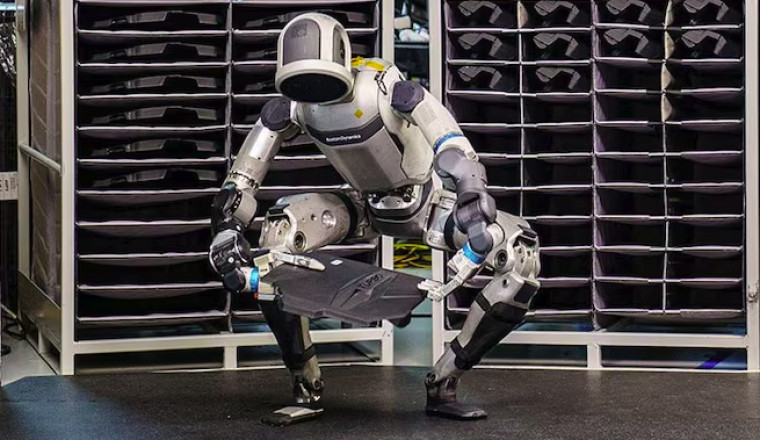
In October, a 5 foot 9 inch, 200 pound Atlas was put to the test at Hyundai's new Georgia factory, where it practiced autonomously sorting roof racks for the assembly line. Not welding. Not precision assembly. Sorting roof racks. By 2030, Atlas robots will be trained to assemble vehicle components. Over time, they'll take on more complex jobs that involve repetitive motions and heavy loads, making work safer and less taxing for factory employees.
The capabilities are real. Its limbs have a reach of about 7.5 feet and lift up to 110 pounds. The robot can operate in temperatures ranging from minus 4 degrees Fahrenheit to 104 degrees Fahrenheit. The robot can be controlled in three different ways: fully autonomous mode, with an operator using hand controls, or using a tablet to direct its actions.
Why Humanoid? Factories Are Already Automated
Here's the critical question: automotive factories already use thousands of robots. BMW's Spartanburg plant has robotic welding. Mercedes uses automated assembly lines. Tesla's gigafactories are famous for automation. So why do you need a humanoid robot specifically?
Scott Kuindersma, head of robotics research at Boston Dynamics, said a lot of this has to do with how we're going about programming these robots now, where it's more about teaching and demonstrations and machine learning than manual programming. Traditional industrial robots are bolted to the floor, programmed for specific tasks, and require complete production line redesigns when products change.
Atlas is different. Wearing a virtual reality headset, machine learning scientist Kevin Bergamin took direct control of the humanoid and guided its hands and arms through each task until Atlas succeeded. That generates data that we can use to train the robot's AI models to then later do that task autonomously. Once one was trained, they were all trained. Teach one Atlas to sort roof racks. Every Atlas globally gains that capability immediately.
The humanoid form factor matters because factories are designed for humans. We would like robots that could be stronger than us or tolerate more heat than us or definitely go into a dangerous place where we shouldn't be going. You don't need to redesign workstations, doorways, or assembly lines. Atlas walks through the door like a person. Picks up tools designed for human hands. Operates in spaces built for human dimensions.
This Is Real, Not Sensationalism
The roadmap includes a plan to manufacture 30,000 Atlas humanoid robots a year by 2028 at its sprawling high tech Metaplant near Savannah and then integrate them into its factories and warehouses worldwide. Thirty thousand units annually. That's not a pilot program. That's industrial scale production.
From 2028, Atlas will be introduced into workflows with demonstrated safety and quality gains, such as parts sequencing. By 2030, deployments are expected to expand to component assembly and, over time, to repetitive, heavy, and complex operations across entire production sites. Phased rollout over years. Start simple. Add complexity gradually. This is how serious companies deploy new technology, not how hype machines operate.
Boston Dynamics said it deployed more than 500 robots in 2025, generating around $130 million in revenue across Spot quadrupeds and the Stretch trailer loading system. They're already shipping profitable robots. Atlas isn't their first rodeo.
Compare that to Tesla. Remember when Elon Musk predicted that there would be thousands of Optimus robots at Tesla factories by the end of 2025? Well, that didn't happen. Not only did that not happen, but Musk's claim Tesla would produce 5,000 to 10,000 Optimus robots in 2025 butted up hard against the embarrassing reality that Optimus isn't only behind the curve, but likely doesn't have any autonomous capabilities at all.
The Google DeepMind Factor
Boston Dynamics announced a partnership with Google DeepMind that aims to integrate cutting edge Google DeepMind foundation models into Atlas to give the robot greater cognitive capabilities. This changes everything. Carolina Parada, head of robotics at Google DeepMind, said tasks that require certain sensors the robot doesn't have are still limited, but the robot can learn almost anything you can consistently demonstrate through teleoperation.
Collecting real world data is expensive, so DeepMind is exploring methods that allow Atlas to learn without needing to see every object in advance. That's the breakthrough. Current robots need to be programmed for every specific part, every specific task. AI powered Atlas learns generalized manipulation. Show it how to handle one type of component. It figures out how to handle similar components without additional programming.
Data collected from Hyundai factories will feed the RMAC (Robot Metaplant Application Center), creating a controlled environment for Atlas to train on complex tasks. Every factory becomes a training ground. Every task performed generates data. Every Atlas improves because of collective learning. That's fundamentally different from traditional automation.
What This Actually Means
Boston Dynamics CEO Robert Playter said the really repetitive, really backbreaking labor is really going to end up being done by robots. But these robots are not so autonomous that they don't need to be managed. They need to be built. They need to be trained. They need to be serviced.
This isn't replacing workers wholesale. Hyundai frames this effort as human centered automation: robots take on labor intensive or high risk work, while people retain control, training systems, supervising operations, and defining how automation is applied. The humans shift from doing repetitive physical work to training and managing robots that do that work.
Will jobs disappear? Obviously some will. At first, they'll work on tasks with proven safety and quality benefits, such as parts sequencing. Those sequencing jobs won't exist for humans anymore. But Hyundai plans to invest 125 trillion won in South Korea over the next five years in AI, robotics, and other technologies, along with $26 billion in the U.S. through 2028. That's infrastructure requiring workers, robot maintenance requiring technicians, AI training requiring specialists.
The Competition Is Real
Tesla is developing its Optimus robot, Chinese EV maker Xpeng has unveiled its Iron humanoid, and Toyota operates an advanced robotics program and in 2024 partnered with Hyundai to accelerate development. BMW is testing Figure AI's robots. Mercedes invested in Apptronik. Every major automaker recognizes this technology matters.
This generation of Atlas significantly reduces the amount of unique parts in the robot, and every component has been designed for compatibility with automotive supply chains. With Hyundai Motor Group's backing, we will achieve the best reliability and economies of scale in the industry. Using automotive supply chains to build robots means costs drop dramatically. Economies of scale kick in. What costs millions per unit today costs tens of thousands at volume.
Is This Sensationalism?
No. This is the logical evolution of industrial automation. Factories are already extensively automated. But that automation is inflexible, expensive to reconfigure, and limited to highly structured tasks. Humanoid robots bring flexibility. They work in spaces designed for humans. They learn tasks through demonstration rather than programming. They improve collectively through shared learning.
Are factories devoid of humans? Not remotely. Walk through any automotive plant. You'll see thousands of workers alongside robotic welders and automated conveyors. The humans do final assembly, quality checks, problem solving, and anything requiring judgment or adaptation. Robots do repetitive, dangerous, physically demanding tasks.
Atlas expands what robots can handle while maintaining human oversight. It's evolutionary advancement, not revolutionary replacement. The hype comes from humanoid form factor and AI capabilities making robots more versatile than before. But the underlying goal remains constant: automate dangerous, repetitive work while humans handle complexity and oversight.
There are no humanoids that do most of the routine tasks that people do in their daily lives nearly as well as a person. Atlas can't pour coffee competently. It can lift 110 pounds repeatedly for hours without breaks, in temperatures humans can't tolerate, with precision humans can't match after the hundredth repetition. That's the advance. Not replacing humans. Augmenting what automated systems can do in human designed spaces.
Sensationalism would be claiming Atlas eliminates factory workers. Reality is Atlas sorts roof racks starting in 2028, expands to component assembly by 2030, and slowly takes over physically demanding tasks while creating new roles for robot trainers, maintenance technicians, and system supervisors. That's not exciting enough for headlines. But it's what's actually happening.