
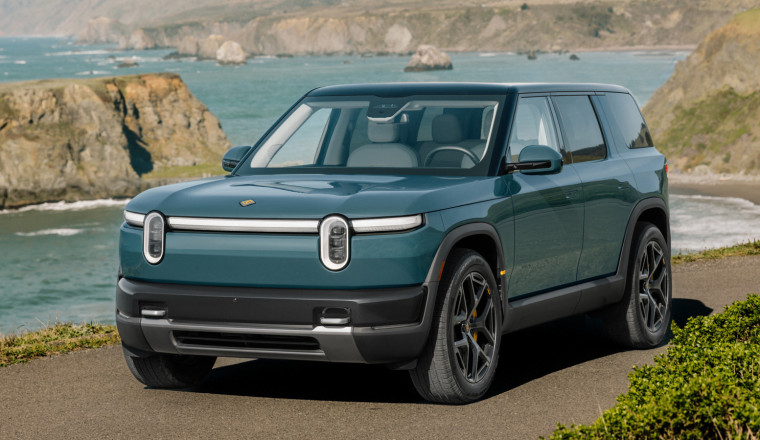

Back in 2024, Rivian unveiled the R2, a smaller and more affordable (but no less adorable) crossover slotting under the R1 lineup. It's hard to overstate how important the R2 is for the American startup. Mid-size SUVs are one of the most popular segments both in the U.S. and everywhere else, and our market is primed for a truly great electric entry. When the R2 was first revealed, Rivian said it would get over 300 miles of range, start at $45,000 and go into production in the first half of 2026. Of course, in 2024 the automaker was only presenting prototypes and preliminary figures, and it still had years' worth of testing to do, and we've all learned to be wary about promises in this industry.
We're now halfway through the first half of 2026, and Rivian is ready to share (almost) all of the specs and details about the R2. And wouldn't you know it, Rivian seems to have delivered on its promises. The R2 has a max range of 345 miles, the base model will start at less than $47,000, and the first customers will get their SUVs within the next few months — the R2 is available to order now, and Rivian says deliveries will start in the spring, which we're already in.
 Rivian
Let's start by talking about the dual-motor Performance model, as that will be the first one to reach customers this spring. Rivian says it has 656 horsepower and 609 pound-feet of torque, only slightly less than a dual-motor R1S Performance, and it'll hit 60 mph in a scant 3.6 seconds. That's slower than Rivian's initial claim of under 3 seconds, but there will almost certainly be a tri-motor R2X model down the line. EPA-estimated range for the R2 Performance is up to 330 miles, and with the Launch Package included it'll come in at $59,485 including the $1,495 destination charge. Going on sale late this year will be the dual-motor Premium, which makes do with 450 hp and 537 lb-ft and is a second slower to 60 mph. It'll also have an EPA range of 330 miles, and a starting price of $55,485.
In early 2027 (as a 2028 model) you'll be able to get the rear-wheel-drive Standard, which has a single motor putting out 350 hp and 355 lb-ft that'll send the R2 to 60 mph in 5.9 seconds. It's the one you want for the longest range, as Rivian estimates it'll get up to 345 miles out of a charge. The R2 Standard comes in just under fifty grand, costing $49,985 including destination.
Those three models all share the same 87.9-kWh battery pack, but in late 2027 Rivian will be adding a fourth R2 trim, a Standard but with a smaller battery. There aren't details on the pack yet, but its motor output and acceleration performance will be the same as the long-range Standard model, and it'll still have over 275 miles of range. Rivian says it will start at $46,495.
All four versions of the R2 have an NACS port on the left rear quarter panel (and come with a CCS adapter, don't worry). We don't know the maximum fast-charging capability, but Rivian says the R2 can go from 10% to 80% in less than 30 minutes. Every powertrain setup will be offered with a towing package that will let the R2 tow up to 4,400 pounds. Coincidentally, that means the R2 will almost be able to tow another R2 — Rivian says it weighs nearly 2,000 pounds less than an R1S, which should put it at around 4,600 pounds, though specific figures aren't available yet. Instead of sharing the R1 platform, the R2 is built on a new architecture that'll also underpin the R3.
 Rivian
So, powertrain aside, what do you get for your money? The R2 Standard comes with four drive modes (All-Purpose, Conserve, Snow and Sport), 19-inch wheels, a 12-way power driver's seat with lumbar and an 8-way power passenger seat, heated front seats and a heated steering wheel, and a 525W sound system with 5 speakers and 2 midwoofers. Rivian's Autonomy+ hands-free Level 2 driver-assist system is optional on every R2, either for $49.99 per month or a $2,500 one-time fee. Every new R2 gets a free 60-day trial of it.
Moving up to the all-wheel-drive Premium adds an All-Terrain drive mode, 20-inch wheels, matrix LED headlights with adaptive high beams, the much-hyped powered drop-down liftgate glass, integrated tow hooks, a fancier interior with birch wood trim and softer textiles, ventilated front seats and heated rear outboard seats, a flashlight in the driver's door, 12-way adjustability for the passenger seat, and a 975W premium audio system with 9 speakers, 2 midwoofers and 2 subwoofers.
Finally, the Performance gets 21-inch wheels, semi-active suspension, Compass Yellow brake calipers and badges, and a few more drive modes: Rally, Soft Sand, and Sport. Oh, and a launch control mode, too. Available on the Performance, ostensibly for the first year only (though Rivian just calls it "limited edition"), is the Launch package. It includes the tow package, Autonomy+ for life, an anodized key fob in Rivian Green, and the option of getting Launch Green paint.
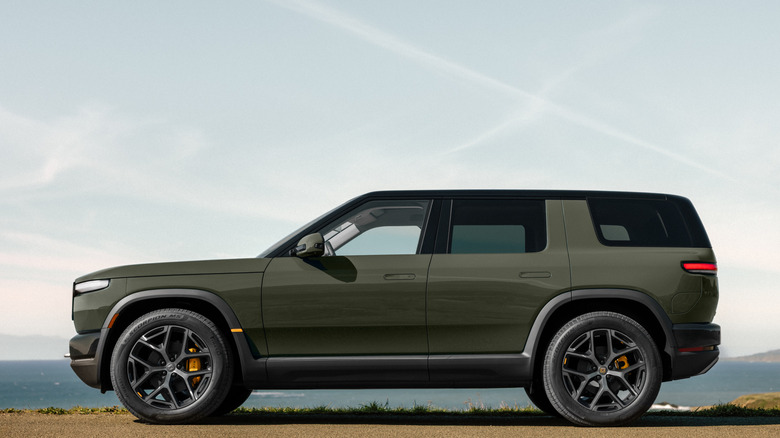
Speaking of paint, the only color that's a no-cost option is Esker Silver. The R2 Standard is also available in Forest Green, Glacier White, Half Moon Grey and Midnight, while the Premium can be had in those plus the lovely Catalina Cove blue. But easily the best R2 color is Borealis, a metallic purple only offered on the Performance. Sadly there's only two interior color schemes, either Black Crater or the Coastal Cloud off-white. There are four different wheel designs, with one of the 20-inch options being wrapped in BF Goodrich all-terrain tires (the rest wear Pirelli all-seasons); Rivian says every wheel and tire package shares the same 32-inch overall diameter.
 Rivian
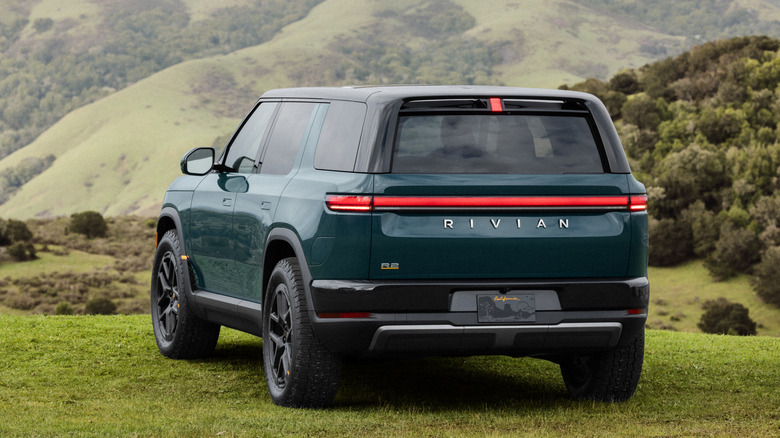
The production R2's design is exactly what we saw in prototype form two years ago, but now we have all the dimensions. The R2 is 185.9 inches long, 75.0 inches wide and 66.9 inches tall; that makes it 14.9 inches shorter in length, 4.3 inches narrower and 10.4 inches shorter in height than an R1S, and its 115.6-inch wheelbase is 5.5 inches shorter than the R1's. Every R2 has 9.6 inches of ground clearance, a tenth more than a new Subaru Outback Wilderness, and it can handle a wading depth of 19.7 inches, but unlike on the R1 models there's no height-adjustable suspension. Rivian says its approach, departure and breakover angles are 25 degrees, 26 degrees and 20.6 degrees, respectively.
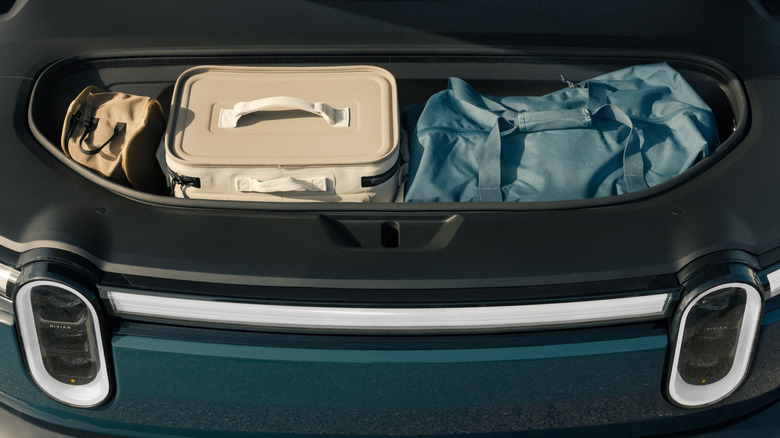
With the rear seats in place you get 28.7 cubic feet of cargo space, which Rivian says is enough for two extra-large checked suitcases, plus several backpacks and a stroller, and there's extra space underneath the load floor that can fit a carry-on suitcase. Fold the second-row seats completely flat and that space expands to 79.4 cubic feet, and it seems like Rivian will sell a mattress pad accessory to take advantage of that. The 5.2-cubic-foot frunk can fit six grocery bags or a carry-on suitcase and a backpack, and you also get two gloveboxes inside, one in the typical spot and another under the center screen. It has class-leading interior room according to Rivian, and while we don't have full specs, the automaker says there's 40.9 inches of headroom in front and 40.4 inches in the rear, and 41.4 inches of front legroom with 40.4 inches in back.
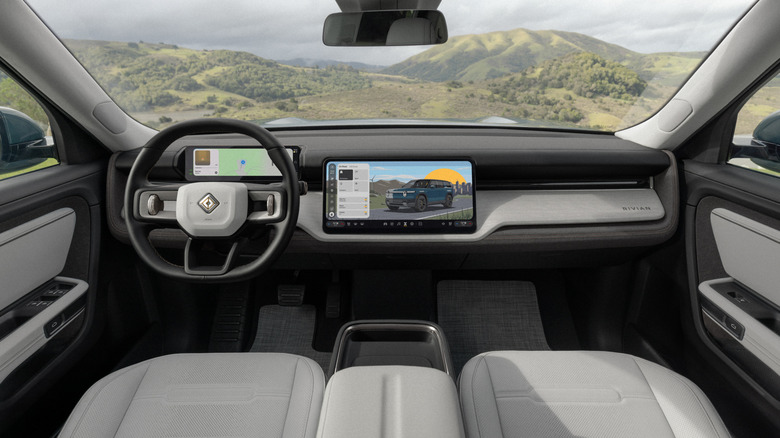
The R2's dashboard will look familiar to anyone who's driven a Rivian, with a pair of large screens running a phenomenal cel-shaded infotainment system, a wonderful mix of materials and textures, and lots of thoughtful design details and ergonomic touches — there's even a removable USB-C power bank that doubles as a hand warmer. The biggest new element are the haptic halo wheels on the steering wheel. Says Rivian: "These dynamic and context-aware controls—capable of scrolling, pushing, pulling and tilting—provide distinct physical responses for multiple functions, bridging the gap between digital software and tactile hardware to keep the driver's focus on the horizon. Both the physical wheels and underlying haptic technology were designed in-house."
 Rivian
Like its current offerings, the R2 will be able to have over-the-air updates for basically aspect of the car, and Rivian says its electrical architecture is streamlined for "more capability with less complexity, providing ample headroom for the future." The car has "200 sparse TOPS of edge AI compute," which I'm sure means something to at least one of you, that will power Rivian's upcoming in-car voice assistant that'll work even when the car is offline. 11 HDR cameras (with 65 MP total) and five radar sensors built into every R2 allow for the Autonomy+ system to be added at any time post-purchase, unlocking the Level 2 hands-free system on 3.5 million roads in the U.S. and Canada. The company didn't say specifics, but it seems like every other driver-assist feature you can think of will come standard.
Though Rivian originally planned for the R2 to go into production at its new factory in Georgia, those plans have been pushed back to 2028, so it'll instead be built at the company's existing plant in Normal, Illinois. The company has said the Normal plant will be expanded to have an annual production capacity of 215,000 cars, of which 155,000 could be the R2. While the R1 had a fairly slow ramp up (and still doesn't sell in huge numbers), the R2 should be a different story. As TechCrunch reports, Rivian is gearing up for this to be one of the fastest EV launches ever, with a target of around 20,000 to 25,000 R2s sold this year.
You can reserve an R2 on Rivian's website now, but sadly we'll still have to wait a little while for the configurator to go live. Reservations cost a refundable $100.