
In customer clinics where Subaru showed regular-degular people the 2026 Trailseeker, most of them apparently guessed it was a Subaru even though the badges were covered up, according to the automaker. Pull quotes with descriptors given by said customers like "rugged and adventurous" and "spacious and versatile" are shown to us during Subaru's morning presentation on our drive day for the brand's new electric wagon, followed by lots of psychographic data about how genuinely outdoorsy, environmentally conscious and pet-loving its buyers are. Subaru clearly knows its customers, especially in this segment.
Unlike the Subaru Solterra/Toyota bZ and Subaru Uncharted/Toyota C-HR, the development and engineering of which Subaru and Toyota split pretty evenly, Subaru took on the bulk of the work for the Trailseeker and its Toyota bZ Woodland twin, including manufacturing them. Subaru is the master of affordable, off-roady wagons, after all, and with the Outback having grown tallier and boxier there's room for the Trailseeker to come in and snatch up EV-curious folk whether they're long-term Subaru fans or new to the brand. While the Trailseeker isn't that different from the bZ Woodland at the end of the day, this wagon pair do feel the most Subaru-like out of the six EVs, and the Trailseeker's design and lower price give it a definite leg up over the Toyota.
Full disclosure: Subaru invited me to head down to Laguna Beach to spend a day driving the Trailseeker and Uncharted.
 Subaru
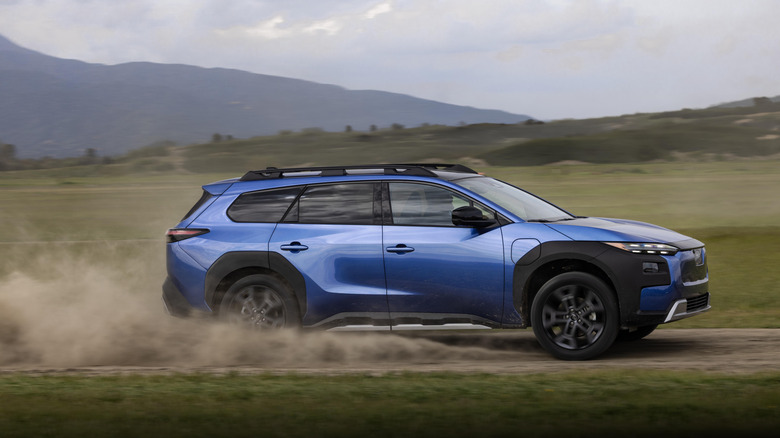
The Trailseeker is essentially a stretched version of the Solterra, with larger body cladding pieces, some faux skid plate elements on the bumpers and side skirts, and a more prominent nose design that, while not faking a grille panel, gives a whiff of a blocky grille. I like both cars, but I definitely prefer the Subaru's more characterful front end styling to the less-expressive Toyota. The majority of the design differences from the Solterra lie behind the C-pillar; the Trailseeker shares the Solterra's 112.2-inch wheelbase, but it's 6.2 inches longer overall. Its taillight bar is the same as the Toyota, but with an illuminated Subaru script that has a nice infinity effect.
I'll give Subaru credit for offering a brown paint option and two different blues — Daybreak Blue Pearl and Sapphire Blue Pearl, which are pretty close to each other — but the rest of the color palette is just grayscale. Come on, Subaru, make the Trailseeker available in the Uncharted's bright orange! Or green, at least.
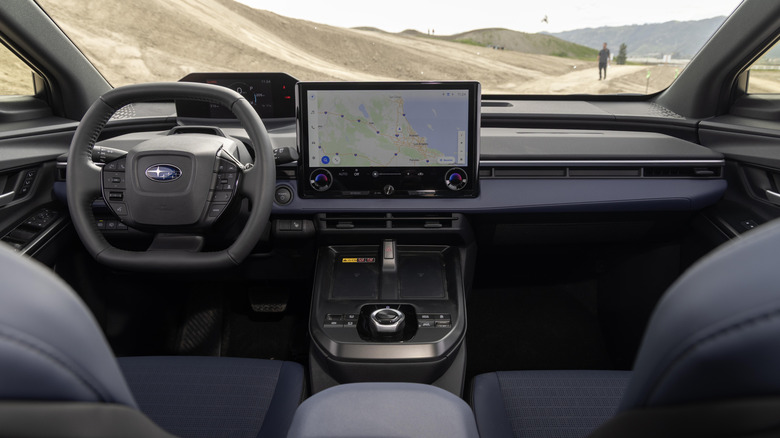
But the best bit of color is on the inside. For the most part, the Trailseeker's cabin is identical to the bZ Woodland, and thus the other EVs from the same litter. Like with the Uncharted, its steering wheel has a flat top and bottom where the bZ Woodland's is perfectly round, and I think I prefer the stranger Subaru wheel. Other than that, and a few slightly different material patterns, what you get in the Subaru is what you get in the Toyota. That is, except for the seat upholstery. Subaru offers actual leather on the Trailseeker, and in addition to black or gray, you can get the leather in blue. Yes, blue! Meanwhile, the bZ Woodland doesn't offer leather at all. That alone should have you running to your local Subaru dealer.
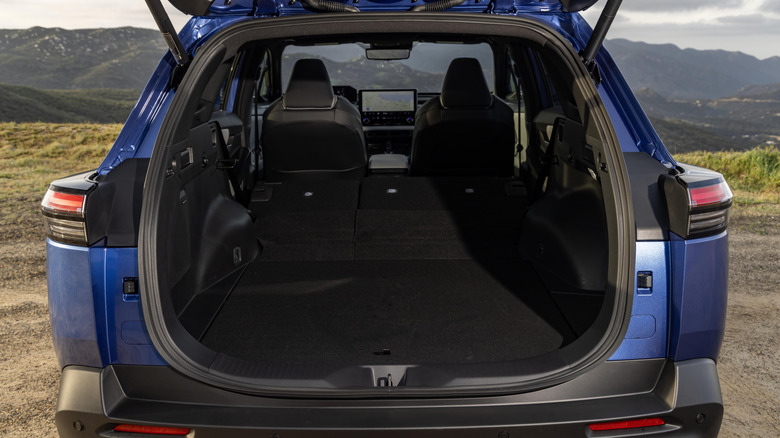
The extended rear end gives the Trailseeker 31.3 cubic feet of cargo space with the rear seats up (almost a cube less with the option panoramic roof), which expands to 74 cubic feet when the 60/40-split rear seatback is folded nearly flat (or 71.8 cubes with the sunroof). That's 7.5 and 10.5 cubic feet more than the Solterra, respectively, and only a few cubes off the slightly longer Outback. The Trailseeker's cargo area height is about four inches taller, and there's more than 8 inches of extra cargo length with the seatbacks up.
 Subaru
All-wheel drive is standard, and as opposed to having a slightly smaller front motor like in the Solterra and Uncharted, the motor on the Trailseeker's front axle is the same size as the one at the rear, giving it more power than the other EVs. Quite a lot of power, in fact. The Trailseeker's dual-motor setup makes 375 horsepower and an untold amount of torque (each motor has a maximum of 198 pound-feet). That'll send it from 0 to 60 mph in a scant 4.4 seconds, quicker than any production Subaru sold in the U.S., including the old STi S209. To bring you down from STI-beating speeds there's five-stage adjustable regenerative braking, but the strongest setting can't do one-pedal driving, and it's not the most linear or predictable system out there.
The Toyota only offers 18-inch wheels with thickly sidewall'd all-season tires, which are also standard on the Subaru, but go for the middle or top trims and you get 20-inch wheels, also with all-seasons that have a more reasonable sidewall. Though it's raining the entire time I'm in the Trailseeker and I'm not really able to give it a try, the 20s should definitely be better for actually putting all that power down — the bZ Woodland felt very undertired on the 18s when cornering even slightly quickly. And it doesn't seem that the 20s really bring about a penalty in ride comfort or interior quietness; the Trailseeker is pretty great in both regards. I prefer the Subaru's heftier steering, and its chassis setup feels a bit tauter than the Toyota's. It's a perfectly nice, ever-so-slightly sporty driving experience that's easy to settle into, and a definite step up from a Crosstrek or Forester.
Its biggest downsides are the same as all of its siblings: Range and charging performance. The Trailseeker's 74.7-kWh battery pack returns a very meh range of 281 miles with the smaller wheels or 274 miles with the bigger ones, and it'll only DC fast-charge at up to 150 kW, which can take it from 10% to 80% in 28 minutes. That'll surely be just fine for most buyers, but it's still disappointing in a world where there are other affordable EVs that can accept double the charging power. It has a battery preconditioning function and a heat pump, at least, so cold-weather performance shouldn't be too bad.
 Subaru
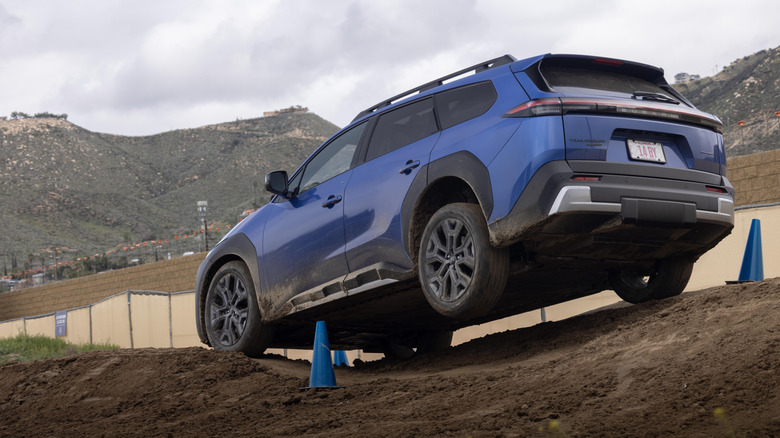
On the bZ Woodland drive we took the crossovers on a long dirt road snaking up a mountain, and it was a piece of cake, so I expected the same as I pull up to the dedicated off-road course that Subaru has set up for us. We do a lap of the muddy track in Trailseekers with the 20-inch wheels, and there's not a single moment where it struggles for traction or feels unsuited for the ruts, dips, steep inclines and banked surfaces. Subaru's pair of X-Mode drive modes (Snow/Dirt and Deep Snow/Mud) are standard, along with hill-descent control and the useful Grip Control low-speed crawl function. It'll be more than capable enough for most regular people, but if it doesn't sound like enough for you, there's almost certainly a Wilderness model coming down the pipeline.
The Trailseeker has two-tenths of an inch more ground clearance than a Solterra for a total of 8.5 inches, which itself is only two tenths off the standard Outback. Its total height is almost an inch taller — chalk a lot of that up to the standard roof rails, which Subaru says are an extremely important feature for 35% of its buyers. They'll handle a static load of up to 700 pounds or a dynamic load of 176 pounds, and if that's not enough, the Trailseeker can tow 3,500 pounds.
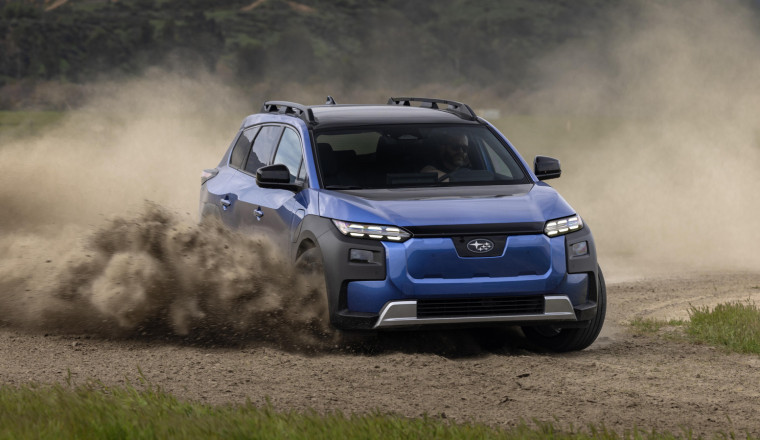
Though we don't get to do any drifting or rally-style driving, Subaru's press photos show Trailseekers doing just that, and the company took a refreshing stance on its powertrain tuning. Ex-WRC rally engineers worked on the Trailseekers development team, and they made sure that the car's traction and stability control systems won't cut in if you're staying on the throttle when the car loses traction. Combine that with the aforementioned three-hundred-and-seventy-five horsepower, and the Trailseeker should be pretty fun if you want to do some Ken Block–inspired hooning.
 Subaru
The Trailseeker's base Premium trim doesn't have a bZ Woodland equivalent, while the Limited and Touring are aligned with the Toyota's two trims. The Trailseeker Premium starts at $41,445 including $1,450 for destination, an upcharge of only $1,500 over a base Solterra. For that price you get a 14-inch touchscreen with a great Toyota-derived infotainment system and wireless Apple CarPlay and Android Auto, that strangely positioned 7-inch gauge cluster screen, a pair of wireless chargers, a power tailgate, keyless entry and pushbutton start, ambient interior lights, heated and power-adjustable front seats with lumbar and memory for the driver, heated power-folding mirrors, automatic (and heated) windshield wipers, LED headlights with washers, and auto up/down front and rear windows. You also get Subaru's whole EyeSight suite of driver-assist features, but the traffic-jam assist with hands-free driving under 25 mph requires a subscription that also includes navigation.
At $45,445 to start, the Trailseeker Limited is $1,305 less than the base bZ Woodland. It adds the 20-inch wheels, a Harman Kardon sound system that's better than the Toyota's optional JBL setup, and then a bunch of features also on the Toyota: a kick sensor for the tailgate, heated rear seats, a heated steering wheel, memory for the mirrors, a 1500W 120v outlet in the cargo area, digital key compatibility and a 360-degree camera system with off-road views. The $48,005 Trailseeker Touring is $845 cheaper than the higher-end bZ Woodland trim, adding the same digital rear view mirror, panoramic glass sunroof (with a powered shade!), radiant leg heaters and ventilated front seats. The Limited also opens up the option of leather upholstery and two-tone paint.
Like I said in my bZ Woodland review, there aren't really any competitors for these cars right now. I mean, are you shocked that no other companies have leapt into the electric wagon field? Subaru does say that more than a third of its customers would consider buying an EV, and across the board Subaru owners take their crossovers off-road more than anything else in their segments, especially when looking at the Solterra and Crosstrek. The 2026 Trailseeker slots neatly into the Subaru lineup, and it feels like it deserves the six-star badge. I can see it being an easy hit for Subaru, especially if the ads have dogs in them — 45% of Subaru buyers own dogs, after all, with that number rising to 52% for the Solterra.