


You drive past a 15 mph sign on a road you use every week. Your brain logs it, files it under "slow down a bit," and moves on before you have consciously processed the number. You have driven that road fifty times. The sign is furniture.
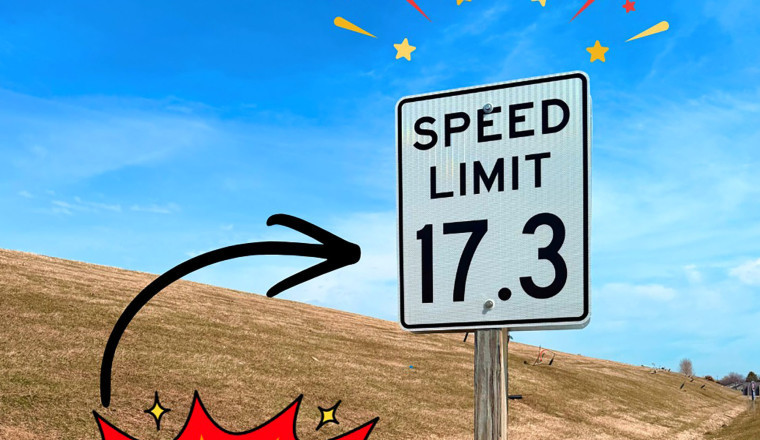
Now imagine the sign says 17.3 mph.
Something in the back of your head trips. That is not a round number. Is that a typo? Are they serious? You look again. You slow down. You are, for a moment, actually paying attention.
That is the entire theory behind what the Outagamie County Recycling and Solid Waste facility in Appleton, Wisconsin, has done. In a Facebook post that has now ricocheted around American media, the facility explained its decision plainly: "Why 17.3? Because it makes you pause. It makes you look twice."
The site processes a constant flow of haulers, contractors, and local residents. Heavy trucks and ordinary cars sharing the same access road, on a route that most users drive regularly enough to stop seeing it. Officials wanted everyone slowed down and alert. A standard limit, they concluded, was not going to do that. So they chose a number nobody could ignore.
"We want every single person to have a safe visit and make it home at the end of the day," the facility said. "Staying alert is key to keeping everyone safe."
The brain science behind it
There is a name for what the county is fighting. Habituation is the process by which the brain deprioritises information it has already processed and filed. A 25 mph sign on a road you drive every day becomes invisible in the same way that your own breathing becomes inaudible. You see it, your brain categorises it as already known, and no conscious attention is paid.
Decimal point speed limits attack habituation directly. The brain cannot file 17.3 mph in the same drawer as all the round numbers it has memorised. It has to stop and read it. That pause, however brief, is the intervention.
Wisconsin is not the first place to try this. Colorado Springs, Colorado, has a shopping centre with a posted speed limit of 8.2 mph that has baffled and amused Reddit for years. Nobody drives through it on autopilot.
Like this? Get the app: iOS | Android
Does it actually work?
Here is where the honest answer complicates the clever idea.
A 2024 study by Minnesota state and local transportation agencies found that simply lowering a speed limit does very little to reduce actual vehicle speeds. Drivers calibrate to what feels right on a given road, not to what a sign says. Changes to physical road design... speed bumps, roundabouts, narrowed lanes, raised crossings... are consistently more effective than changing the number on a sign.
A 17.3 mph sign might generate a double take. Whether it generates a genuine reduction in vehicle speed, compared to a physical intervention that makes going faster feel uncomfortable, is a different question. Carscoops noted this directly: the novel sign is creative, but transport planners have decades of evidence that the road itself is a more reliable teacher than the signs beside it.
The Outagamie County facility has not released data on whether the sign has changed speeds at the site. It is also unclear whether any specific incidents prompted the change, or whether it was a proactive decision. The county did not respond to media enquiries on that point.
The wider conversation this opens
Speed limit enforcement in the United States is, in practice, largely voluntary. Limits on private facility roads like this one carry no legal enforcement mechanism equivalent to a public road. The 17.3 mph sign communicates an expectation; it cannot generate a fine. The bet being placed is entirely on psychology.
That bet may not be entirely wrong. Novelty has measurable effects on attention. A sign that makes you look twice is better than a sign you do not see at all. The question is how long novelty lasts. The first time you see 17.3 mph, you notice it. The fiftieth time, it may have become as invisible as the 15 mph sign it replaced.
Road designers in the UK, Netherlands and Scandinavia have increasingly moved toward physical interventions precisely because the evidence on signage alone is thin. Shared space design, raised surfaces at junctions, and visual narrowing of lanes all reduce speeds more reliably than a number on a post.
None of which changes the fact that 17.3 mph is genuinely funny, clearly intentional, and probably the most attention any recycling facility's access road has ever received. Wisconsin officials set out to make drivers notice a speed limit sign. Mission accomplished.
Whether anyone is actually doing 17.3 mph as a result is a separate experiment, and nobody appears to be running it.
Sources:
- Carscoops — A 17.3 MPH Speed Limit Sounds Like A Mistake, Wisconsin Says It Isn't
- The Daily Beast — Officials Set Bizarre Speed Limit for Genius Reason
- The Hill — Wisconsin speed limit with decimal point
- WGN-TV — New Wisconsin speed limit has a decimal point. Why?
- WFRV Local 5 — New speed limit featuring a decimal point posted in Outagamie County
- Outagamie County Recycling and Solid Waste — Facebook post