

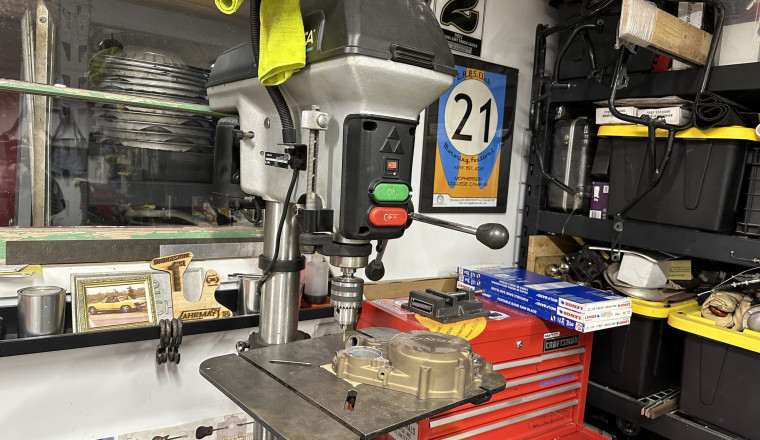

The majority of maintenance done on vintage cars involves assembly and disassembly of completed parts, but occasionally the necessity arises to fabricate or restore a piece. In that case there are few tools as useful as a drill press for creating brackets, removing broken hardware, or helping put in a fresh set of threads.
A drill press allows clamping the workpiece to the table for careful drilling. This is critical when removing broken or stripped bolts without creating collateral damage from a bit that walks off center while drilling. Always secure your workpiece to the table in case a bit bites while breaking through the backside of your material, as a drill press can easily snatch a workpiece and whip it around with little regard for you or other items nearby. Keeping the area around a drill press clear will make it far more convenient to use, and therefore, you will be more likely to turn to it for simple tasks, which can elevate the quality of your work.
Sure, handheld drills exist and are better than ever, but the most annoying part about a drill press is its biggest advantage: It’s big and doesn’t move. In one word, it’s rigid. That lack of flex means accuracy and repeatability, something that can be the difference between scrapping a part and having a repair that will last generations. A bench-top or tall pedestal drill press can be a wonderful asset in any DIY garage.
If you are looking to add a drill press or just tune up the one that’s already in your shop, be sure to inspect the motor, drive pulleys, and spindle bearings for free and easy rotation before setting the belt to the proper pulley combination to achieve the appropriate spindle rpm for the bit and material you are working with. If you have a variable speed model, consider yourself lucky and dial in the perfect speed without fooling with belts.
It’s important to take a moment to align the table with the spindle so the holes drilled are as square as you expect them to be. There is nothing worse than clamping down a part and drilling a hole only to find it was at some goofy angle. Having the table trued up also allows the chuck to be used to start a tap by hand, ensuring the threads are square to the workpiece. Start by unplugging the drill press. Secure the tap in the chuck, the work piece to the table, and turn the chuck by hand to start the tap. Remove it from the drill press to finish tapping. Behold, a hole tapped nice and square with minimal effort.
Many of us got by for years without a drill press, but, like many tools of this scale, once one enters your shop, it rarely leaves unless it is getting replaced. It’s a big tool with a lot of utility, and if you can find space for one, it can solve more than a few problems.
Wait… people don’t have drill presses?! I think I use it more than most my tools; I’d bet money I use it more than the screwdriver set.
I have a bench top and get good use from it.
“A vice is a mandatory accessory for any drill press.”
No, this is not true. A v-i-s-e is a great addition, but a v-i-c-e on your drill press might get you in trouble with law enforcement…