
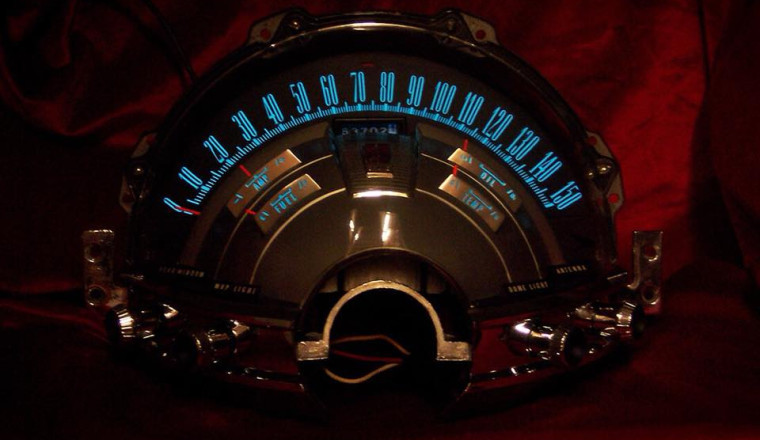

Walk up to a 1964 Chrysler Imperial at night and turn the key. The dashboard doesn't flicker to life like some cheap laptop screen. Instead, the entire gauge cluster begins to glow with an ethereal blue light that seems to emerge from within the metal itself. No hot spots. No shadows. No pixelated edges. Just pure, even illumination that makes every needle and number crystal clear from any angle.
This is electroluminescent technology, and it represents one of the automotive industry's most elegant solutions to a problem that modern car makers still haven't properly solved. While today's vehicles blind you with harsh LED backlighting or strain your eyes with dim OLED panels, these 1960s gauge clusters achieved something remarkable. They created light without heat, uniformity without complexity, and readability that puts contemporary digital displays to shame.
The technology worked through a sandwich of phosphor powder between conductive plates, requiring between 100 and 400 volts of alternating current at frequencies up to 3000 Hz. When energized, zinc sulfide crystals doped with copper or manganese would emit that characteristic cool glow, consuming just 0.1 to 1.0 watts per square inch. Ford engineers discovered they could make entire gauge faces luminous without a single bulb, shadow, or reflection.
Chrysler Corporation led the charge in 1960, installing electroluminescent panels in their premium models. The technology wasn't cheap, but it delivered something no incandescent bulb could match. Every graduation mark, every number, every zone of the gauge face received identical illumination. Read your speedometer from the driver's seat, then slide over to the passenger side. The clarity remained constant because there was no single point light source to create viewing angle problems.
Lincoln Continental models from the mid 1960s took the concept further, creating dashboard environments that felt more like spacecraft control panels than car interiors. General Motors experimented with the technology in Cadillac luxury vehicles, recognizing that electroluminescent displays suggested technological sophistication in ways that conventional lighting simply couldn't achieve.
Like this? Get the app: iOS | Android
The operational advantages extended beyond aesthetics. Electroluminescent panels responded instantly to power, with no warm up time like modern HID systems. They generated virtually no heat, eliminating the thermal management problems that plague today's high intensity LED arrays. With operational lives exceeding 10,000 hours, they outlasted most other electrical components in the vehicle. The thin profile allowed designers to create sleeker dashboard shapes impossible with bulky incandescent housings.
Modern automotive displays, for all their digital sophistication, struggle with fundamental issues that electroluminescent technology solved sixty years ago. LCD screens suffer from uneven backlighting, with bright spots and dim zones depending on LED placement. OLED displays offer better uniformity but burn in over time and cost exponentially more to replace. Even the latest Mercedes S-Class or BMW 7 Series digital instrument clusters create visibility problems in bright sunlight or at extreme viewing angles that would never occur with properly implemented electroluminescent gauges.
The technology did have limitations. Color options remained restricted to blue green and amber tones determined by the phosphor chemistry. Brightness degraded gradually as the phosphor aged, and the panels required careful sealing against moisture. The high voltage inverters needed to drive them added complexity and cost. But these drawbacks pale beside the elegant functionality they delivered.
What killed electroluminescent automotive lighting wasn't superior technology. It was cost cutting and the false promise that digital displays would solve every problem. Manufacturers convinced themselves that programmable screens offering infinite customization justified abandoning proven analog solutions. The result has been decades of dashboard lighting that creates more problems than it solves, with harsh LED arrays that tire your eyes and complex digital interfaces that distract from driving.
Contemporary car makers spend millions developing adaptive brightness systems, anti glare coatings, and viewing angle compensation algorithms to address problems that didn't exist with electroluminescent displays. They've created expensive solutions to problems they created by abandoning better technology. Sometimes the future isn't an improvement. Sometimes it's just different, more complex, and considerably worse at doing the job that mattered most.
Sources: Automotive engineering journals from the 1960s document electroluminescent display implementation, though specific URLs are not available for this historical technology research.