

Many people instantly think of the supercharged fifth-generation small-blocks when they hear someone mention General Motors' LT4 and LT5 engines. However, we shouldn't forget about the original LT4 and LT5 from the 1990s. The original LT4, a second-generation small-block GM engine, debuted (and ended) with the manual-transmission-equipped 1996 Chevrolet Grand Sport — though it also made appearances in the Camaro and Firehawk in 1997. The naturally-aspirated LT4 5.7-liter, with its iron engine block and aluminum cylinder heads, was good for 330 horsepower and 340 lb-ft of torque, placing it among the most powerful Chevy small-block engines ever made.
Meanwhile, the first LT5 — an all-aluminum, 5.7-liter, Gen-II small-block — came out in the 1990 C4 Corvette ZR1 and continued through 1995. Its oldest incarnation was a naturally aspirated, dual-overhead-cam, 32-valve engine developed in conjunction with GM-owned (at the time) Lotus and built by MerCruiser in Stillwater, Oklahoma. That construction allowed it to produce a respectable 375 horsepower with 370 lb-ft of torque. In 1993, improvements to the LT5 increased its power ratings to 405 horsepower and 385 lb-ft of torque.
The are a few main differences between the original LT4 and LT5 engines. This includes the LT4's one-and-done production model usage and engine block material, and the LT5's valve-train featuring overhead cams and four-valves-per-cylinder. There's no doubt that they were advanced powerhouses in the 1990s. However, the power they generate pales in comparison to the fifth-generation small-block LT variants.
 Raymond Boyd/Getty Images
General Motors ushered in the fifth-generation small-block GM engine with the introduction of a new LT1, kicking off another series of LT V8s. The Gen-V LT1 was first installed in the 2014 C7 Chevrolet Corvette, a car GM spent basically nothing to develop. The 2014 C7's naturally-aspirated 6.2-liter LT1 produced around 450 horsepower. An updated LT1 crate engine from GM Performance makes 460 horsepower and costs $12,668.49 — unless it's on sale, shaving roughly $2,000 off of that price.
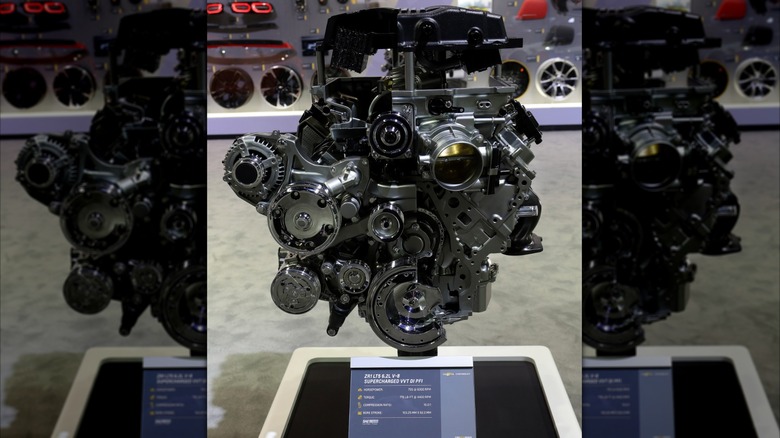
Later, GM installed the all-aluminum LT4 Gen-V small-block in the 2015 C7 Z06 Corvette. With its supercharged induction, the modern LT4 produced 650 horsepower and 650 lb-ft of torque in the Z06. Cadillac used the LT4 in a variety of sporty models, including the CTS-V, CT-5 Blackwing, and Escalade. Chevrolet also used it in the Camaro ZL1, including the Special Edition ZL1 Garage 56 Camaro. If you're so inclined, Chevrolet sells the supercharged LT4 as a crate engine, but it's intended for competition use only.
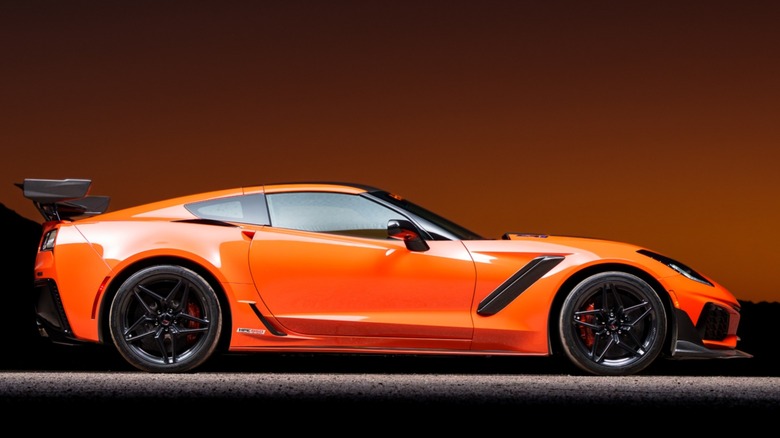
The supercharged Gen-V LT5, with 755 horsepower and 715 lb-ft of torque, debuted underneath the hood of the 2019 C7 Corvette ZR1. It's a rare specimen as it was only available in production vehicles of that model, numbering less than 3,000 units. The LT5 was available as a crate engine from Chevrolet for a time after its production vehicle run, but that also ended abruptly after just a couple of years.
 JoshBryan/Shutterstock
In addition to the different vehicle models and model years, there are some mechanical differences between the LT4 and LT5 Gen-V small-blocks. With the LT5's 105 horsepower advantage over the LT4, you've probably already guessed that it flows better. While both engines use the same rotocast aluminum cylinder heads with 65.47cc combustion chambers, 2.126-inch diameter intake valves, and 1.590-inch diameter exhaust valves, they use different roots-style superchargers.
The Gen-V LT4 gets its forced air induction from an Eaton 1.7-liter supercharger. The Eaton R1740 atop the LT4 delivers between 9.2 and 9.7 pounds of boost pressure through an 87mm throttle body. For comparison, the LT5 uses a 2.65-liter Eaton R2650 to deliver up to 14 pounds of boost through a 95mm throttle body. Production LT4s, other than those found in the manual-shift Camaro ZL1, utilize GM's Active Fuel Management system (AFM) to deactivate half of the cylinders when it can, saving fuel. The LT5 — and manual ZL1 LT4s — do not use AFM, omitting the heavier lifters in favor of lighter-weight hydraulic roller lifters.
Other differences in the fuel delivery system include the LT5's 16 fuel injectors compared to the eight injectors found on the LT4. Both engines use the same primary injectors, with one in each cylinder. The LT5's additional port injectors introduce fuel farther upstream, closer to the supercharger, when the primary system cannot provide enough fuel. The LT5 also uses a stronger crankshaft with special tri-metal main bearings. Lastly, the LT5's supercharger drive belt has 11 ribs compared to the 8-rib belt used on the LT4.