

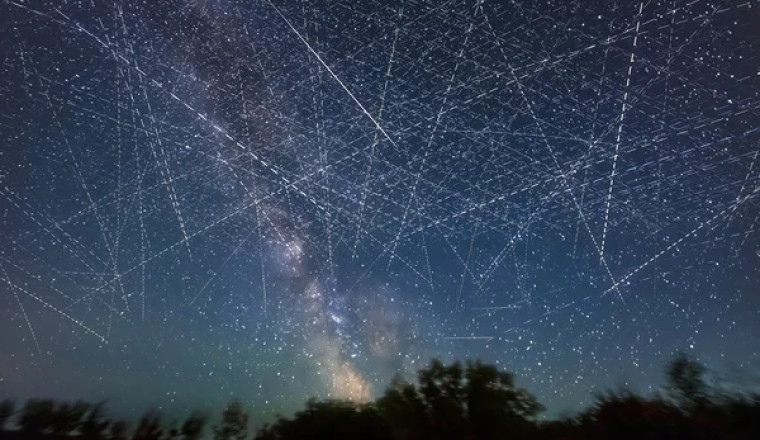

If you live in a city you probably have no idea this is happening. Light pollution has already stolen the stars from most of the world's urban population. But out here on a farm in New Zealand, where the sky goes properly dark and the Milky Way sits overhead like something from another era, I have watched Elon Musk methodically wreck one of the last things on this planet that belonged to everyone.
A few years ago, lying on a blanket in a paddock, you could spot the occasional satellite drifting across the sky. One, maybe two, in a clear hour. That was part of the experience. A quiet little reminder that humans had reached into space. Now I look up and the sky moves. Not metaphorically. There are so many satellites crossing the sky at any one time that the effect is genuinely unsettling, a slow restless mesh of moving light that never stops.
As of March 2026, SpaceX had launched roughly 11,400 Starlink satellites, with around 9,900 in orbit and approximately 8,300 actively operational according to satellite tracking data compiled by astronomer Jonathan McDowell. Starlink now comprises 65 per cent of all active satellites on Earth. Sixty five per cent. That is one man's company occupying the sky.
And the plan is to keep going. SpaceX already has FCC authorisation for up to 42,000 satellites. In February 2026, SpaceX filed an application with the FCC to deploy one million satellites in low Earth orbit, framed as a network of space based AI data centres. To put that number in context: before Starlink launched its first batch in 2019, there were around 2,000 satellites total in orbit across the entire history of the space age. One million would represent a factor of 70 increase on every satellite ever launched by every nation and company in human history.
The scientific community has been shouting about this for years. The Vera C. Rubin Observatory in Chile, one of the most advanced astronomical instruments ever built, has modelled that satellite light pollution could reduce its ability to detect faint objects by 7.5 per cent and add roughly $22 million in costs to its survey programme. Researchers publishing in Astronomy and Astrophysics in 2025 confirmed that Starlink satellites are also leaking unintended radio frequency emissions that fall within protected astronomical frequency bands, actively corrupting data from radio telescopes. A NASA analysis published in December 2025 found that almost every image taken by future space observatories in low Earth orbit could be contaminated by satellite light trails.
Musk initially said the brightness problem would not happen. Then he said it had been fixed. The satellites got darker coatings, then the sun visors were scrapped because they created too much atmospheric drag, and the second generation satellites ended up brighter at lower altitudes than the first generation had been. Dr Meredith Rawls, a research scientist at the University of Washington working with the Rubin Observatory, has been consistent: the problem can be mitigated somewhat but never fully eliminated.
The FCC, the agency responsible for licensing all of this in the United States, has consistently applied a categorical exclusion to large satellite constellations under the National Environmental Policy Act, meaning Starlink has never been required to file an environmental impact statement. The FCC's reasoning, put in writing during a 2025 rule review, was that satellites are "extraterrestrial activities" with effects entirely outside US jurisdiction. The American Astronomical Society's light pollution working group COMPASSE pushed back immediately, pointing out that the effects are measurable on observatories on American soil and that burning satellites deposit aluminium oxides into the atmosphere at rates 646 per cent above natural levels.
Starlink is not alone. Amazon's Project Kuiper has more than 3,200 satellites planned. China's Guowang, Qianfan and Honghu 3 projects each call for thousands more. The scientists who study this estimate that the commercial space sector will add more than 100,000 satellites to low Earth orbit by the end of this decade under current trajectories.
The night sky has existed for the entire span of human history. Every culture on Earth has navigated by it, been humbled by it, built religions and calendars and stories around it. Indigenous communities across the Pacific, including in New Zealand, have carried sky knowledge through generations that is now being degraded by a privatised mesh of broadband hardware. No one voted on this. No government signed off on it as a trade worth making. The FCC handed out licences and the rockets kept flying.
I have no doubt Starlink has genuinely improved internet access in places that had none, and that matters. But the framing of this as pure humanitarian infrastructure does not survive contact with an FCC filing to put a million satellites in orbit to power AI data centres. That is not connecting remote villages. That is something else entirely, and it is being done to a sky that does not belong to Elon Musk.
The last genuinely dark skies on Earth are already scarce. What is being done to them is irreversible on any human timescale, and it is accelerating. When you finally get away from the city and lie on your back in the dark, you will understand what has been taken.
Sources: Sentinel Mission Starlink Statistics | Scientific American | Astrobites / SpaceX FCC filing | Physics World / NASA analysis | Astronomy and Astrophysics 2025 | Wikipedia / Starlink
Like this? Get the app.