




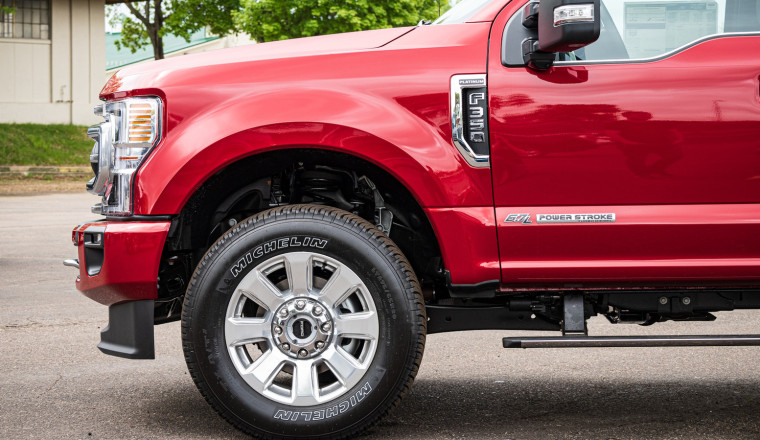

So, you need a heavy-duty pickup truck, and have decided on something that adorns the legendary Blue Oval badge. However, Ford offers two compelling engine options, and you're not sure which direction you should go in. Those options come in the form of Ford's 6.7-liter Power Stroke V8, and the 7.3-liter Godzilla V8.
There is much which separates these two engines, but they both look to serve the same function — to function as capable mills in some of Ford's hardest-working truck models. We'll start off by saying that both are widely admired engines from within the Blue Oval circle, with many enthusiasts sharing equal amounts of praise for the two of them. Having said that, they also have their own unique sets of strengths and weaknesses.
While the task at hand is ultimately identical for both engines, the way they each go about doing their business is quite different. Read on to see how they differ from one another in terms of output, approach, reliability, longevity, and everything else in between.
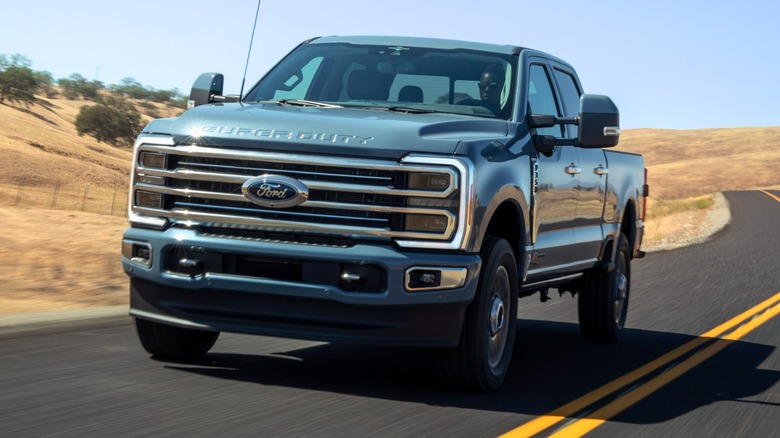
The first difference between these two engines is really quite obvious. While the Godzilla lump takes gas, the Power Stroke engine is diesel-powered. If you are used to one or the other, and wish to stay within your comfort zone, then your preference should immediately be presenting itself.
We will delve deeper into the numbers of these engines shortly, but one major benefit of turbo-diesel engines is that they tend to deliver overwhelming amounts of torque. They also tend to be a little more efficient in terms of miles per gallon, and both of these facts are true here, so it's point one to the Power Stroke.
However, just because the Power Stroke is more efficient doesn't necessarily mean it's cheaper to run. While 6.7-powered Ford trucks typically return between 12 and 18 MPG, those numbers aren't unbeatable in the face of the Godzilla's 8 to 14 MPG. Furthermore, gas is cheaper than diesel, so even if you get fewer miles to each gallon, the per-mile cost of running a 7.3-motivated truck might still be cheaper — or at least comparable.
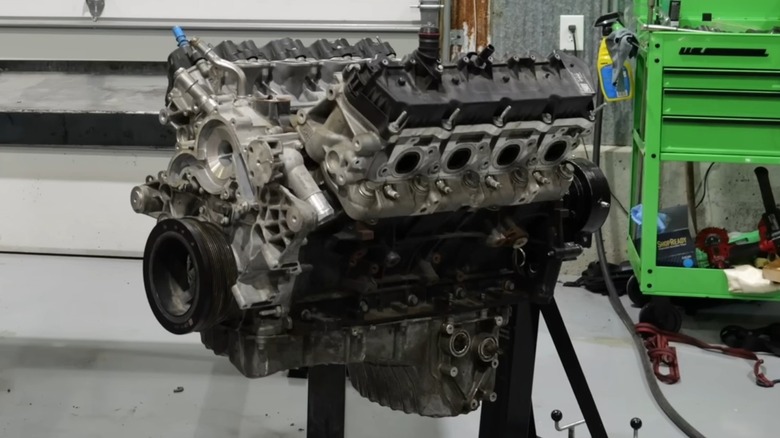
As we alluded to above, these two engines provide different outputs. Depending on whether your appetite prefers horsepower or torque, one engine may outshine the other. Starting with the 7.3-liter gas V8, it manages to churn out an impressive 430 horsepower in addition to 475 lb-ft of torque. Peak power arrives at 5,500 rpm while peak torque comes in sooner, arriving at 4,000 rpm. Impressive figures, for sure, and considerably more powerful than the 6.7-liter diesel V8, which makes do with just 330 horsepower — a full 100 fewer.
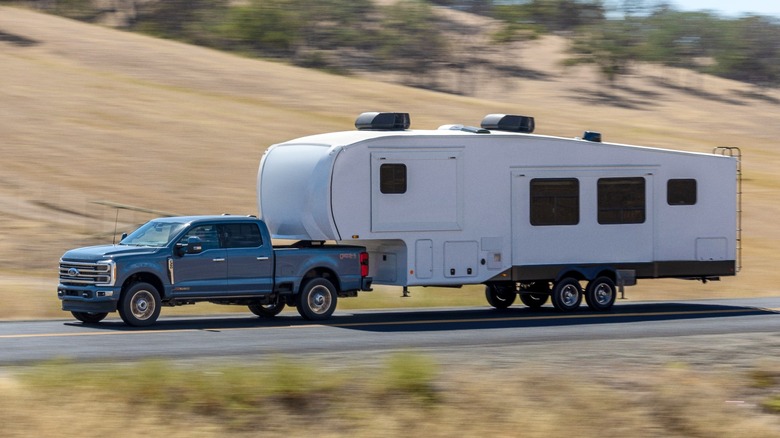
However, torque is where the Power Stroke really shines. Earlier iterations of the engine were compelling enough, with a chassis-twisting 725 lb-ft arriving at 1,800 rpm. Peak power comes in much sooner, too, at just 2,600 rpm. There is no need to wring the Power Stroke's neck when hauling heavy loads, as is typically the case with a diesel engine. Later guises of the diesel were more impressive still, out-shining the Godzilla with 475 horses and a startling 1,050 lb-ft of torque. Ford wasn't done there, either. Pick the High Output Power Stroke and you'll be blessed with a further 25 horsepower and 150 lb-ft of torque, culminating in an engine which truly blows the Godzilla into the weeds when it comes to capability. In fact, pick up a 2023 Ford Super Duty Power Stroke with the right options, and you'll be able to pull a record-beating 40,000 pounds.
Another major difference between these two engines is the way they make their power. Not only do they take in different fuels, but while the diesel lump opts for turbo power, the gas engine prefers to keep things simple with natural aspiration. The benefits of a naturally aspirated engine include less pressure on internal components — which may result in better reliability and longevity — and predictable power delivery, which is great for cruising at steady speeds on the highway. Turbo engines, particularly turbocharged diesel engines, bring about a different set of benefits.
Turbochargers allow the engine to produce more power, of course, but they also introduce this extra power without destroying fuel efficiency. As seen above, turbo-diesel engines are brilliant producers of low-end torque. This might not be as great for highway cruises, but if you plan on using your diesel-powered Ford truck for towing and hauling on a regular basis, heaps of torque will definitely be a big plus.
With a turbocharged engine, though, there are more things that could go wrong, and that's worth bearing in mind when weighing up which is right for you. Not only do turbochargers themselves fail as a unit, but actuators and EGR systems can act up, diesel particulate filters can get clogged, and charge pipe failures can cause plenty of headaches, too.
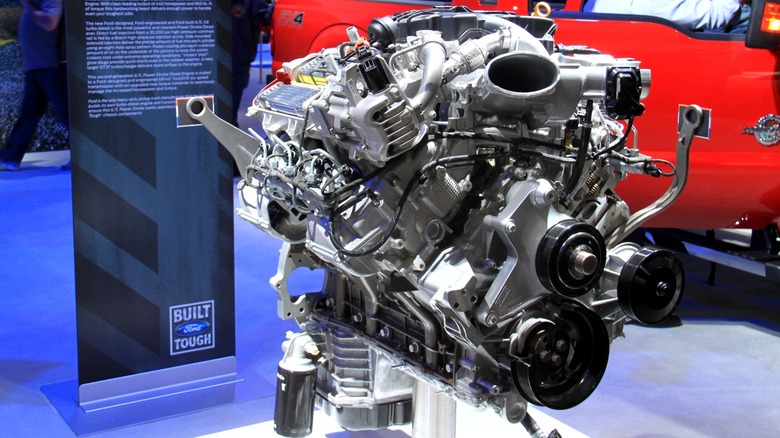 Joseph Brent/Wikimedia Commons
The 6.7-liter Power Stroke has been making the rounds since 2011 now, and therefore, it's had the chance to develop and improve over the years. The Godzilla engine, on the other hand, is still fairly young, but we have seen Ford turn it up to 11 with the debut of its Megazilla and Megazilla 2.0 engines.
The original Megazilla built upon the Godzilla's naturally aspirated base, whereas the Megazilla 2.0 engine adds in that all-important missing ingredient — boost. In a nutshell, it's made to produce over 1,000 horsepower, which comes courtesy of a monstrous 3.0-liter Whipple supercharger. The Godzilla engine itself arrived in 2020, so it's considerably newer than the Power Stroke. Sadly, the Megazilla engine is only ever destined to be a crate engine, so while it might be perfect for a big-budget restomod build, you're never going to be able to tick the 1,000-HP Megazilla option when speccing out that new Super-Duty.
There is potential for the Godzilla to grow in terms of output and efficiency as the years progress, much in the same way that the Power Stroke did, but the gas V8 seems fairly set in its ways for now. The real win to take away here is the very fact that Ford even still offers two such powertrains in 2025.
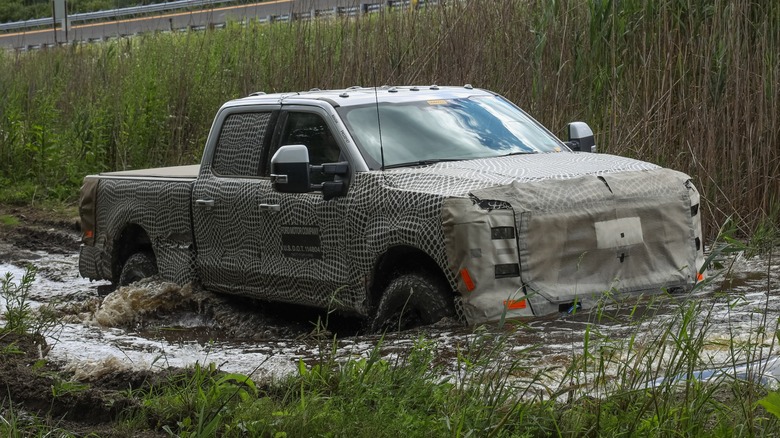
Since its inception, the 6.7-liter Power Stroke diesel engine has proven itself as a largely reliable and impressively durable powerplant. Sure, some Power Stroke model years are more reliable than others, with the first few years of production proving particularly troublesome. However, some owners have managed to put moon miles on their Power Stroke Ford trucks, with the highest mileage currently recorded sitting somewhere north of 1.3 million. Issues that generally get in the way of such miles though include turbo failures, injection pump failures, clogged EGR coolers, and even broken glow plugs.
In contrast, the Godzilla lump hasn't been in production nearly as long, so it is less tried-and-tested than the Power Stroke. As a result, there are no seven-figure mileage examples to point at and go "look, see, it's reliable." Many owners claim to have covered numerous hundreds of thousands of miles, though, so the early signs look good in terms of durability. That being said, the Godzilla isn't totally devoid of headache either, with lifter and camshaft failure being experienced by some.



























.jpg)