
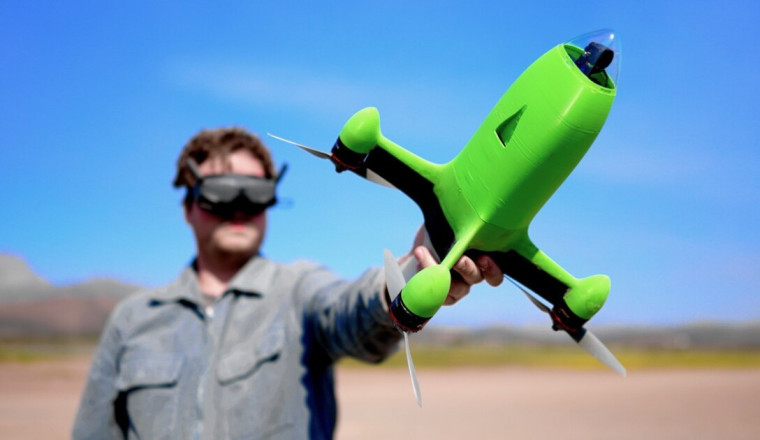

Benjamin Biggs is an Australian aerospace engineer who works at XM2, a Melbourne company specialising in drone cinematography. In mid-2024 he watched a YouTube video of a high-speed drone and decided he could build something faster. He called the project Blackbird. The drone is a 40-centimetre, two-kilogram gyro-stabilised quadcopter that flies on its side like a missile, with its two front motors pushing and two rear motors pulling. It is built from 3D-printed plastic and carbon fibre with off-the-shelf components. It cost approximately $3,000 Australian dollars and took 18 months to build and refine.
On 8 December 2025 in Melbourne, Biggs flew Blackbird over the measured 100-metre Guinness course and set a verified ground speed of 626.42 km/h (389.24 mph), officially recognised as the highest ground speed by a battery-powered radio-controlled quadcopter in history. He had beaten the previous record held by the Dubai Police. He had out-run a Koenigsegg Jesko Absolut and was travelling at approximately 51 per cent of the speed of sound. Guinness issued the certification.
Three days later, it was gone.
Luke Maximo Bell and his father Mike, a father-and-son team from South Africa who have been building speed record drones since 2024, flew their fourth-generation Peregreen quadcopter in Cape Town and set a new Guinness record of 657.59 km/h (408.60 mph). It was the fourth time the Bell team had held the record. It remains the current official Guinness figure.
Biggs watched it happen and went back to work. In January 2026 he took Blackbird to the Australian outback, followed every Guinness measurement protocol, ran two passes in opposite directions, and hit a peak GPS speed of 690 km/h (428.8 mph). The speed is documented on video and data logging. There is one problem. He could not secure the required professional drone pilot witnesses on a Thursday morning in rural Australia. The speed is real. The record is not official.
The engineering behind 400mph on battery power
The drone world has been watching this rivalry produce results that would have seemed impossible twelve months ago. In May 2024, the Bells' Peregreen 2 set a Guinness record at 480 km/h. By December 2025, Biggs was at 626 km/h. By January 2026, his unofficial number was 690 km/h. That is a 44 per cent speed increase in under two years, driven entirely by independent builders working from workshops and garages, not corporate laboratories.
Blackbird's January 2026 run gives a window into what it takes. Biggs uses two SMC 7S 6,000-milliamp-hour batteries wired in series to create a 14S configuration, producing higher voltage at lower current to keep everything cooler under extreme loads. He overcharges to 4.35 volts per cell instead of the standard 4.2, allowing the motors to maintain higher voltage under load. His AAX 2826 Competition motors, custom wound with extra-long leads running directly through the arms and soldered straight to the speed controllers, were spinning at 34,000 RPM during the run. At that point the propeller tips were approaching, and possibly crossing, the sound barrier. Biggs estimates the physical ceiling for a propeller-driven multirotor sits between 800 km/h and 900 km/h, defined by the point at which tip velocity goes supersonic and compressibility effects destroy propulsive efficiency.
After the January run, the motors were warm but not cooked. The batteries still had 8 per cent charge remaining at 76 degrees Celsius. The airframe was intact. On a machine travelling at 690 km/h on 3D-printed plastic, these are remarkable numbers.
Like this? Get the app: iOS | Android
The Bell team, meanwhile, has already begun work on the Peregreen V5. Luke Maximo Bell recently completed a 3 hour 31 minute endurance flight on a single charge while the speed record rivalry paused, demonstrating the range of engineering problems this community tackles beyond raw velocity. Neither team is done.
An official Guinness attempt from Biggs is expected before June 2026. If Bell responds first, the record goes to whichever team gets a witness-verified run above 670 km/h on a calm day. Either way, 700 km/h will almost certainly fall this year on a machine built in a garage, by someone who started because they watched a video and thought they could do better.
The total combined investment across both programmes is a rounding error on what it costs to run a Formula One team for a single race weekend. What it has produced is engineering at the edge of what physics will allow, documented on YouTube, available for anyone to study, and moving faster every month.
Sources: Tech Business News, January 2026 | DroneXL, January 2026 | DroneXL, February 2026 | DroneXL, March 2026 | New Atlas, February 2026 | Tom's Hardware, January 2026 | SlashGear, December 2025 | Guinness World Records official database