
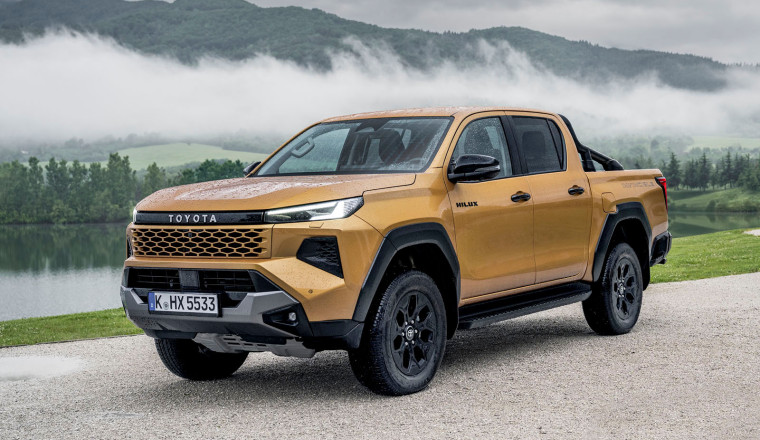

The face of low-budget regime changes, the Toyota Hilux, has received a makeover.
The incoming ninth-generation Hilux sports a rather swanky new front, as part of a redesign that Toyota calls ‘all-new’, although the word ‘all’ is doing heavier lifting here than even the load bay is able to.
The Hilux can now be had with a battery-electric powertrain, but its the 48V diesel that will remain the volume choice.Matt PriorEditor-at-large
To recap, the famously indestructible Hilux is one of two major volume players in the UK’s double-cab pick-up truck market, beside the Ford Ranger, although Toyota is expecting a lot more competition from both incumbents and new entrants.
The Hilux retains its separate body-on-frame design from last time, although the chassis’ side-rail thickness has been increased, the front crossmember has been stiffened and redesigned to accommodate electrically rather than hydraulically power-assisted steering and the front suspension towers have been strengthened.
There are double wishbones at the front with redesigned lower arms, new bushes and a stiffer anti-roll bar; and a rigid rear axle suspended on leaf springs. The spring and dampers rates have been retuned all round.
We’re getting only the double-cab variant this time, no single-cab, despite last year’s benefit-in kind tax increases that vastly reduced demand for the former.Matt PriorEditor-at-large
There are new mounts for the engine and body as well, plus the body receives 36 new spot welds for better stiffness and isolation.
By autumn 2026 Toyota is going to offer a rear-seat delete option, fitted and homologated in the UK before registration when cars land here, which will restore the double-cab to commercial tax status (not unlike the way it turns Land Cruiser 4x4s into commercial vehicles).
Toyota says users would prefer that over the single-cab Hilux, because it gives them somewhere dry and (relatively) secure to store gear, which is what they mostly use the back seats for anyway.
The load bed is the same as before except for new steps at the sides and rear. There are more basic variants elsewhere, but here we get a 48V mildly hybridised 2.8-litre four-cylinder diesel engine making 201bhp, which is carried over without mechanical change from the previous Hilux, where it made its debut in 2025.
There’s a fully electric version too, but this 48V diesel will remain the volume choice. It comes exclusively with an automatic gearbox.
There will be four trim grades, Active, Icon, Invincible and Invincible X, with pricing from around £44k-£54k.
Inside the Hilux has been given a new, latest Land Cruiser-style fascia. The dash top sits 35mm higher than it did (it now aligns with the door tops), it’s still button-heavy (which is fine), there’s a 13.2in touchscreen (also fine, given it doesn’t have to do too much) and most of the driving controls can be configured via the steering wheel (ADAS) or a grouping on the lower central dash (4WD, drive modes).
There are two gloveboxes, a good amount of stowage and physical climate controls.
Head room is more generous than leg room in the rear seats, but I’d expect most buyers to delete them anyway.Matt PriorEditor-at-large
The seats have been given thicker padding and a thicker surface material, and the driving position still feels good, a couple of months gap since I last drove a Mk8 Hilux.
The bonnet has been reprofiled along with the front end, and the bulges look a bit unsettling from the driver’s seat: they angle towards the middle, restricting your view of the far side of the truck and making it feel like a bit like you’re pointing the prow of a boat.
I imagine you would get used to it, like the nose design, which looks more, well, ‘designed’ and modern.
Gratifyingly, the door mirrors remain large and the Hilux retains its (relatively) modest 1855mm width, which could be particularly helpful on worksites or in the sticks.
The Hilux fires to a muted and softly rounded dieselly idle. With the gear selector slipped into D and your foot off the brake pedal, it will creep forwards gracefully, assuming you’ve disengaged the electronic parking brake – another new feature on the Mk9.
Throttle travel is deftly judged, but response varies according to the off-road drive modes: softer in Rock, sharper in Sand, say.
The 2.8-litre four-cylinder engine remains as it was: torquey but thirsty for a diesel.Matt PriorEditor-at-large
There are 2WD high, 4WD high and 4WD low ratios on the six-speed gearbox, with a Sport mode or a manual override selectable. There’s also a lockable rear differential and a hill-descent control.
There are no 0-62mph times quoted, but one could imagine it at around 10sec - or perfectly decent for a car of this type.
If you ask little of the drivetrain, it mooches around very amiably. Work it more and the gearshifts are more notable, to coincide with a four-cylinder thrum that is of course less smooth than a six (as is available in the Ranger). But I can see why people choose a double-cab as their daily (I’ve run two Rangers as mine happily).
The turning circle is 12.6m, the towing limit is 750kg (unbraked) or 3500kg (braked) and the bed payload is 1025-1065kg.
The steering is light at low speeds and builds weight for an improved feeling of security as speeds rise. It’s still quite a slow rack but, given the turning circle is tight, a turn of the wheel isn’t too sluggardly. There’s no distinct road feel to speak of but it’s accurate and weighted towards the comfortably light side.
You can tell, though, that this is a separate-chassis truck with a heavy unsprung rear because of the way it knobbles down the road, with small shimmies reaching from road to driver’s seat, giving it an unsettled, albeit quite absorbent, ride.
It's not as car-like to drive as a Ford Ranger but still very respectable on the road.Matt PriorEditor-at-large
It’s the only hint of a lack of refinement really, with noise levels reasonable and decent isolation and stability otherwise. My test truck carried a big bladder of almost 200 litres (200kg) of water in the load bay, which will have contributed to keeping the ride less deflected by bumps (many trucks feel too stiff when unladen), albeit presumably with the trade-off that once the water starts shivering it would enhance lateral body movement.
Regardless, the Hilux is perfectly decent on the road. Off-road, the Hilux is mega. The wade depth remains at 700mm, because Toyota placed the starter-generator up high, approach angle is 29deg, breakover angle is 24deg, departure angle is 24deg and ground clearance is 309mm.
In our experience with the previous Hilux, only its long wheelbase means it won’t go where stock versions of, say, the Jeep Wrangler will in the rough.
If there’s a notable change for this generation, it’s how light and muted in feedback the steering remains off road, making it more relaxing over prolonged rough terrain.
The official figures say that the Hilux will return nearly 29mpg. We will see about that when we get a car in the UK for a more extensive test, but it's quite believable.
No pick-up is cheap these days, but running costs are of course of high priority for both the maker and the user. We expect the Hilux to be competitive and, if previous versions are to go by, to be extremely durable.
The Hilux is a truck that feels more composed and refined in all situations than ever before but just as ready to put a shift in when the ground – or the political situation – turns gnarly.
Matt is Autocar’s lead features writer and presenter, is the main face of Autocar’s YouTube channel, presents the My Week In Cars podcast and has written his weekly column, Tester’s Notes, since 2013.
Matt is an automotive engineer who has been writing and talking about cars since 1997. He joined Autocar in 2005 as deputy road test editor, prior to which he was road test editor and world rally editor for Channel 4’s automotive website, 4Car.
Into all things engineering and automotive from any era, Matt is as comfortable regularly contributing to sibling titles Move Electric and Classic & Sports Car as he is writing for Autocar. He has a racing licence, and some malfunctioning classic cars and motorbikes.