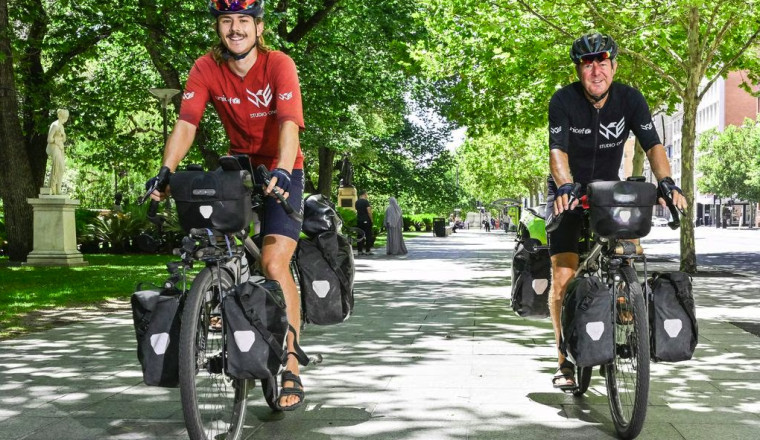

Joshua and George Kohler are on day 308 of cycling around the world. The Norfolk pair, Joshua is 23, George is 57 have already covered more than 6,000km across the United States, threaded through Europe's cycleways, crossed the mountain corridors of the ancient Silk Road, and dodged scooters through Southeast Asia. By the time they finish in May, they will have covered more than 30,000km across 29 countries, a world-first for a father and son, raising nearly $60,000 for UNICEF UK. They are attempting a Guinness World Record.
New Zealand took 17 days and 1,591km. It was, by their account, the most hostile country they have encountered.
A near-miss along the Buller Gorge road near Murchison crystallised what had been building for two weeks. Cycling downhill around a tight blind bend, a car towing a caravan overtook Joshua, forcing an oncoming vehicle to pull over entirely to allow the caravan through. Three vehicles, one lane, one bend. Joshua caught the driver at traffic lights and asked them to be more careful. The passenger replied that she thought they were, then wound up the window.
"There wasn't enough room for all three of us," Joshua said. "We're quite vulnerable on bikes, and if you come off at that speed, it wouldn't be nice."
The incident made national news when the reel Joshua posted online drew hundreds of responses, mostly supportive, mostly apologetic, mostly from New Zealanders.
What They Found Here That They Didn't Find Elsewhere
The Kohlers' comparison is not between New Zealand and a handful of other places. It is between New Zealand and almost every other country a human can reach by bicycle. That context matters.
Joshua said that in Turkey and across Asia, drivers encountering a cyclist simply sit behind and wait for a safe overtaking opportunity. Nobody honks. Nobody shouts. The cyclist is accepted as part of the road environment. In New Zealand, he said, the instant reaction from a meaningful proportion of drivers is anger, not at anything the cyclist has done, but at the 30 seconds of delay the cyclist represents.
"As a Western society, it's so go go go that as soon as something crops up delaying them by even thirty seconds, they get annoyed," Joshua said. "The instant reaction is to get angry instead of being patient and chill."
George added that New Zealand's scenery consistently lifted their spirits throughout the journey. He had expected that people travelling through such landscapes might be in a similar frame of mind. The driving behaviour suggested otherwise.
"I've had New Zealand cyclists say they no longer ride on the roads because of driver behaviour," Joshua told RNZ.
This Is Not a New Problem
The Kohlers' experience is not an isolated tourist complaint. It lands in the context of a documented, longstanding and worsening pattern on New Zealand roads.
Nine cyclists were killed on New Zealand roads in 2024, with 146 seriously injured, according to the most recent Ministry of Transport data. That figure covers a country with a population of five million and relatively low traffic volumes by international standards. The death rate does not reflect a shortage of road space. It reflects what happens on the road.
A nationwide survey by IAG in 2021 found that 50 percent of New Zealanders reported encountering road rage in the previous year. A March 2026 AA Insurance survey found that 49 percent of New Zealanders believe the problem is getting worse. NZTA's own data shows safety fears about driver behaviour are the single most common reason people in New Zealand choose not to cycle, cited by 43 percent of respondents. Only 55 percent of urban New Zealanders perceive cycling as safe.
The Spinoff investigated the specific question of why New Zealand drivers are so aggressive toward cyclists in November 2025. Transport researchers interviewed for that piece pointed to a combination of road design and cultural factors. Roads are narrow and largely built around moving cars quickly, creating structural conflict between drivers and cyclists at every interaction. Protected bike lanes are still sparse. The environment trains drivers to treat any slower road user as an obstruction rather than a participant.
"Poor design encourages aggressive driving," one researcher said. "There is a culture war element around hatred of cyclists on some level, but the research suggests it's primarily environmental. It's quite stressful for drivers to interact with cyclists on poorly designed roads."
Members of the Tour Aotearoa Facebook group had been raising the same concerns for years before the Kohlers arrived. Police Inspector Peter McKennie acknowledged the problem directly after the Kohlers' video went public, noting that many rural roads were narrow and not designed with cyclists in mind, and urging motorists to only pass when it is safe to do so.
Like this? Get more MotorBuzz delivered to your phone. Download the app: iOS | Android
The Law That Doesn't Exist Yet
One of the more revealing details in the coverage of the Kohlers' trip is a single line buried in the RNZ report: the Ministry of Transport would "soon seek public consultation on introducing a minimum overtaking gap for vehicles passing cyclists."
The minimum passing distance rule, which requires drivers to give cyclists at least one metre of clearance when overtaking at speeds up to 60km/h and 1.5 metres above that, is already law in every Australian state and territory, in the United Kingdom, in Canada, in most of Europe, and in numerous US states. In New Zealand in 2026, it does not exist. There is no legal minimum. A driver can pass a cyclist at 100km/h with centimetres to spare and, unless contact is made, has committed no offence.
The Ministry of Transport is consulting. That is a different thing from legislating.
NZTA has widened shoulders and created shared paths over the past two decades. Joshua specifically noted that signage on New Zealand roads regularly reminds drivers to "share the road," which he found striking for exactly the wrong reason: the signs exist because the problem is serious enough to require signs. In the countries where cycling is treated as normal road infrastructure, no such signage is necessary.
The Bigger Picture
The Kohlers are attempting a Guinness World Record and raising money for UNICEF. They are exactly the kind of visitors New Zealand's tourism marketing is designed to attract: active, international, documenting their experience on social media to audiences that follow long-distance adventure travel. The version of New Zealand they encountered and shared with those audiences was one defined by driver hostility on its roads.
The viral reel from the Buller Gorge drew hundreds of apologies from New Zealanders embarrassed by the representation. That reflex is encouraging. What it cannot do is substitute for infrastructure and law.
New Zealand's road toll, its cycling fatality rate, its documented pattern of driver aggression toward vulnerable road users, and the specific absence of a minimum overtaking distance law all point toward the same structural gap. The Kohlers experienced it as visitors with a reference point spanning 28 other countries. New Zealand cyclists experience it as the daily condition of using the roads they live on.
The world-first father-and-son cycling record will be completed in May. New Zealand will be remembered as the leg where the scenery was spectacular and the driving was the worst they encountered on the entire planet.
Sources: NZ Herald, 4 March 2026, RNZ, 4 March 2026, The Spinoff, November 2025, Ministry of Transport Road Deaths and Injuries data 2024, IAG nationwide road rage survey 2021, AA Insurance survey March 2026. All analysis and editorial commentary is original.