

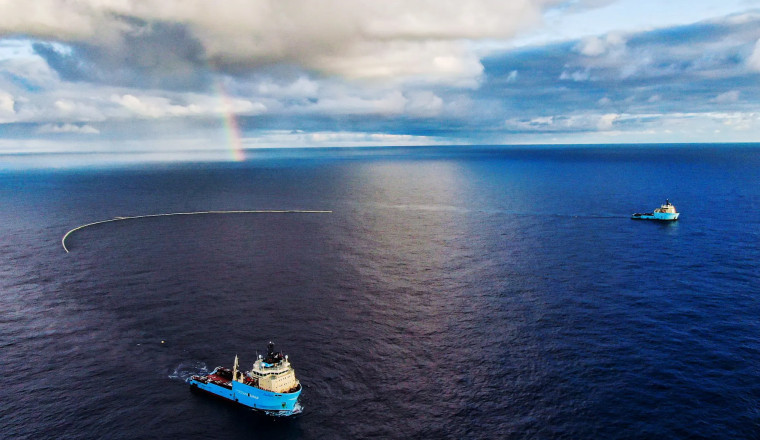

The Ocean Cleanup, the Dutch nonprofit founded by Boyan Slat in 2013, announced in January 2026 that its systems have removed over 45 million kilograms of plastic and debris from rivers and oceans globally. The milestone, achieved through a combination of ocean-going collection vessels and river interception barriers, represents the organization's most significant accomplishment since launching operations and demonstrates the potential for technological interventions in addressing marine plastic pollution.
The 45 million kilogram total, equivalent to approximately 45,000 metric tonnes or the weight of roughly 300 blue whales, comes from two distinct cleanup approaches deployed across multiple continents. Ocean-going systems operating in the Great Pacific Garbage Patch account for approximately 15 million kilograms, while river interception devices installed in waterways across Asia, Africa, and Latin America contributed the remaining 30 million kilograms.
"Reaching 45 million kilograms confirms that large-scale cleanup is technically feasible and economically viable," Slat stated during a press conference announcing the milestone at The Ocean Cleanup's Rotterdam headquarters. "We've proven the technology works, refined our systems through multiple iterations, and established operational procedures that allow sustained removal at scale. This is just the beginning of what's possible."
The ocean systems consist of massive U-shaped barriers, currently measuring up to 2,500 meters in length, that drift with ocean currents while trailing a mesh screen beneath the surface. Plastic debris accumulates within the barrier as it moves through garbage patches, concentrated areas where ocean currents converge and trap floating waste. Support vessels periodically extract collected plastic from the systems and transport it to shore for recycling or disposal.
System 03, the latest generation ocean device deployed in the Great Pacific Garbage Patch in 2024, demonstrated breakthrough performance by collecting plastic at rates exceeding 10,000 kilograms per week according to operational data The Ocean Cleanup published. The system's improved design addresses earlier challenges including breakages and plastic escaping from collection areas that plagued initial prototypes tested between 2018 and 2021.
River interception systems, branded as "Interceptors," operate differently by positioning barriers across waterways that funnel floating waste onto conveyor belts leading to collection bins. Solar panels power the automated systems, which operate continuously without permanent human supervision. The Ocean Cleanup has installed over 30 Interceptors across rivers including the Klang in Malaysia, the Cengkareng Drain in Indonesia, and various waterways in Vietnam, Guatemala, and the Dominican Republic.
The river approach targets plastic pollution at its source, preventing ocean entry rather than extracting debris after it spreads across vast maritime areas. According to research cited by The Ocean Cleanup, approximately 1,000 rivers contribute roughly 80 percent of riverine plastic entering oceans, with the majority located in Asia, Africa, and South America. Interceptors positioned strategically on these high-pollution waterways theoretically prevent millions of kilograms of plastic from reaching marine environments annually.
Independent verification of the 45 million kilogram claim proves challenging given the distributed nature of operations and reliance on The Ocean Cleanup's internal monitoring systems. The organization publishes quarterly reports detailing collection volumes and provides footage of extraction operations, but comprehensive third-party auditing of total removal figures has not been conducted. Environmental scientists generally accept the organization's data as credible while acknowledging that precise verification remains difficult.
The environmental impact of removing 45 million kilograms requires context. Academic research estimates that between 8 and 15 million metric tonnes of plastic enter oceans annually, meaning The Ocean Cleanup's total removal since operations began represents approximately 0.3 to 0.6 percent of a single year's plastic ocean influx. The Great Pacific Garbage Patch alone contains an estimated 80,000 to 100,000 metric tonnes of plastic, making the 15 million kilograms removed roughly 15 to 19 percent of that single accumulation zone.
"The Ocean Cleanup deserves credit for technological innovation and operational persistence, but we must maintain realistic perspectives about scale," explained Dr. Marcus Eriksen, co-founder of the 5 Gyres Institute, which researches plastic pollution. "Removing 45 million kilograms is laudable, but new plastic enters oceans at rates vastly exceeding current removal capabilities. Technology alone cannot solve this problem without addressing production and consumption at source."
Critics argue that resources directed toward cleanup technology might achieve greater environmental benefit if invested in preventing plastic production and improving waste management infrastructure in countries where collection systems remain inadequate. The Ocean Cleanup's operating costs reportedly exceed $30 million annually based on public financial disclosures, funded through donations and corporate partnerships. Similar investment in waste management could potentially prevent substantially more plastic from entering waterways than cleanup operations can extract.
The recycling question also generates debate. The Ocean Cleanup partners with companies to convert collected plastic into consumer products including sunglasses and other accessories, marketed as made from ocean plastic. However, the heavily degraded, salt-contaminated plastic recovered from marine environments requires extensive processing before becoming usable material. Some environmental groups question whether this recycling genuinely creates circular economy benefits or primarily serves marketing purposes.
Ocean cleanup operations also face concerns about bycatch, the unintended capture of marine life in collection systems. Early Ocean Cleanup prototypes attracted criticism after marine biologists warned that the systems might trap fish, turtles, and other organisms alongside plastic. The organization responded by modifying designs to include escape routes and monitoring protocols, though comprehensive bycatch assessments across all deployed systems remain limited.
The Great Pacific Garbage Patch cleanup specifically raises questions about prioritization. The patch consists primarily of microplastics and degraded debris floating far from human populations in the North Pacific Ocean. While removing this plastic prevents further degradation and potential food chain entry, some scientists argue that resources might achieve greater immediate impact addressing coastal pollution affecting communities directly or preventing new ocean plastic entry through river interventions.
The Ocean Cleanup's river interception strategy addresses these criticisms by preventing ocean entry, theoretically offering better return on investment than ocean extraction. However, river systems face their own complications including flood damage to equipment, maintenance requirements in remote locations, and waste disposal challenges in countries with limited landfill or recycling infrastructure. Several Interceptors have sustained damage from extreme weather events or required relocation after initial deployments proved suboptimal.
Corporate partnerships funding The Ocean Cleanup operations create additional tensions. Companies including Coca-Cola, Maersk, and various plastic manufacturers have provided financial support or collaboration, drawing criticism from activists who argue these companies' continued plastic production dwarfs any cleanup benefits. The partnerships create public relations advantages for corporations facing pressure about plastic pollution while potentially deflecting attention from production reduction demands.
"Ocean cleanup represents technological optimism that allows society to avoid confronting consumption patterns driving plastic pollution," argued Dr. Sarah Jewell, environmental policy researcher at the University of California Berkeley. "It's psychologically comforting to believe we can simply remove plastic after it's discarded rather than reducing production, but the math doesn't work. We're trying to bail out a bathtub while the tap runs at full flow."
The Ocean Cleanup counters that cleanup and prevention strategies need not be mutually exclusive. Organization representatives argue that demonstrating successful plastic removal maintains public engagement with ocean pollution issues while the collected plastic serves as tangible evidence of the problem's scale. The visibility of cleanup operations potentially motivates broader behavioral and policy changes that prevention-only approaches might not generate.
Technological improvements suggest that collection efficiency may increase substantially in coming years. The Ocean Cleanup has announced plans for System 04, a next-generation ocean device measuring over 3,000 meters in length and potentially capable of collecting 20,000 kilograms weekly. Additional Interceptors are planned for high-priority rivers in India, the Philippines, and Thailand. If these deployments succeed, annual collection rates could reach 20 to 30 million kilograms, doubling current performance.
The question remains whether such scaling can meaningfully impact ocean plastic pollution or merely represents expensive theater that distracts from systemic solutions. Optimists point to the 45 million kilogram milestone as proof that human ingenuity can address environmental damage once society commits resources and attention. Skeptics view it as evidence of misplaced priorities that emphasize cleanup over prevention because cleanup requires less fundamental economic and social disruption.
The reality likely lies between these positions. The Ocean Cleanup's technologies work as advertised, removing substantial plastic from waterways and proving that large-scale extraction remains technically feasible. Whether this approach constitutes wise resource allocation compared to prevention strategies involves value judgments about immediate environmental benefit versus long-term systemic change.
For the 45 million kilograms already removed, the environmental benefit seems clear. That plastic no longer threatens marine life, degrades into microplastics entering food chains, or washes onto beaches as pollution. Whether continuing down the cleanup path or pivoting resources toward prevention proves more effective depends partly on which environmental outcomes society prioritizes and how we value different interventions.
The Ocean Cleanup's milestone demonstrates what dedicated engineering and substantial funding can achieve against environmental challenges. It also highlights the vast scale of plastic pollution, where 45 million kilograms represents a fraction of the problem despite years of effort and tens of millions in investment. Progress, certainly. Solution, not yet. The path forward likely requires both cleanup and prevention, technology and behavior change, innovation and regulation. The 45 million kilogram milestone marks achievement worth celebrating while acknowledging the enormous work remaining before ocean plastic pollution becomes memory rather than ongoing crisis.