
Every year since the early ’90s, some of the world’s greatest cars and drivers have gathered in Chichester, England, to do something rather unusual: race up the driveway of Lord March, the Duke of Richmond. Known as the Goodwood Festival of Speed, the central event is a hillclimb unlike any other. Contestants must navigate a short, narrow ribbon of asphalt framed by unforgiving walls of stone and slightly less punishing bales of hay, all on a sprawling country estate whose main residence was built in 1600.
Since 1993, the Festival of Speed has become a world-class event, expanding to include a full forest rally course at the top of the hill, giving dirt-slinging competitors somewhere to strut their stuff, too. For 2025, the weather was gorgeous, and the cars were spectacular. These ones in particular caught our eye.
One of the most mysterious cars at the Goodwood Hillclimb is the Toyota GT Concept. Speculation is rife that this will come to America as the Lexus LFR, successor to the LFA. Here in the U.K., this is (and likely will be) clearly labeled as a Toyota.
Two flavors were on display, the road-going GT Concept and a track-only GT Racing Concept. The former had a full interior and looked remarkably close to production, but sadly, that interior was covered when we swung by to take photos.
It’s anyone’s guess what’s under that long, long hood, but its hushed exhaust note had most speculating it was a downsized, turbocharged V-8. That camouflage does a great job of hiding the details, but there’s no obscuring the fact that the GT Concept is going to be a dramatic-looking vehicle, whatever logo it carries on that prodigious nose.
Because 2025 marks 60 years of iconic race- and road cars from Gordon Murray, the organizers of the Festival of Speed decided to honor the man (and his creations) with a special display. The most notable entry was the epic sculpture, which soared high above the weekend’s proceedings.
That installation (called a “Central Feature” in Goodwood-speak) bookended the designer’s career, featuring the Brabham BT52, Nelson Piquet’s 1983 Formula 1 Championship–winning car, and a Gordon Murray Automotive T.50s. The latter is Murray’s more recent road-going machine, which shares more than a little DNA with his epic McLaren F1.
Elsewhere on the show grounds, there were a fair few examples of F1s to be found, including an iconic GTR model from 1997, a longtail example, and the last F1 GTR ever produced. That was tucked neatly in the paddock next to many other Murray highlights, including the BT46B from 1978, the “fan car” that raced only once, thanks to the amount of ire it provoked from competitors.
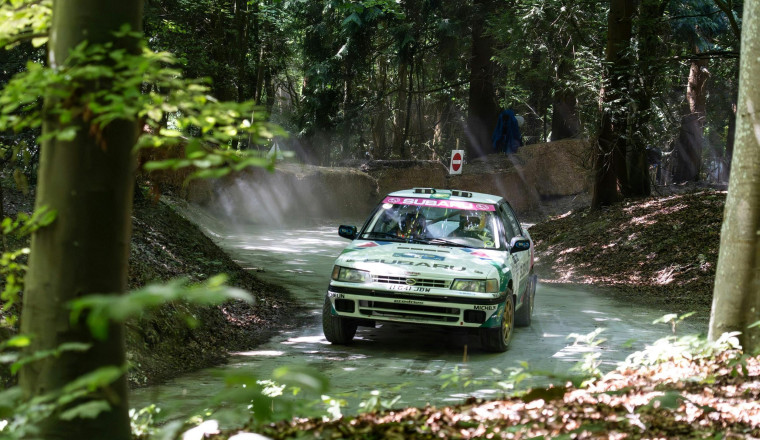
This year is also the 30th anniversary of Colin McRae’s first World Rally Championship title. To celebrate the Scottish superstar, whom we lost in 2007, this year’s Festival hosted many of the machines that made the man famous, including an enviable selection of blue and gold Subarus.
The story starts with a rather more lurid pink-and-white Subaru Legacy RS, which McRae raced with codriver Derek Ringer in 1992. The Legacy was used as a sort of test for Subaru’s fledgling World Rally Championship efforts, and feedback from that effort informed the design of the Impreza.
Subaru launched the Impreza in 1993. That car, a sedan, was sold in the U.K. as well, plus many subsequent coupe models. It was those two-door variants with which McRae, with codriver Nicky Grist, would go on to win the WRC constructors’ championship for Subaru in 1995, 1996, and 1997.
The McRae and Subaru saga ended in 1999, when McRae switched over to the M-Sport Ford team to run an Escort WRC. That car, too, was on display.
The Festival of Speed doesn’t just celebrate historic cars. It’s also become an important venue for the unveiling of new machines that won’t hit the road—or, in this case, the track—for months to come.
This is the Temerario GT3, a race-car version of Lamborghini’s upcoming Huracán replacement. The road car pairs a turbocharged, 4.0-liter, flat-plane-crank V-8 with a hybrid system to make 907 horsepower. Since hybrids aren’t allowed in the endurance classes Lamborghini is targeting with the Temeraro GT3, it ditches the hybrid system and downsizes the turbos.
Output will be somewhere between 500 and 600 horsepower, depending on the series and which way the Balance of Performance winds are blowing. The car’s interior, of course, is gutted, the car’s aluminum monocoque is augmented with a roll cage, and the bodywork is replaced by fewer, larger pieces designed for quick changes in the pits. Look for this one to make a racing debut in Florida early next year, at the 2026 12 Hours of Sebring.
Goodwood-native Rolls-Royce is celebrating 100 years of the Phantom this year, and despite being among the older cars at the show, this Boat Tail Tourer was among the most talked about, and not just because of its wild, nautical shape.
It was the pair of double-barreled shotguns mounted just aft of the spare tire that made many passers-by look twice. No, it’s not a shooting brake, but the car was designed expressly for the sport of tiger hunting. Multiple generations of Indian royalty used the Rolls to that end before the car found its way to the U.S. in the 1960s.
The car would later serve as inspiration for designer Ian Cameron in the creation of the 2003 version of the Phantom.
What was born of a joint marketing effort between Ford of Britain Truck Sales and the British touring car builders Terry Drury Racing has evolved into something of an iconic series of oddball hot-rods. The first Supervan came as a one-off in 1974, a Transit supplanted with a Gurney-Eagle Ford 289 engine, capable of somewhere around 400 horsepower.
In the early ’80s, Ford commissioned another one, dubbed Supervan 2, which led to Supervan 3 in 1994, Supervan 4 in 2022, and the upgraded Supervan 4.2 the next year, which in 2024 ran a ridiculous 43.98 seconds in the hands of two-time Le Mans winner Romain Dumas. That time was fast enough to win the Festival Shootout last year.
In 2025, all five vans were there on display, drawing huge crowds in a paddock full of far more shapely machines.
Hyundai chose the Festival of Speed to unveil its raciest road car yet, the Ioniq 6 N. This, believe it or not, is an EV that sounds great. Hyundai’s engineers created a series of simulated engine notes, including one that replicates the raspy exhaust of the company’s World Rally Championship i20.
This EV isn’t just about the sound, though. Like the Ioniq 5 N before it, the N version of the Ioniq 6 gets dual electric motors and a big power bump, from 320 hp to 641, enough to get to 62 mph in 3.2 seconds.
It also features upgraded cooling and inverters, with quick-charging to match. The Ioniq 6 N and its big wing are headed to production soon, but no word on the price just yet.
The infield at the Festival of Speed is littered with booths and tents of all shapes and sizes, highlighting cars with a similar amount of variety. A significant portion of those were companies selling various flavors of restomods, old cars that promise to look, drive, and smell better than when new.
Among the dozens of lovingly reimagined autos at the show, this Mini was a standout. Formally, it’s called the Wood & Pickett Mini by Callum. That would be Ian Callum, whose resume includes the Aston Martin V8 Vantage and Jaguar F-Type. The W&P Mini has all the diminutive charm that the original is known for, but augmented with a few subtle styling tweaks, like custom LED lighting front and rear in custom housings.
While the exterior is largely faithful, the interior is fully bespoke, beautifully fitted with new seats, switchgear, and surfaces. It’s truly beautiful, lovely enough to justify its £75,000 asking price. (That’s about $100,000 based on today’s exchange rates.)
Speaking of Singers, the company Rob Dickinson built was at the Goodwood Festival of Speed showing off its new model, formally named the Porsche 911 Carrera Coupe Reimagined by Singer. It’s based on the 1980s wide-body Porsche 964, here powered by a 4.0-liter flat-six that was designed with help from Cosworth.
Its period looks are augmented by modern electronics, including traction, stability control, and ABS from Bosch, plus four-way adjustable dampers and, of course, an enviable degree of finish on every surface, inside and out.
This one was dipped in a minty hue and set up high on a pedestal right outside of the Goodwood Estate, where it drew a huge crowd, looking so fresh you could almost taste it from afar. Just 100 will be built.
Rimac celebrated the 2025 Goodwood Festival of Speed not by unveiling a new car, but by completing its quest to obliterate virtually every test of speed and acceleration known to man. On the day before the event, the company announced that its electric Nevera R hypercar had reclaimed the world record for the fastest time accelerating from a standstill to 400 kph (about 250 mph), then back to zero again, doing it in just 25.79 seconds.
Rimac dethroned the Koenigsegg Jesko Absolut, which in 2024 reset the record at 27.83 seconds. The Nevera R also hit 60 mph in just 1.66 seconds and shot all the way to 268.2 mph, setting a new EV top speed.