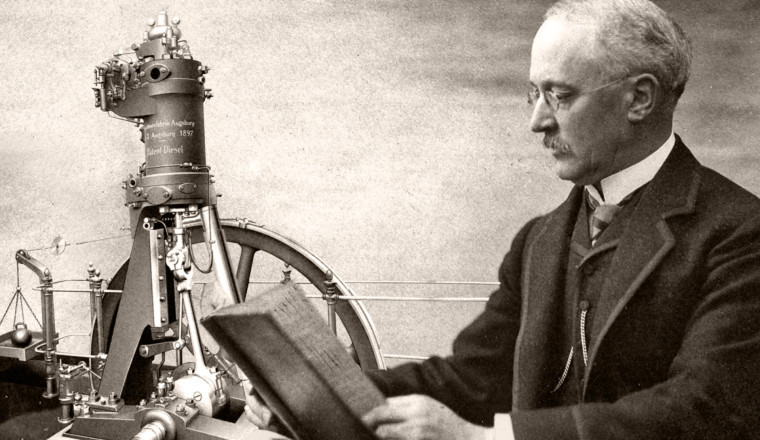

Rudolf Diesel was born in Paris in 1858 to German parents, grew up in poverty after his family fled the Franco-Prussian war, and educated himself into one of the most consequential engineers of the industrial age. His compression ignition engine, patented in 1893, was not simply a better machine. It was a fundamentally different one. By eliminating the spark ignition and fuel mixing problems that plagued petrol engines of the era, Diesel produced a motor of exceptional efficiency and extraordinary commercial potential. He also designed it to run on virtually anything: crude oil, vegetable oil, peanut oil, coal dust. At a 1900 world exhibition in Paris, he demonstrated his engine running on peanut oil. He spoke openly of a future in which farmers could fuel their own machinery from their own crops, free from dependence on the oil industry.
That last part got him enemies.
By 1913 the engine that bore his name was powering ships, factories and the first generation of German submarines. Diesel himself was nearly bankrupt. He had been a brilliant inventor and a catastrophic investor, repeatedly losing fortunes in ventures that had nothing to do with engineering. His health had been deteriorating for years, with accounts of severe headaches, vision problems and periods of mental collapse. On the morning of 28 September 1913 he left his Munich home carrying a small bag. He told his wife Martha not to open it until the following week.
That evening he boarded the steamship Dresden at Antwerp, bound for Harwich. He was travelling to London to attend the founding of a new diesel engine plant and to meet with representatives of the British Royal Navy about fitting his engine to their submarines. He dined with two travelling companions, retired to his cabin at around 10pm and was never seen alive again. When a colleague knocked the next morning there was no answer. The cabin was empty. The bed had not been slept in. His nightshirt was laid out ready to wear. In his diary, the entry for 29 September had a small cross drawn next to it.
When Martha opened the bag she found 200,000 German marks in cash, worth around $1.2 million today. With it were financial documents showing their bank accounts were empty. The money in the bag was what remained.
On 10 October a Dutch vessel recovered a badly decomposed body from the North Sea. The sailors removed the items from the man's pockets: an identity card, a wallet, a pocketknife and an eyeglass case. They returned the body to the water. The personal effects were later identified as Rudolf Diesel's.
Like this? Get the app: iOS | Android
The suicide argument rests on the financial collapse, the deteriorating health, the money bag prepared in advance, the diary cross and the simple fact that a man standing at a ship's railing in darkness is very easy to lose. His biographers have largely accepted it.
The murder arguments are more numerous and harder to dismiss entirely.
The first points to Kaiser Wilhelm II. Diesel had refused to grant the German military exclusive rights to his invention. He was now on his way to England to help the British Navy improve its submarine programme, travelling on the eve of a war that was thirteen months away. German intelligence services were active. Newspapers within days of the disappearance ran headlines reading "Inventor Thrown Into the Sea to Stop Sale of Patents to British Government." The kaiser reportedly expressed no sorrow at the news.
The second points to the oil industry. Diesel's engine threatened the monopoly of oil as a transport fuel. A machine that ran on peanut oil was a direct threat to John D. Rockefeller's Standard Oil empire. The front pages also ran headlines about Diesel being "Murdered by Agents from Big Oil Trusts." This was not a fringe theory. It ran in major newspapers on both sides of the Atlantic.
The third is the Canada theory, which sits at the more colourful end of the spectrum: that Diesel faked his death, pocketed the 200,000 marks and lived out his days quietly in North America, free of debt and enemies alike. There is no evidence for this. There is also no evidence against it, which is precisely the point.
Douglas Brunt's 2023 book, "The Mysterious Case of Rudolf Diesel," which became a New York Times bestseller, reopened the case with fresh research. Brunt places Diesel at the intersection of four figures who shaped the coming war: Rockefeller, Kaiser Wilhelm, Winston Churchill and Diesel himself. His conclusion is that the suicide verdict is too convenient for too many powerful interests.
The honest answer is that nobody knows. A man stepped onto a ship and did not step off it. The engine he invented is still running, a hundred and twelve years later, in every corner of the world. The question of who decided that was enough of him remains open.
Sources
- History.com — Inventor Rudolf Diesel mysteriously vanishes, September 29, 1913
- TIME Magazine — The Mystery of the Diesel Engine's Disappearing Inventor
- This Day in Automotive History — September 29, 1913: Inventor of the Diesel engine mysteriously disappears from ship
- Jalopnik — Rudolf Diesel, Inventor Of The Diesel Engine, Mysteriously Vanished In 1913
- CarBuzz — The Curious Case of Rudolf Diesel's Death
- Yachts International — The Mysterious Case of Rudolf Diesel
- Douglas Brunt — The Mysterious Case of Rudolf Diesel: Genius, Power, and Deception on the Eve of World War I (Simon & Schuster, 2023)