

The story starts not with failure but with extraordinary promise. John Zachary DeLorean was born in Detroit in 1925, the son of a Romanian immigrant factory worker. He earned an engineering degree and joined Packard in 1952, then moved to General Motors in 1956 where his rise was unlike anything the staid corridors of American automotive management had seen. He is credited with developing the Pontiac GTO, the car that invented the muscle car genre, along with the overhead cam engine, the lane-change turn signal and more than 200 claimed patents. By 1972, at 47, he was a GM vice president and widely expected to become its president. He was also the kind of man who wore turtlenecks to board meetings and dated models, which in 1972 at General Motors made him about as welcome as a sports car at a traffic light.
In 1973 he quit. Not quietly. He told the press that GM's culture was conservative, corporate and creatively bankrupt, which in the context of that era was simply true. He wanted to build a car on his own terms: durable, safe, innovative, and completely unlike anything Detroit was making. He called it the ethical sports car. He founded the DeLorean Motor Company in Detroit in 1975.
What followed was a masterclass in leveraging personal brand above operational reality. DeLorean was a celebrity before celebrity founders were a concept. He courted Johnny Carson, Sammy Davis Jr. and Roy Clark as investors. Carson reportedly put in $500,000. DeLorean married fashion model Cristina Ferrare and entertained in a 15-storey Fifth Avenue duplex in Manhattan. He also owned a 434-acre estate in Bedminster, New Jersey, later purchased by Donald Trump and converted into Trump National Golf Club Bedminster. He gave endless interviews about his vision and held the press's attention effortlessly. What he did not do was run a tight company.
The factory, built in Dunmurry on the southwestern edge of Belfast starting in 1978, was funded largely through the British government, which contributed approximately $120 million of the company's $200 million startup costs. The rationale was straightforward: Northern Ireland's unemployment exceeded 20 per cent and sectarian violence was at its peak. Two thousand jobs in a new advanced manufacturing facility seemed like both an economic and a political intervention. The government was not wrong about the need. It was wrong about the man.
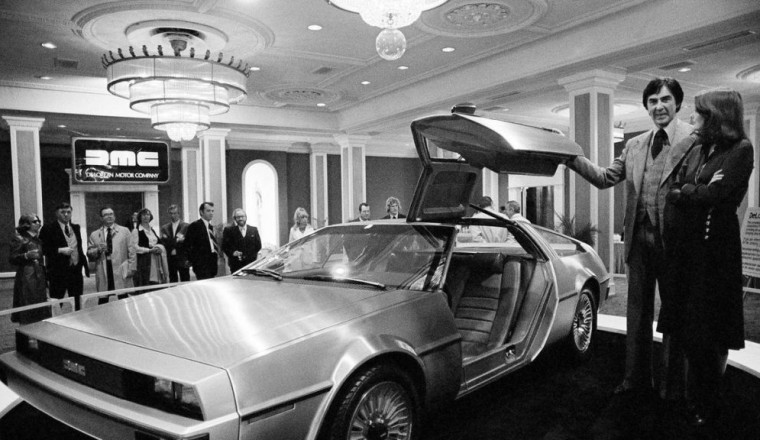
DeLorean never moved to Belfast. He barely visited. His wife came once and left when she found the conditions disagreeable. He ran the operation remotely from New York, setting deadlines that bore no relationship to engineering reality and expecting a workforce that had largely never manufactured cars before to build a world-class sports car on an aggressive timeline with technologies nobody had combined in this way. The gull-wing doors were controlled by cryogenically sealed torsion bars developed by Grumman Aerospace, a company that normally built fighter jets. The body panels were brushed stainless steel, left unpainted partly because painting equipment was considered an unnecessary expense. Lotus was contracted for engineering assistance. The entire car, as DeLorean had conceived it, was purpose-built from scratch rather than assembled from existing components wherever possible.
The first DMC-12 rolled off the production line in early 1981, six years after the company's founding. It looked extraordinary. The gull-wing doors rose vertically. The stainless panels gleamed. The Italian styling by Giorgetto Giugiaro was genuinely futuristic. And then it drove, and the problems began.
DeLorean had originally intended to sell the car for $12,000, a figure so far embedded in the project that it became the model name. The DMC-12 launched in 1981 at $25,000, more expensive than a Pontiac Firebird, more expensive than a Porsche 911, more expensive than a Chevrolet Corvette. Under the bonnet was a 2.8-litre PRV V6, a joint venture engine produced by Peugeot, Renault and Volvo, producing 130 horsepower. The stainless steel body made the car heavy, around 1,230 kilograms, which the 130 horsepower struggled to move with any conviction. Zero to 60 miles per hour took 10.5 seconds. A Corvette did it in 6.7.
The quality control issues were severe in early production cars. Panel gaps. Door seal failures. Electrical gremlins. Water leaks. Workers at Dunmurry were, by and large, people who had never worked in car manufacturing. The British government's original conditions for the subsidy had included requirements around local hiring, which left the factory populated with skilled and motivated but inexperienced labour who could not be expected to solve the engineering problems DeLorean's ambitious custom-everything approach had created. The first cars shipped to dealers arrived needing extensive remedial work. DeLorean kept shipping more.
Like this? Get the app: iOS | Android
The United States economy entered recession in 1981. Interest rates rose above 20 per cent. The market for $25,000 luxury cars, never easy, became extremely difficult. DeLorean raised prices trying to cover rising costs: to $29,000, then $34,000. Sales projections had assumed 10,000 cars per year. The company was nowhere close. By February 1982, DMC entered receivership in Northern Ireland. Investigators later determined that approximately £17.6 million had been diverted to a Panamanian subsidiary in a scheme allegedly involving DeLorean and Lotus founder Colin Chapman. Chapman, who denied involvement, died in December 1982 in an aircraft accident before he could be prosecuted. DeLorean was never convicted of the fraud.
With receivership underway and no prospect of further British government support, DeLorean became desperate. A former neighbour named James Hoffman, a convicted drug trafficker working as an FBI informant, approached him. The FBI knew DeLorean was financially vulnerable and authorised a sting operation. Hoffman told DeLorean about a cocaine deal that could generate millions. DeLorean, his company insolvent and $17 million in debt, agreed to participate as financier.
On 19 October 1982, DeLorean sat in a hotel room near Los Angeles International Airport. FBI cameras were rolling. He was shown 27 kilograms of cocaine, part of a proposed 100-kilogram deal valued at $24 million. He was recorded raising a glass of champagne and saying the cocaine was "better than gold." Federal agents arrested him as he left.
The trial began on 18 April 1984. The prosecution had extensive video and audio surveillance. DeLorean's attorney Howard Weitzman took an unconventional approach: he put the FBI on trial rather than defending his client's behaviour. The jury heard that Hoffman had made the initial contact. They heard that FBI agent Benedict Tisa had pressed forward with the deal even knowing DeLorean lacked the $1.8 million he claimed to have available. They heard that Hoffman stood to benefit personally from the seizure. They concluded that a man with no prior criminal record had been targeted specifically because he was financially desperate, and that the government had manufactured the opportunity rather than uncovered one.
On 16 August 1984, after 29 hours of deliberation, DeLorean was acquitted on all eight charges. He walked from the Los Angeles federal courthouse to waiting cameras. He had won. His company had been liquidated two years earlier. He would never build another car.
The Belfast factory was closed. The remaining cars were sold off. The 9,000 DMC-12s that had been produced sat in garages and showrooms across America. Three years later, director Robert Zemeckis needed a time machine for a film. He had originally planned to use a refrigerator before concerns arose that children might imitate it and get trapped. He turned to the DeLorean, attracted by its futuristic look and gull-wing doors. The film was Back to the Future. When it opened in 1985, the car that DeLorean had built had been out of production for three years and its creator had been tried for cocaine trafficking. The film made it immortal anyway.
DeLorean spent the rest of his life fighting fraud charges, paying creditors and attempting to revive projects that never materialised. He became a born-again Christian. He sold his New Jersey estate. He designed watches. He sketched plans for new cars that were never built. He died on 19 March 2005, in Summit, New Jersey, from a stroke, aged 80. His ashes are at White Chapel Cemetery in Troy, Michigan. His tombstone shows a DMC-12 with its doors open.
After his acquittal he was asked whether he planned to return to the car industry. He said: "Would you buy a used car from me?"
Sources: Wikipedia / John DeLorean | Wikipedia / DeLorean Motor Company | EBSCO Research Starters, Law | History.com, October 19 / August 16 | Hagerty UK | Encyclopedia.com / John DeLorean Trial 1984 | The Next Web / Back to the Future DeLorean history | This Day in Automotive History | MotorBiscuit