
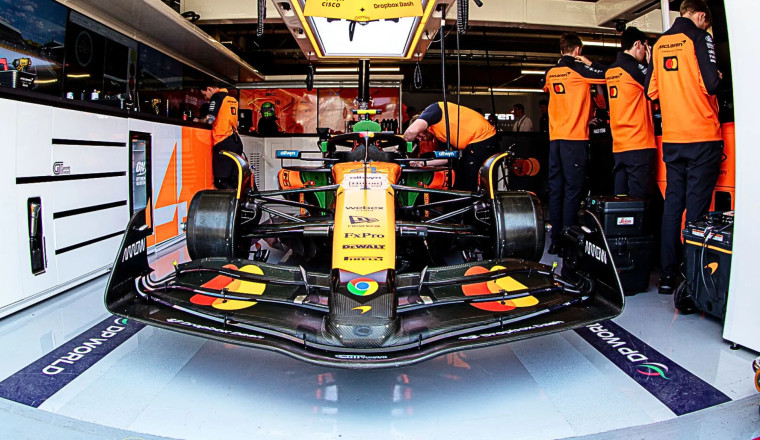

McLaren has turned heads throughout the 2025 Formula 1 season, and much of their newfound competitiveness comes down to the intricate details hidden within the front-end of the MCL39. F1 technical experts like Mark Hughes and Giorgio Piola have shed light on several specific innovations that set this car apart from the chasing pack.
Integrated Mechanical & Aerodynamic Sophistication
At the heart of McLaren’s advantage is the seamless integration of its mechanical layout with aerodynamic concepts. The front-end is not just about steering and support—it also acts as a finely tuned airflow manager and thermal regulator.
Advanced Front Suspension Layout
-
Decoupled Lower Wishbone Attachment:
McLaren’s engineers opted for a novel arrangement where the lower wishbone is not fixed conventionally to the wheel hub. Instead, by decoupling the attachment point, they’ve achieved greater flexibility in how suspension loads are transmitted and, crucially, how the air flows around this crucial area. -
Steering Precision and Camber Control:
This design allows more precise control of camber and toe, improving how the tyre maintains contact with the road—vital for extracting consistent grip through changing conditions and tyre wear.
Optimised Air Channeling to Brakes
-
Flow Management:
Critical to performance is how air is guided from the nose and suspension to the brake assemblies. The current McLaren channels air with remarkable efficiency, using carefully shaped ducts and surfaces to direct cooling airflow exactly where needed. -
Brakes & Tyre Temperature Control:
By controlling airflow so precisely, McLaren manages to get the right amount of heat into the front tyres at the right time. This means the tyres quickly reach their optimal working temperature—a distinct advantage, especially in qualifying or early laps after a pit stop.
The Secret: Consistent Tyre Performance
Modern F1 tyres are notoriously temperamental. Teams need to strike a delicate balance: bring tyres up to temperature quickly, but avoid overheating them and losing grip later in a stint. McLaren’s front-end package appears to tackle this with a two-pronged approach:
-
Rapid Warm-Up:
The synergy of suspension geometry and air ducting ensures energy (both mechanical and thermal) is delivered into the tyres efficiently, allowing for rapid warm-up without excessive sliding. -
Thermal Stability:
Once up to temp, the system helps maintain that optimal window, minimising peaks and troughs in heat that lead to unpredictable handling and tyre degradation.
Beyond Just Hardware
It’s not just the physical parts but how they work together. The MCL39’s development reportedly involved extensive simulation and track validation, refining the airflow around suspension elements and brake components until the team found the sweet spot for 2025’s tyres and regulations.
The Result
The upshot of these developments is a car that feels "plugged in" at the front—immediately responsive, confidence-inspiring for the drivers, and consistent through a race distance. Those seemingly minor details in wishbone geometry, hub design, and air ducting add up to the kind of lap-to-lap consistency and peak performance that have put McLaren firmly back among F1’s frontrunners.
In a sport defined by fractions of a second and millimetres of rubber, it’s this relentless pursuit of marginal gains at the front end that explains so much of McLaren’s 2025 leap forward.