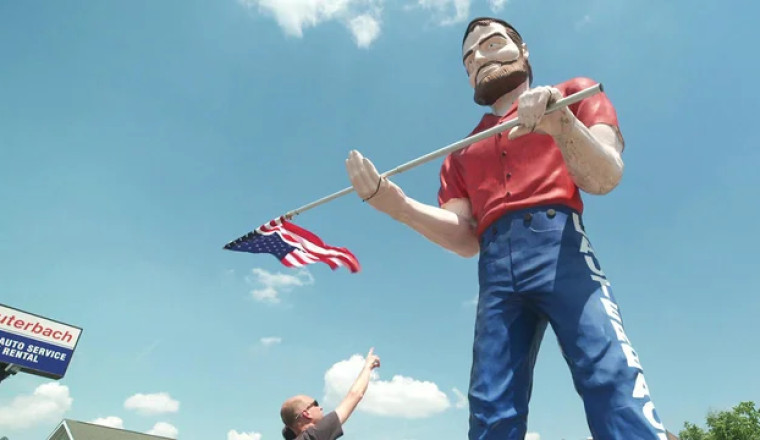

Drive any stretch of American highway long enough and you'll see him. Twenty feet of weathered fiberglass, arms crossed or holding an axe, staring down at your windshield with that blank expression that somehow manages to be both welcoming and deeply unsettling. The Muffler Man has become as much a part of the American road trip as gas station coffee and license plate games, but his origin story is far more innocent than his current reputation suggests.
Steve Dashew didn't set out to create roadside nightmares when he started International Fiberglass in Venice, California in the early 1960s. His towering creations were pure business, designed to catch the eye of drivers speeding past tire shops and muffler repair centers. At 18 to 25 feet tall, these giants served a simple purpose: make motorists remember where they could get their exhaust system fixed.
The formula worked brilliantly. Between 1962 and 1976, International Fiberglass churned out hundreds of these roadside sentinels, shipping them across the country to automotive businesses desperate for visibility on increasingly crowded highways. The standard model came with crossed arms and a serious expression, though customers could order variations including lumberjack Paul Bunyans holding axes or space age figures in helmets.
Mr. Bendo became the most famous of Dashew's children, standing guard in North Hollywood, California, where he still watches over Bendo's Muffler Shop today. His fame spread through social media and roadside attraction enthusiasts, turning a simple advertising gimmick into a cultural icon. The Gemini Giant in Wilmington, Illinois took a different approach, donning a space helmet and rocket ship to advertise the Launching Pad Drive-In when he was installed in 1965.
Like this? Get the app: iOS | Android
When the automotive boom of the 1960s ended and franchised quick-lube chains replaced independent muffler shops, most of these giants became orphans. Business owners moved on, buildings were demolished, and the towering advertisements were often scrapped or abandoned. According to Roadside America, only 150 to 200 Muffler Men survive today from the hundreds that once lined American highways.
That scarcity has turned them into unlikely collectibles. At specialty auctions, restored Muffler Men now sell for $20,000 to $75,000, with restoration costs alone running $15,000 to $30,000 per figure. The World's Largest Things organization actively tracks their locations, treating each surviving giant as a piece of American roadside history worth preserving.
Route 66 maintains the highest concentration of surviving Muffler Men, with the Illinois Route 66 Association leading preservation efforts along the historic highway. California still claims the most examples with 25 to 30 remaining, though many have been repurposed far from their automotive origins. Paul Bunyan versions stand in Akeley, Minnesota and Bangor, Maine, while Louie the Lumberjack holds court in Kenton, Oklahoma.
The documentation project continues through enthusiasts like Erika Nelson, whose 2005 book "American Giants" catalogs locations and histories of surviving figures. Modern GPS tracking through roadside attraction websites has turned Muffler Man hunting into a legitimate hobby for road trip enthusiasts, complete with dedicated forums and social media groups sharing sighting photos.
What started as Steve Dashew's practical solution to automotive advertising has evolved into something approaching folk art. These giants represent a time when businesses competed for attention through sheer physical presence rather than digital algorithms. Standing in parking lots from coast to coast, they serve as monuments to an era when getting your car fixed required finding the right guy with the right tools, usually marked by the biggest, most impossible-to-miss sign money could buy.
Sources: Roadside America, World's Largest Things