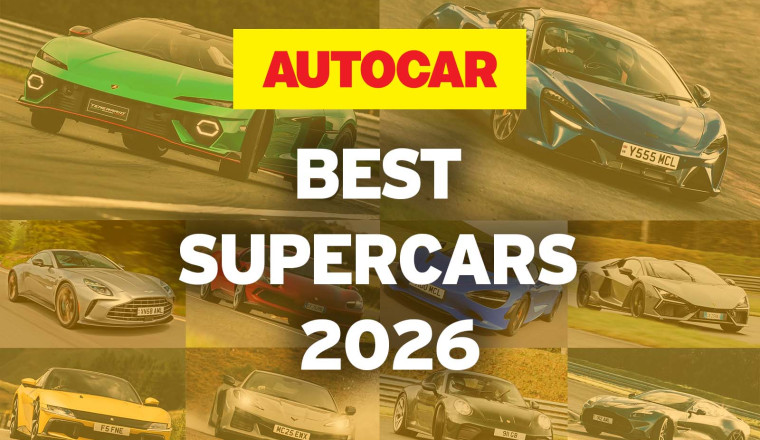

Supercars represent the pinnacle of automotive engineering, occupying an arena in which manufacturers push the boundaries of performance, ride and handling.
Over the years the class has stretched to include all manner of automotive exotics, but at their core lies a group of cars with endless power and striking design.
What makes the class particularly intriguing is that there are no guidelines governing how a manufacturer develops such a machine: they are free to create their own interpretation. Combustion-loving car makers still relish sliding a naturally aspirated V10 or flat-plane-crank V8 into their latest creations, while Lamborghini has electrified its V12 to prolong the lifespan of its models.
Yet top speeds exceeding 200mph and sub-3.0sec 0-62mph times only tell half the story; the very best supercars must also entice you at lower speeds, whisper promises of greatness and then deliver their full potential on the fly. This is what makes them a true driver’s car.
We think the McLaren Artura excels here, which is why it sits atop our list. It is usable enough to drive every day, yet its all-round engagement is better than any other car on sale.
But keep reading to discover our definitive list of the finest supercars you can buy in the UK right now.
Best for: B-road blasts and track-day fun
Most Porsche 911 variants are excellent to drive, but the latest 911 GT3 (992.2) takes things to a whole new level.
A spellbinding petrol engine perfectly optimised for qualitative appeal, plus the right kind of gearbox, chassis and steering to put you into a state of fully immersive bliss and oneness. Yup, that will do it.Matt Saunders, Road test editor
Powered by a sublime 4.0-litre flat six, the GT3 makes 503bhp and revs all the way to 9000rpm – and how you get there is your choice, because you have it with a snappy seven-speed PDK automatic or an analogue six-speed manual.
In an era of electrification and hybridisation, the GT3 proves that less really is more: its light, compact design; its old-school involvement of three-pedals and a manual shift; and its communicative chassis and tactile steering – they all combine to make it one of the most immersive driving experiences on offer today, be it in road-going Touring specification or bewinged track-ready form.
We even crowned it the winner of our illustrious Britain’s Best Driver’s Car contest last year, during which it trumped the likes of the McLaren Artura and Lamborghini Revuleto to take top honours.
McLaren's plug-in hybrid supercar gets a host of powertrain and chassis revisions to increase its performance and excitement factor
Best for: Everyday driving
The Artura has a 3.0-litre V6 engine and flux electric drive motor that combine to generate 690bhp, making it capable of 0-62mph in 3.2sec. Which is impressive.
The Artura is a car that feels enhanced by the process of electrification – but not totally reinvented by it.
But the reason this big Mac features at the top of our list is because, if the moods takes you, it could do the office commute, run day-to-day errands and take in trips away.
You would want to, too, because the Artura is so easy to get into and so lovely just to drive ‘normally’. Conversely, when driven on a track that singular usability also runs parallel with a level of performance, handling precision, control feedback and all-round driver engagement that absolutely nothing else can get close to.
Best for: Straight-line speed
Lamborghini finally confronted the age of electrified supercars with the Revuelto – the latest in a fabled line that includes the Miura, Countach and Diablo.
This is the quickest supercar we’ve ever road-tested, and it’s a measure of the Revuelto’s success that mad speed is only the third most laudable thing about it.Richard Lane, Deputy road test editor
While rivals shrink and turbocharge their engines to suit their new purposes, somehow the boffins at Sant’Agata kept a wonderful, free-revving, atmospheric V12 engine as part of the Revuelto’s mechanical recipe. In total, it produces 1001bhp at 9250rpm, enabling the car to hit 62mph from rest in just 2.5sec and run to 217mph, should you need it.
At 1800kg it's a heavy supercar, but its handling is enhanced by the technology behind its electric motors. The car simply goes right where you’re pointing it, as it screams away at real pace and stratospheric revs. Overall, the Revuelto is a deeply impressive feat of engineering.
Best for: Distance driving
A few Ferrari fans fretted over the demise of the old F8 Tributo, the last pure-petrol mid-engined car to bear the Prancing Horse badge. Many thought a plug-in hybrid Ferrari would be a soulless shadow of its predecessor.
Benign and adaptable but also wildly quick and expressive, the 296 GTB is spectacular to drive – and the V6 sounds stunning.Richard Lane, Deputy road test editor
They were wrong. The Ferrari 296 GTB is sensationally well executed. At the heart of the car is a new twin-turbocharged 3.0-litre V6 engine mated to a 164bhp electric motor to deliver a staggering combined total of 819bhp - in what is essentially a 'mid-ranking' Ferrari.
Performance is relentlessly, savagely sensational, plus the 298 GTB will crack a claimed 15.5 miles of electric-only range.
What's more remarkable is that Ferrari has managed to make a car with this much power and performance potential feel so approachable and engaging.
It is a remarkable supercar and shows that increasing levels of electrification don't necessarily mean diminishing driver rewards.
Best for: Searing hybrid performance
Lamborghini's junior sports car can only be judged as an incredible achievement for Sant’Agata’s team of engineers.
You will want to extend this engine – the final 1000rpm or so are purely for fireworks value.Richard Lane, Deputy road test editor
They had to ditch the intoxicating V10 that powered its predecessor, the Huracán, and instead follow in the footsteps of the Revuelto by fitting a plug-in hybrid engine.
With a twin-turbocharged V8 combined with three electric motors, it makes a staggering 907bhp – that's 88bhp more than the Ferrari 296 GTB. It can therefore hit 60mph in a mere 2.48sec, the same time as the Revuelto, and travel from 0-190mph in 19.5sec, which is an exact match for the 296 GTB. Oh, and the engine will spin to 10,000rpm.
It is wonderfully agile and fun on track, but its 1905kg kerb weight does hinder its capabilities. That said, it's ergonomically stronger and more luxurious than its predecessor, and it pushes the hybrid supercar genre to new heights.
Best for: Braking power
McLaren hit spectacular form when it launched the 720S in 2017. It showed that class-leading results could come from an unrelenting focus on stunning performance made usable.
McLaren claims 30% of the 720S’s overall component count has been replaced or revised for this car.Matt Saunders, Road test editor
Be in no doubt: this was the best and most accomplished supercar on the planet for some considerable time. Not the most exciting, perhaps; not the most outrageous, either. Just the best.
This car spent years in a league of one for its neat cornering balance and taut body control twinned with a fluent, road-appropriate ride; for its superlative ergonomics and visibility; and for its outstanding tactile control feedback and linear responses, rather than class-typical hyped-up steering.
But if the 720S was the supercar of the 2010s perfected, and sweated for every detail, the 750S is… well, it’s broadly the same thing. Wonderful in all the same ways but, existing as it does in the era of the 800bhp, electrified plug-in hybrid supercar, something of a particular prospect with a whiff of antiquatedness about it.
When McLaren revised this car last year, it tweaked the exterior styling. Engineering-wise, it quickened the steering rack a little here, stiffened some engine mountings there, fitted new dampers and wheels and installed a new braking system. But it updated details rather than made wholesale changes where they weren’t needed.
And the 750S is still great to drive – although perhaps not as technically alluring as its predecessor once was.
Best for: Agility
Just when you thought the days of the naturally aspirated V12 were numbered, Ferrari delivers the goods with another spellbindingly fast supercar in the form of the 12Cilindri.
The 12Cilindri duly marries real usability with glorious dynamics. The benchmark.Richard Lane, Deputy road test editor
And what an engine it is: 819bhp, 500lb ft and a redline that goes all the way to 9500rpm. The theatre it brings to the 12Cilindri is enchanting, and while it lacks the rip-roaring howl of the 812 Superfast, it’s a more usable and exploitable car to drive on the fly.
You might look at the 12Cilindri’s proportions and feel intimidated, but it handles with the agility of something much lighter. Aided by independent four-wheel steering, it is responsive and precise and rides with an unwavering sense of control and smoothness.
It might be a super-GT, but at the helm it feels like a supercar – and a sensational one at that.
Best for: Grand touring
While it might carry a few extra kilos compared with the Ferrari 12Cilindri, the Aston Martin Vanquish is another superfast supercar that brings a brain-out turn of pace without harming its unparalleled grand touring capabilities.
You can’t take the same liberties with the Vanq as you can with the Vantage, but when it does come together on a cross-country charge, there’s little else like it. Richard Lane, Deputy road test editor
It’s better suited to longer, sweeping curves as opposed to the tighter, narrower B-roads on which its size and weight can feel a little cumbersome. That said, as a brawny cross-continent cruiser, few can match the Vanquish's ability – or indeed its looks.
Its twin-turbo 5.2-litre V12 is an absolute monster, putting out 824bhp and 738lb ft for a 0-60mph time of 3.3sec. Mid-range punch is off the chart, and yet it remains refined and dignified as an Aston should.
Inside it's as luxurious as ever, with plush leather seats and lots of tactile switchgear.
Best for: All-round ability
With greater performance and a wide spectrum of dynamic capabilities, the Vantage has slowly moved from the sports car segment to the supercar realm. The latest generation is a brilliant machine that’s brawny and full of character.
The 7.0sec needed to reach 100mph puts the Vantage 0.3sec up on the DBS Superleggera, if you can believe it.Richard Lane, Deputy road test editor
The 4.0-litre AMG-supplied V8 is tuned to 656bhp and 590lb ft, helping it along to a 3.4sec 0-60mph time. The muscular V8 engine can, in certain areas, outperform the DBS Superleggera, and yet new Skyhook dampers from Bilstein have helped broaden the Vantage’s ride and handling package.
The new dampers have upped torsional stiffness to give the car a more sure-footed feel, and yet still retains old-school front-engine, rear-drive balance.
Factor in its much-improved cabin technology, luxurious interior and bags of GT appeal, and the Vantage is a brilliant driver’s car that’s likeable and usable.
Best for: Track driving
The uprated Corvette Z06 has ruffled quite a few feathers in the rarefied atmosphere of the supercar class.
The Corvette Z06 feels like it explores every shred of potential that the C8 Corvette’s mid-engined chassis has brought, and then some.Matt Saunders, Road test editor
As you’d expect, there’s more power than the standard Corvette, with a flat-plane-crank 5.5-litre V8 developing a healthy 670bhp and revving to a heady 8500rpm.
It'll get you from 0-60mph in 2.9sec, but, just as important, it sounds the business, bellowing and crackling with the aural excitement of true blue-blood Italian.
With a 30%-stiffer suspension set-up than the standard C8, the Z06 dives into corners with zeal, and it grips hard and resists understeer.
For road use its limits are spectacularly high, while the quick steering engenders the car with a real sense of agility. The adaptive dampers combine supreme control with enough compliance to make the Corvette a usable, everyday car too.
Choosing a supercar is an emotional decision, but you still need to consider a number of factors to ensure the car matches your driving ambitions and, in some cases, talent.
Here’s what to look for:
Engine and soundtrack
Why it matters: In an era of electrification, the engine is often what makes a supercar particularly special.
Road vs. track focus
Why it matters: some supercars can be used as a daily-driver, while others are essentially road-legal race cars.
Transmission and engagement
Why it matters: how you interact with the car defines the driving experience.
Ownership and provenance
Why it matters: these are high-stakes investments.
How to decide if you actually need a supercar
A supercar makes sense if:
If you need to carry more than one passenger or want to go unnoticed in a car park, a high-performance SUV or a Grand Tourer such as a Bentley Continental GT might be a more sensible, but it won't be as engaging or involving to drive.
When reviewing supercars, we don't just focus on the driving experience and the on-paper perfromance figures: we look for engagement, technical innovation, and performance on the limit.
Here’s what we assessed…
1. Performance and acceleration
A supercar must deliver more than just a headline 0–62mph time. We use satellite timing gear to benchmark standing starts and in-gear acceleration. We look for linear power delivery and high-end reach, testing whether the engine – be it a high-revving V12 or a cutting-edge hybrid V6 – keeps on pulling all the way to the redline.
2. Handling and driver engagement
Thousands of miles of road and track testing inform our handling verdicts. We evaluated steering feedback, body control and mid-corner stability on challenging UK B-roads and dedicated circuits. We pay particular attention to how the car communicates at the limit of adhesion and how intuitive its electronic stability systems are when the driver wants to push harder.
3. Technical innovation
We examined the key technical aspects of a car, such as active aerodynamics ( DRS and moving wings), carbonfibre architecture and the integration of hybrid systems. We assessed how these technologies enhance the drive rather than just adding weight or complexity, and in the latest PHEV models we look in particular for seamless transitions between electric and combustion power.
4. Braking and control
Supercars require immense stopping power. We performed repeated full-pressure brake tests from different speeds to monitor for brake fade and to evaluate the feel and modulation of carbon-ceramic discs.
5. Interior quality
We evaluated the quality of the interior, taking into account how the cabin is desgined around the driver in supercars. We also considered visibility and low-speed manners; the best supercars should be as seductive at walking pace as they are at 200mph
Join our WhatsApp community and be the first to read about the latest news and reviews wowing the car world. Our community is the best, easiest and most direct place to tap into the minds of Autocar, and if you join you’ll also be treated to unique WhatsApp content.