
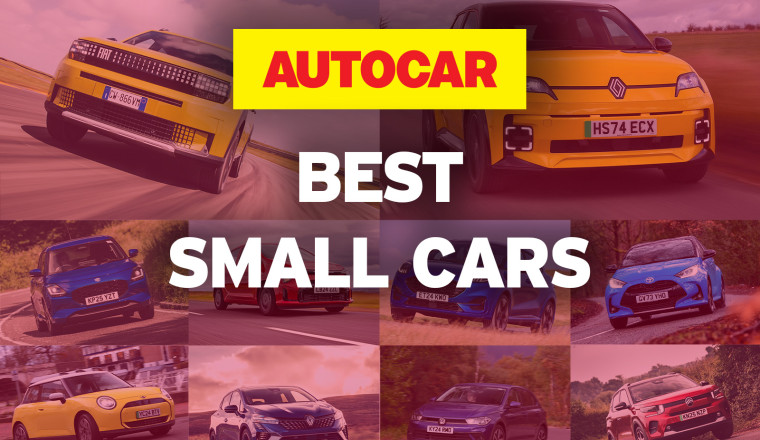

If the old adage translates into the automotive world, then the best cars must be small.
Yet wander along any major city’s streets and you would be forgiven for assuming most drivers felt they needed a gargantuan SUV to battle rush-hour traffic and arrive home relatively unscathed.
It’s nonsense, really, especially given that most car journeys are within urban environments with only the driver on board.
We've also lost some big hitters over the last few years, including the Ford Fiesta, the Toyota Aygo and Kia Rio. But there is some good news: many of the best small cars are among the best cars full stop.
The 10 listed below are our favourite compact conveyances, all bristling with clever features, clipped running costs and bags of cheeky character.
According to our experienced team of road testers, the best small car on sale today is the Renault 5 - but we think the Best Small Car of 2025 is the Fiat Grande Panda. Read on to see why...
Best for: Style
The Fiat Grande Panda is our pick for 2025's Best Small Car, and it's easy to see why.
Spacious and well priced - we just wish it could be a bit more fun to drive.Mark Tisshaw, Editor
The distinctive small crossover boasts a unique, retro-infused design to stand out from the crowd, not least its platform-mates, the Citroen e-C3 and the Vauxhall Frontera.
We've tested the model in both hybrid and all-electric form, and like both. The latter is powered by a 1.2-litre three-cylinder turbocharged petrol engine aided by a 29bhp electric motor, while the former gets 111bhp and 90lb ft from a single, front-mounted electric motor.
As for range, the official claimed figure for the electric version is 199 miles. Either way you go, all versions of the Grande Panda should offer a frugal and characterful package.
Electric supermini offers attention-grabbing style and the promise of sophisticated dynamics for as little as £23k
Best for: Style
There’s a school of thought that the third generation gets technology right, and the Mk3 Renault 5 is a manifestation of this thinking, being the French marque’s third attempt at approaching small electric cars after the Twizy and Zoe.
The motors are a development of those found in the Renault Megane and Scenic but they’re smaller and lighter, since they don’t need to be as powerful.Illya Verpraet, Road Tester
For the car that defined the idea of the supermini in the 1970s only to refine it further in the mid-1980s, there was a danger that a 21st-century retro revival of the Renault 5 could be bloated and disastrous.
On the contrary, the 5 E-Tech is a desirable wee thing. Staying within a 4m-long footprint, the five-door hatchback isn't quite the packaging marvel it was before — batteries and Euro NCAP safety are factors — but it’s close.
Its boot space is good and you will easily get less bulky child seats and older kids in the back seats.
It looks brilliantly proportioned, fun without being forced, offers a fine driving range and is rich in clever details that anyone old enough to remember the original 5 will recognise.
These will be everywhere very quickly and rightly so. Vive la Cinq.
Best for: Price
This list began with a new iteration of the car that the original Renault Clio replaced, yet the famous 5’s comeback doesn’t signal the end of Papa and Nicole's supermini of choice.
Where other brands have stuck their heads in the sand, Renault has correctly observed the emerging trends in this classJack Warrick, Staff Writer
A recent facelift revitalised the pared-down Clio range, with the remaining petrol and 'self-charging' hybrid options focusing on where its appeal is strongest.
As the cheapest full hybrid on sale, undercutting even the Dacia Jogger Hybrid, the Clio E-Tech doesn’t feel like a budget-priced option. Yet the Clio's value feels even more extraordinary in pure-petrol TCe 90 guise.
Sadly bereft of a truly sporty derivative these days, the Clio’s handling still bears the hallmarks of an enviable lineage of hot hatchbacks, being enjoyable to hustle at lower speeds, with well-weighted controls and reassuring feedback through bends.
Renault’s commitment to the Clio may not survive the switch to full electrification, but it has outlived at least one significant rival so far. With its freshened looks, engines and tech, that feels more like success than stubborn survival.
Best for: All-round ability
If overall competence and quality are your benchmark, then the Volkswagen Polo occupies a solid place as ‘the essence of small car’.
The standard-fit digital instrument cluster is pretty clear to read and the screen makes good use of its real estate, with proper configurability between each of the menu screens.Jonathan Bryce, Social Media Executive
It clearly resonates with British buyers, as it was the only supermini to secure a spot in the 2024 best-sellers chart.
Make no mistake: the Polo is enduringly compelling because of its all-round competencies. It's evenly balanced in terms of price, packaging, performance and quality.
It handles with sophistication and it's decently roomy for four or five adults, and the boot is a usable size too.
Sure, in its cheapest form, the Polo does feel spartan and low on energy, plus the dearest models are well inside Volkswagen Golf territory, but grab yourself a good deal and you will be glad you chose the Polo.
Best for: Zero-emission city living
While 2024’s revitalised combustion-engined Mini Cooper models are very effective facelifts of their predecessors, the electric versions are new-new, with a unique platform and, despite the styling similarities, bespoke bodywork.
There’s plenty of power and responsiveness on tap from the electric Mini Cooper’s drive motor, regardless of whether you choose the E or the SEFelix Page, Deputy editor
Diddier dimensions than the Renault 5 also mean smaller batteries for the Cooper S and Cooper SE, but it doesn’t lose out too much in driving range compared with its Gallic challenger.
While the three-door-only EV is still a squeeze for a pair of rear-seat occupants, it’s a tad more spacious than the previous-generation Mini Electric, although it also feels devoid of an nth or two of that car’s sporty character.
Visibility remains Mini-esque, with thick, upright A-pillars creating a letterbox view of the world, while the minimalist fabric-swathed dashboard and wok-sized circular infotainment-and-everything-else touchscreen are divisive.
If you’re a Mini fan, you will love these new EVs – and if you’ve steered clear so far, take one for a test drive before FOMO sets in.
Best for: Economy
No longer a cheap, simple car (the Aygo X fulfils that duty these days), the Yaris offers a different kind of simplicity now, thanks to Toyota’s peace-of-mind-boosting engineering.
The last incarnation of the Yaris was chided for its lack of “carefree spirit and imagination” but, on the basis of this road test, Toyota seems to have rediscovered both characteristics.Matt Saunders, Road test editor
That sense of intrinsic longevity complements the 1.5-litre hybrid powertrain perfectly, with low running costs and slow depreciation as appealing side effects.
Okay, it’s not the most thrilling small hatchback to drive, but the Yaris nevertheless benefits from a nimbleness common to all diminutive cars, which makes it very effective around town.
That’s further amplified by its unshakable determination to eke every inch of motion from its petrol-electric powertrain, seamlessly slipping into EV mode at every possible opportunity. No matter how hard you drive it, the Yaris will do everything in its power to keep you averaging north of 50mpg.
Rear seat space is sufficient for a couple of adult passengers, although it helps if they’ve studied the methods of Harry Houdini to contort themselves out of the small door openings.
But aside from that, the Yaris is a good-quality, stylish small car with plenty of beneficial on-board technology.
Best for: Compact practicality
The new electric Citroën C3’s chamfered boxiness has a dash of SUV-wannabe about it, hinting at the function-before-form approach for which French small cars are historically famous.
The ë-C3 becomes quite a spacious-feeling supermini, one with particularly abundant head room in the front row and enough space in the second row for most adults to be fairly comfortable.Matt Saunders, Road test editor
While a liberal sprinkling of joie de vivre wouldn’t be unwelcome, if simplicity keeps this electric hatchback’s price down, it’s fine – and it has.
Inside it’s a similar story, although the ë-C3’s novel high-set digital instrument slot and small, squared-off steering wheel feel airy, modern and unfussy, making more space for comfortable, generous front seats and championing the brand’s comfort mantra.
That hasn't translated quite as effectively in the back, but this car is only a smidge over 4m long and still has a 310-litre boot as well as high-voltage batteries to package within its shell.
A range one mile shy of 200 between charges will suit most urban motorists very well, while the ë-C3’s quiet powertrain and cushioned ride could be just the ticket to help ease off the stresses of the working day on your stop-start-stop trudge home.
Best for: Lightness
‘Simplify, then add lightness’ are often misappropriated words by Lotus founder Colin Chapman, but it’s a mantra that was present for the firm’s sports and racing cars during his lifetime.
It's light enough around town to make it a doddle to manoeuvre, while on faster roads it’s still perfectly stable around the straight-ahead position. Matt Prior, Editor-at-large
It also seems to be the rationale behind how Suzuki goes about engineering its cars, so much so that the latest Swift weighs less than a tonne. Even the gently elevated Allgrip 4x4 version with mild-hybrid electrification on board tips the scales at only 1037kg.
Yet a quick poke around the Swift confirms that everything you would expect to find in it is there: safety kit and all mod-cons, comfortable room inside for a quartet of adults and a fifth for shorter journeys – and yes, there’s a petrol engine under the bonnet.
Clever engineering is at play here and – disappointingly for Suzuki – it’s a quality that’s not better known by the majority of car buyers.
The Swift is light, efficient, well-equipped and good-value and has a degree of handling engagement that encourages to you press on and wring its revvy triple for extra fun. Imagine what a hoot a Lotus version would be.
Best for: City car proportions
Formerly a cute, underpowered bargain-basement supermini, the Kia Picanto has since received an angry facelift. If it were a terrier, you would fear your ankles were about to get gnawed to the bone.
The 255-litre boot is usefully deep, but the Aygo X and Dacia Sandero have longer seats-down load bays.Richard Lane, Deputy road test editor
That snarl is more severe than the Picanto’s bite, though, because one feature deleted at the facelift was its predecessor’s turbocharged triple. Now natural aspiration rules, with a choice of a 1.0-litre three-cylinder or a 1.2-litre four.
A maximum of 77bhp to move the still-sub-tonne Picanto, plus occupants, ensures its performance is adequate rather than peppy.
With the Picanto’s more sedate pace, there’s more time to appreciate the relative quality of its interior and marvel at the delightful precision of its standard-fare manual gearchange.
Perhaps the greatest satisfaction the Picanto serves up as one of the few dinky city-centric cars on sale is how deftly you can nestle into parking spaces that would cause drivers of models from the segment above to break into a spell of clamminess.
Best for: Handling
'Crossover' is a word that has been used and abused so many times that it has lost all meaning, but if you consider the elements that come together to create the Ford Puma, it’s about the only word that fits.
This is unquestionably a strong contender for the class lead. It's more fun to drive than the Kamiq and T-Cross, just as compliant as the Captur and more practical than the MokkaMatt Saunders, Road test editor
Inheriting an effective evolution of its 1990s coupé namesake’s style, the small car prowess of the last (and best) Ford Fiesta, enough of the Kuga’s off-road stance to appeal to larger SUV buyers yet still low enough to the ground and agile enough to truly be worthy of handling accolades in hot ST form, the Puma is less of a mashup and more of a symphony of genres.
There’s now an electric version, too, called the Puma Gen-E, although its small battery means it’s less competitive than bespoke EV designs.
All Pumas offer good rear passenger access and high-set rear seats for easier child-seat installation, a huge plastic tub with a plughole for a messier lifestyle kit under the boot floor and styling that looks ‘right’ among a slew of awkwardly angled contemporaries.
Not bad for a car that’s both the spiritual successor to the Ford Fusion and a Ford fusion.
Small cars offer compact proportions, so any options on this list will be a great choice.
Decades' worth of small car testing gives our road testers a uniquely deep insight into what makes a great supermini.
Representing many different perspectives and tastes of driver and lifestyle, there’s more to putting the top 10 together than pulling names out of a hat.
In a guide like this, crossing genres slightly, we’ve looked for the small cars that have that intangible X-factor that ensure every journey has the potential to feel special.