
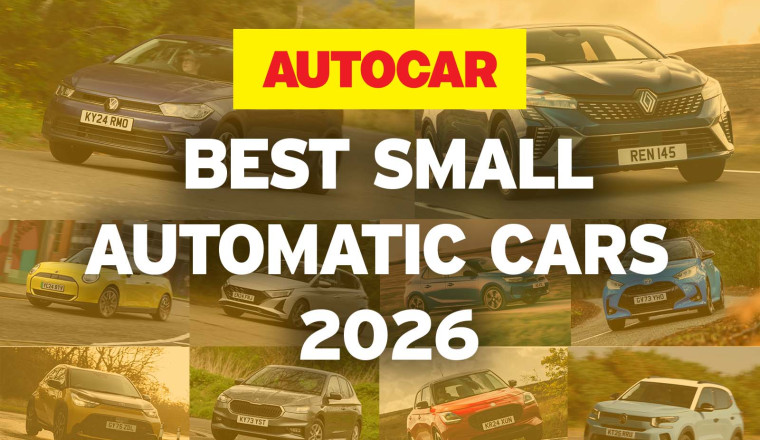

Finding a small car with an automatic gearbox is no longer the tiresome task it once was.
It wasn’t that long ago when most superminis were predominantly fitted with a manual gearbox, with many forgoing an automatic option altogether because of higher production costs.
But with the rise of electric and hybrid cars, which are inherently automatic, there has been a paradigm shift away from the manual 'box, with more drivers preferring the convenience, smoothness and added efficiency of an auto.
Small cars are the ideal choice for urban commutes and inner-city jaunts, their compact size making them easy to thread through narrow streets, while also being affordable and cheap to run.
An automatic 'box is therefore. much better for a small car, eliminating the need for shifting gears yourself in busy traffic. Plus, thanks to mild-hybrid technology, an auto is often more efficient than a manual.
We think the best small automatic car is the Renault Clio E-Tech, a full-hybrid supermini that blends driver appeal and comfort with affordability and efficiency.
But there are plenty more small automatic cars to choose from, so read on as we reveal the best cars on sale today.
We’ve excluded electric cars from this list, but you can read about our favourites in our top 10 electric cars here.
Best for: Material quality
The Renault Clio offers a choice of two engines: a turbocharged 1.0-litre petrol triple and a hybridised 1.6-litre petrol four, badged E-Tech.
Turn-in is keen, with disciplined body control and good composure. It’s not ultimately as rewarding to drive as a Ford Fiesta but few, if any, other rivals match itMatt Saunders, Road test editor
Only the latter comes with an automatic gearbox, but both are great options on the road.
The E-Tech hybrid produces 143bhp and power is managed by an unusual 'multimodal' automatic gearbox with two electric motors.
This parsimonious supermini is claimed to achieve up to 67.3mpg and is one of the cheapest hybrids to buy, starting from £21,795.
No-nonsense supermini goes big on sophistication and practicality
Best for: Price
Like the Seat Ibiza, the Skoda Fabia is a Volkswagen Polo underneath, so you’ve got the same 1.0-litre TSI petrol offering with a seven-speed automatic gearbox.
The handling is quite vanilla, but that will prove a popular flavour for many supermini buyers, who will appreciate its undemanding competence in corners and value its ride comfort.Illya Verpraet, Road Tester
It comes in at £21,780, though, which represents a slight saving over the Ibiza.
We’re big fans of the Fabia, because it’s roomy and practical and has a genuinely user-friendly interior.
What's more, it rides better than some luxury cars on the market - a big boost to its appeal as an everyday runaround.
It’s not quite as fun to drive as the Renault Clio, but it’s a great small car in its own right.
Best for: All-round ability
Few small cars can match the Volkswagen Polo for its practicality, refinement and well-mannered drive.
Competent in almost every direction, the Volkswagen Polo’s dependability seems to be at the expense of any charm.Matt Saunders, Road test editor
It may not be the most dazzling or exciting offering in its class, but the Polo has a level of sophistication that far exceeds its supermini billing. Here we have a small car with intuitive technology, a roomy cabin and reassuring on-road manners that is also economical and refined.
It’s dearer than rivals, but its broader range of ability justifies its price tag. The cheapest automatic costs from £24,440 and comes fitted with a 94bhp 1.0-litre petrol engine and seven-speed dual-clutch (DSG) gearbox.
Opt for R-Line trim and above and the power is upped to 114bhp, but this drops the 53.1mpg economy figure down marginally to 52.9mpg.
Best for: Character
Mini's evergreen hatchback gained a substantial update in 2024, returning for its fourth generation.
For sure, there are cheaper alternatives, with more abstemious engines, bigger boots and more intuitive infotainment, but few with the charisma and panache of this usefully updated stalwart.Felix Page, Deputy editor
Thankfully, it retained its eye-catching, characterful design, but the brand also chose to keep a choice of petrol or electric power.
Drivers can choose between Cooper C, Cooper S and John Cooper Works variants.
Power starts at 154bhp in the C, jumps up to 201bhp in the S and climaxes at 229bhp in the JCW.
Mini's decision to drop the manual gearbox for this generation will be disappointing to some. It's a shame, for sure, but it doesn't stop the British-built car from offering one of the most fun driving experiences in its class.
It's the best-handling small hatchback besides the rally-bred Toyota GR Yaris, with brilliant traction and accurate steering. This is detrimental to the ride, however, which is quite firm.
Best for: Economy
Yet another great supermini on this list, the Toyota Yaris is offered with an automatic gearbox as standard – but things are slightly different here.
Electric propulsion is a real asset in town, enabling the Yaris to be quick off the mark, and the base-spec model’s greater pliancy over its firmer range-mates is welcome.Matt Saunders, Road test editor
It’s an e-CVT, meaning there's just one continually variable 'gear'. Thankfully, on the surface, it works the same as a traditional automatic.
The Yaris is priced from £23,845, which makes it one of the cheapest of its kind on sale today. Things are made even more simple, because there's just one engine option: a hybridised 1.5-litre petrol triple.
It matches 114bhp of power (for a 9.7sec 0-62mph time) with class-leading frugality, with up to 70.6mpg officially on offer and achievable in reality.
Best for: Value
For those who want a simple, comfortable and affordable small automatic, the Citroën C3 is likely to make it on your shortlist, and deservedly so.
No version of the C3 can be described as 'quick', but there's enough power here to make daily duties a breeze.Jack Warrick, Staff Writer
Sure, its drive lacks the verve and engagement of the Renault Clio and Mini Cooper, but it’s by far one of the softest riding offerings in its class.
The Hybrid variant is powered by a 1.2-litre turbo petrol engine that's paired with a small battery and a 39bhp electric motor integrated into the dual-clutch automatic gearbox.
It’s not fast or exciting, but it delivers the right amount of performance you would need and expect from a car of this ilk.
Prices start at £21,145, which makes the C3 competitive for the class – and unlike with many rivals, the entry-level version gets plenty of standard kit.
Best for: Town driving
Were it not for its iffy ride, frustrating ADAS technology and cheap-feeling interior, the Suzuki Swift might have ranked a bit higher in this list.
The chassis feels very well-balanced and it provides for a much more involving drive than the Volkswagen Polo or Skoda Fabia.Illya Verpraet, Road Tester
It’s a bit more fun to drive in manual form, too, but don’t let these points deter you from what is a compact, affordable and frugal small automatic car.
For £20,949, the Swift is well priced and comes fitted with all the kit you would expect, such as Apple CarPlay and a reserving camera.
You won’t feel short-changed when it comes to the Swift’s driving experience either, with its well-judged steering and body control making it a fun car to pilot down a cross-country road. And it’s pretty civilised on a motorway too.
If you want more space and refinement, however, look at the Volkswagen Polo or Renault Clio.
Best for: Cheap running costs
A smooth hybrid powertrain and a claimed efficiency figure of 74.6mpg this little pseudo-crossover is one of the best options for those who want cheap running costs.
I used to run a Mk1 Honda Insight, which would do 85mpg without much trouble. This Aygo X does similar in the right circumstances. Richard Lane, Deputy road test editor
The adoption of hybrid power has heightened the Aygo X’s appeal dramatically. You will have no trouble achieving more than 65mpg from its electrified 114bhp 1.5-litre petrol engine (borrowed from the larger Yaris). Indeed, in the right circumstances, it will do closer to 80mpg.
While the old pure-petrol Aygo X took 15.6sec to reach 60mph (fitted with a manual gearbox) the new hybrid takes just 9.0sec, its e-CVT offering smooth and uninterrupted progress.
It’s not quick, but it’s good around town, with a pleasing sense of urgency.
That the Aygo X starts from £21,595 is a bit of a sticking point, however, because this puts it in the same bracket as cars that offer greater practicality and performance.
Best for: Style
The Hyundai i20 isn't the driver of sales that it once was but still has an important role to play.
The i20 is far from the best-handling or best-riding supermini. Then again, this small, relatively light hatchback still feels fundamentally right in a way that most crossovers don’t.Matt Saunders, Road test editor
This stylish supermini is available with a seven-speed-clutch automatic gearbox and, although it isn't the most spritely option, is fairly frugal, offering 52.3mpg.
The gearbox is mated to a 1.0-litre turbocharged engine with just 99bhp.
It's a pleasant small car; just don't expect fireworks.
The Peugeot 208 is mechanically very similar to the Vauxhall Corsa, and that includes its six-speed automatic transmission, which is fitted with an electric motor.
They're both popular choices, thanks to the option of petrol, hybrid and electric power. The cheapest automatic will be equipped on the hybrid variant of either.
The Corsa’s light steering wants for both feel and a build-up of resistance as lock is applied, but the car is stable and predictable at speed and easy to manoeuvre in town.Richard Lane, Deputy road test editor
Vauxhall's automatic supermini comes in slightly cheaper than its French counterpart, costing at least £23,595, compared with £25,375.
Regardless, both are refined, comfortable and good to drive, so it will come down to which design or brand you prefer.
Gearbox type will often dictate the characteristics of the car more than the engine itself, so here’s what you need to consider before buying a small automatic.
Gearbox type
Why it matters: This can change how the car feels to drive and how much it costs to maintain.
Urban or motorway use
Why it matters: Some small automatics feel busy and loud at high speeds, while others are geared for the open road.
Essential features for automatics
Why it matters: A smooth gearbox should also come with auto-hold and parking aids to make driving more seamless, particularly in built up traffic.
How to decide if you actually need a small automatic
A small automatic makes sense if:
If you predominantly drive long distances on empty A-roads, a manual version of the same car might be cheaper to buy and more fun to drive.
When reviewing the best small automatic cars, we focused on the specific needs of the modern driver: effortless urban commuting, refinement at speed and the smoothness of the gearbox itself. Here’s what we assessed:
1. Transmission calibration
Not all automatics are the same. We evaluated the responsiveness of dual-clutch transmissions (DCTs) for low-speed 'creep' and shift speed, tested CVTs for engine "drone" under acceleration and checked traditional torque converters for smoothness. We also looked out for jerkiness at low speeds.
2. Urban agility and manoeuvrability
A small car must excel in tight spaces. We compared the turning circle of each car and tested the steering weight to see how easily each car navigates mini-roundabouts and multi-storey car parks.
3. Real-world efficiency
Small cars are often chosen for low running costs. We assessed each car’s claimed MPG and compared this to its real-world figure. We measured the efficiency both in urban and motorway driving.
4. Refinement and ride quality
Small cars often struggle with the UK's pockmarked roads. We tested each vehicle’s ability to soak up potholes and speed bumps. Crucially, we measured cabin decibel levels at 70mph to see which cars actually feel more mature at a cruise on the motorway.
5. Visibility and technology
Ease of driving is paramount. We assessed over-the-shoulder visibility and the effectiveness of standard-fit driver aids like reversing cameras, blindspot monitoring and auto-hold functions.