
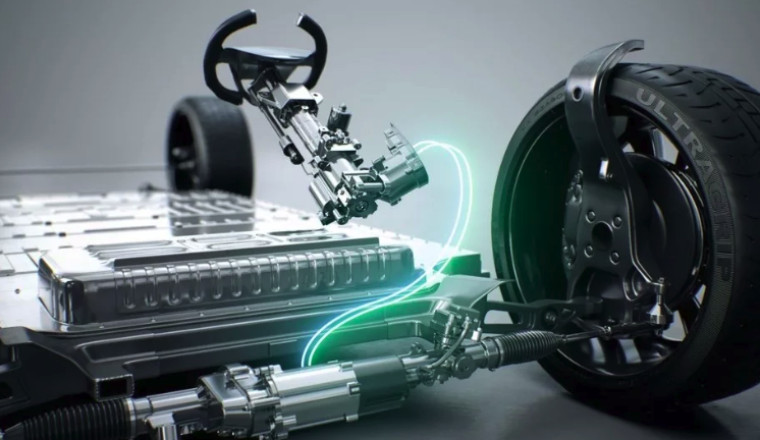

At first, the idea is unnerving: a steering wheel with no direct link to the front wheels. Instead of shafts and gears, steer by wire uses sensors, motors, and computers to translate your movements into steering action. It’s the same principle used in fighter jets and spacecraft systems you’d trust with your life. That’s because these digital steering systems aren’t just smart; they’re engineered to be redundant, fail-operational, and far safer than old-school mechanical setups.
Here’s how it works.
When you turn the wheel, sensors measure your input down to fractions of a degree. These signals travel electronically to the control unit, which commands powerful electric actuators in the steering rack to move the wheels precisely. Meanwhile, feedback motors on the wheel recreate the “feel” of the road bumps, grip, resistance all simulated in real time. What you get is a programmable connection that adapts instantly to speed, terrain, and even weather.
So what happens if the power cuts out?
That’s where redundancy comes in. The system uses multiple power sources, usually split between the car’s main 48-volt network and a backup 12-volt system. If one fails, the other instantly takes over. The same goes for sensors and actuators: a Tesla steer by wire setup, for example, uses triple redundancy, two steering motors and a third backup sensor acting as a “referee” if one disagrees with the others. If all else fails, the car enters a safe “limp mode,” electronically locking steering in a stable position so you can coast to safety.
Modern steer by wire cars also follow aviation-grade rules for safety architecture. Known as fail-operational design, this ensures that even with one or two component failures, the steering remains controllable. Systems use what’s called the two-out-of-three rule, three sensors cross-check each other’s readings, ignoring any faulty data. It’s a safeguard used in aircraft autopilots, and now in your front driveway.
Engineers love steer by wire because it opens doors for sharper handling, autonomous driving, and packaging freedom ... no bulky steering column punching through the cabin. But for everyday drivers, its biggest gift might simply be safety. With no physical link, a crash can’t send steering torque back into the cabin, and the system can adjust steering ratios on the fly to keep the car stable at any speed.
So yes, the idea of steering your car through wires and motors instead of metal rods might sound like science fiction until you realize it’s the same technology guiding airliners through storms and rockets into orbit.