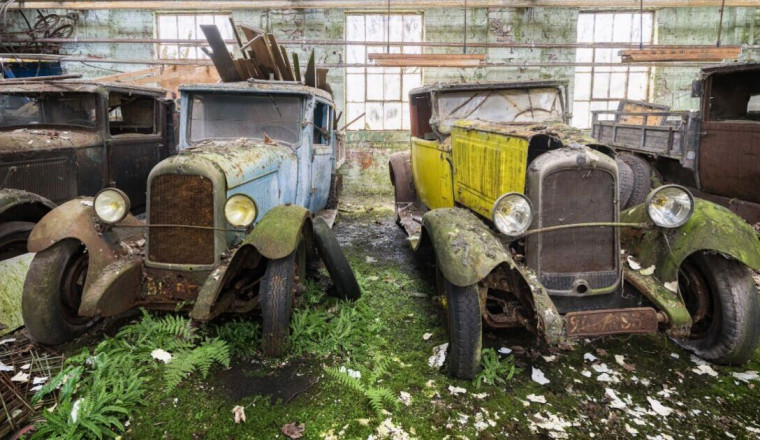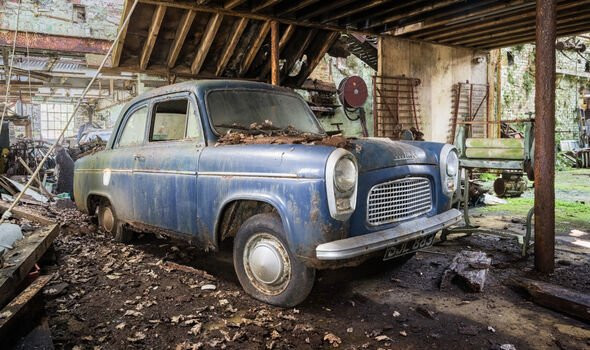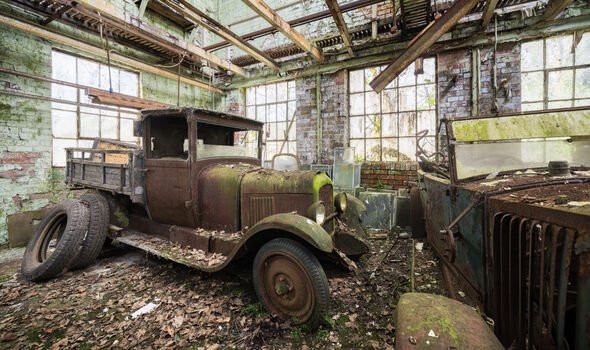

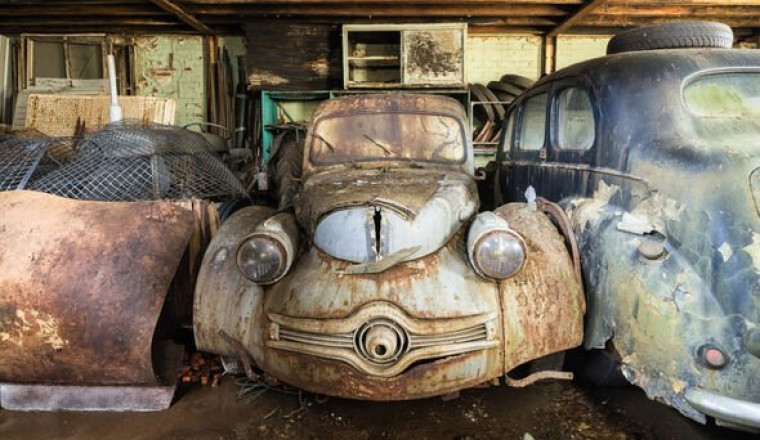

The location has no official name. It has no website, no visitor numbers, no curator. What it has is a ground floor packed with cars ranging from the 1930s to the 1980s, sitting in the dark since Margaret Thatcher was Prime Minister, slowly being reclaimed by moss, ferns, and time.
The find belongs to Janine Pendleton, who documents abandoned places under the name Obsidian Urbex Photography. She explored the site several years ago and published her images in Spring 2025, calling it "Motors & Miniatures" — a reference to the car collection on the ground floor and the whimsical dioramas she found elsewhere inside the building. The images circulated widely.
"In the far corner lie 1930s old-timers, rusted and rotting and surrounded by moss and ferns. In an adjacent room are a couple of 1960s cars in similar condition."
The oldest vehicles in the collection are believed to be a Citroën B14 or B15, French motorcars first produced between 1926 and 1928. If confirmed, they are approaching a century old, having spent most of that time inside a building that has not been a functioning business since the 1980s. The B14 was a mid-range family car of its era, powered by a small four-cylinder engine, built during a period when Citroën was establishing itself as one of Europe's most technically ambitious manufacturers. Finding one in a derelict English mill, overgrown and rotting, is the kind of discovery that makes classic car historians look twice.
The mill's collection spans roughly 60 years of automotive production. Models from the 1930s sit alongside cars from the 1960s in an adjacent room, each in varying states of deterioration. The cars were not placed there as exhibits in any formal sense. This was not a museum that was opened and then closed. It appears to have been a private accumulation, a collector's passion project that outlasted the collector's ability or willingness to maintain it, and simply stayed where it was.
Britain has a long tradition of exactly this. Garages, farms, barns and industrial buildings across the country contain cars that were parked with the intention of restoration and never touched again. MotorBuzz has written about some of the worst cars ever made — but there is something almost perversely compelling about the ones that survive precisely by being forgotten. No rust-proofing campaigns, no well-meaning enthusiasts stripping them for parts, no auction house cataloguing their flaws. Just darkness, and decades, and the slow return of nature.
Like this? Get the app: iOS | Android
The preservation community has mixed feelings about finds like this. On one hand, every year spent in an unheated, damp mill accelerates the corrosion that makes restoration progressively less viable. A Citroën B14 that might have been a viable restoration project in 1985 is considerably more challenging in 2025. On the other hand, the cars are still there. They have not been crushed, parted out, or poorly restored by someone who thought bright red paint would be an improvement on the original colour. The collection exists as an intact time capsule in a way that is increasingly rare as barn finds become a documented subgenre of YouTube content and prices for anything pre-war with a continental badge have made the most significant examples worth finding and selling.
Pendleton has declined to identify the location, which is standard practice in the urban exploration community. Naming a site publicly risks vandalism, theft, and the kind of heavy-handed attention that leads to the sort of rapid dispersal that destroys collections that have survived intact for forty years. The cars are where they are. Whether they stay there, whether someone with the means and the intention to save them eventually finds the owner and makes an offer, is unknown.
What the photographs show is a building that time forgot, sitting in England somewhere, full of machines that once carried people to work and on holidays and to weddings and funerals, now ringed by ferns in the dark.
Sources: Obsidian Urbex Photography — Janine Pendleton, published Spring 2025 | Citroën B14 production records: 1926 to 1928 via Wikipedia / Citroën Type B14