

We may receive a commission on purchases made from links.
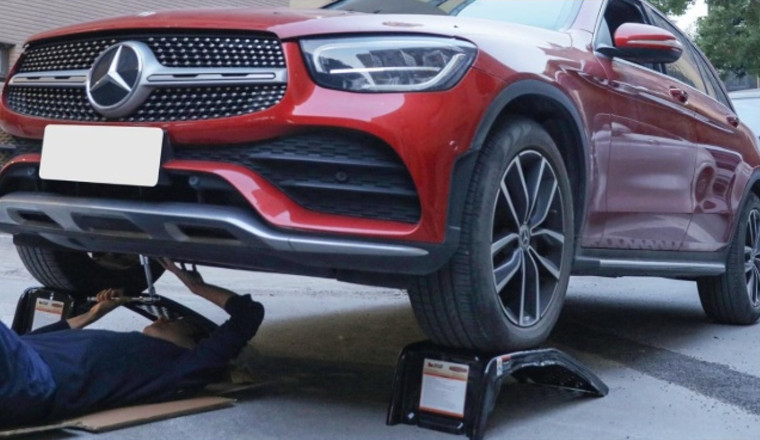
When doing maintenance or repairs to your car, access to the underside of the vehicle is often essential. But many automobiles don't have the necessary clearance in order to squeeze between the ground and undercarriage. Ideally, a hydraulic lift offers the best access, with powerful supporting arms able to raise the car high into the air. Unfortunately, not only do you need a dedicated garage space for such a piece of equipment, but it'll also run you well into the thousands of dollars for something like an AMGO hydraulic 2 post lift, which retails for around $3,800. Alternatively, The QuickJack is a slick tool that makes working under a car quick and easy, with some models costing less than $2,000. Nevertheless, these costly solutions aren't for everybody, especially considering you can find various drive-up ramps for less than $100. But are they any good?
One YouTuber, Project Farm, sought to test several different drive-up ramps ranging from around $60 up to $160. Surprisingly, the least expensive Pittsburgh plastic ramps grabbed the number one spot, whereas the much higher priced VOWAGH ramps came in sixth. The tests featured a variety of cars, including front-wheel drive, four-wheel drive, and rear-wheel drive vehicles, and a total of 11 different ramps. Each product was put through a series of evaluations, such as how well each stays in place, how much weight each can support before failing, and how much force it takes for the vehicles to roll off the ramps.
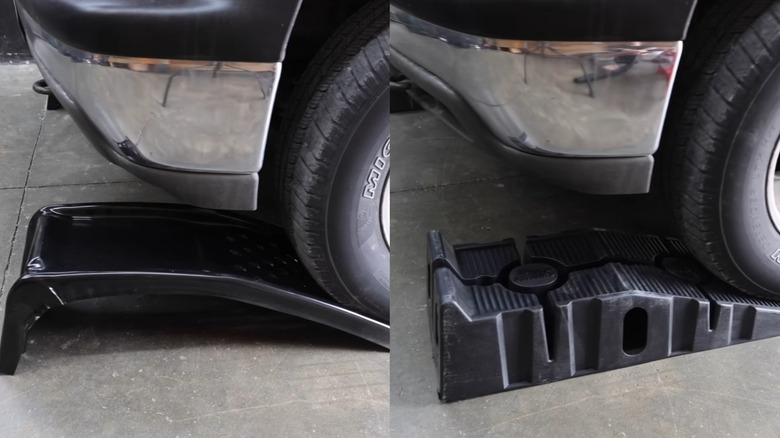
While you may expect that a ramp made from steel will offer greater strength and durability, several plastic ramps were able to support more weight. For example, the BiSupply (plastic) ramps, which are rated for 4,000 pounds each, were able to take over 25,000 pounds before beginning to fail. In contrast, the Harbor Freight (steel) ramps with a rating of 2,000 pounds each began to deform near 7,000 pounds of pressure, which is, admittedly, still several times over the rating, but nowhere near the capabilities of the leading plastic ramp.
Another critical component of a safe drive-up ramp is what's underneath it. To get the vehicle higher off the ground, the ramps themselves must resist sliding. Some of the products offered multiple rubber feet on the underside (which is ideal), to help reduce the chances of slippage. Others only had just one or even no grip pads. In the case of rear-wheel drive vehicles, every ramp slid across the garage floor, rubber feet or not. Fortunately, by adding a damp cloth under the ramp, most of the products remained in place, but a few of them slid out no matter what. Some products, like the Rhino ramps, struggled during testing, as they only feature a single rubber pad, which wasn't enough to keep the ramps in position.
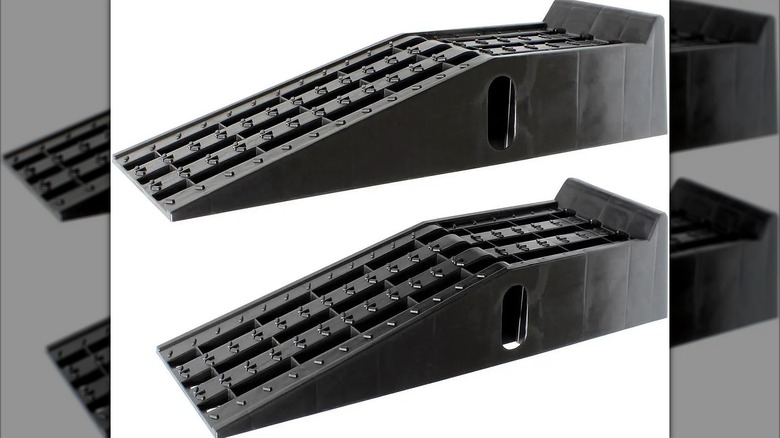
While they may not necessarily affect the performance of the ramp, certain safe-guards do provide some peace of mind. Of course, you could always just opt for an SUV with more ground clearance than a Jeep Wrangler, which wouldn't necessarily need drive up ramps at all. However, for the rest of us, there are some products that offer small raised edges on either side of the ramp, which can help guide the tire into the center. This can ensure you don't position the vehicle awkwardly as you roll up the ramps.
Another handy inclusion is a more pronounced wall or lip at the end of the top part of the ramp (tire stop), providing a clear indication where the wheel should rest. Among the test finding's, several ramps under $100 required well over 700 pounds of forward force to roll the vehicle over the tire stop.
Lastly, some options are designed with a small hump as you crest the ramp and a concave spot for the wheel to rest. This can help prevent the vehicle from accidently rolling back if you neglect to engage the emergency brake. While the torture-test handed the most expensive ramp of the group, the VOWAGH, the top spot in this particular exercise, requiring nearly 370 pounds of force to get the vehicle to roll back, the MaxxHaul, at less than $60, wasn't too far behind.