
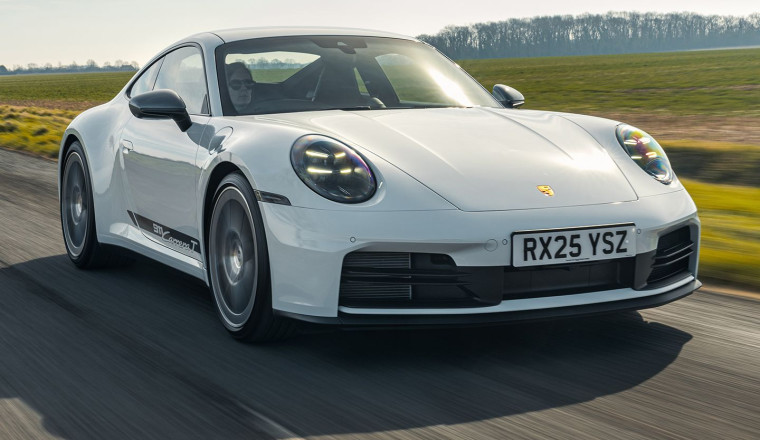

It would be fair to call 2025 an annus horribilis for Porsche. Even the company itself called it ‘challenging’, and for a long time it felt that Porsche was the gold standard that all aspired to. But thanks to what it terms ‘extraordinary burdens’ - tariffs, China’s decline, a cooling of EV demand - it really struggled through 2025. The numbers are staggering: while sales weren’t drastically different at 36.27 billion euros (40.08 in 2024), profit plummeted from €5.64bn to €413m. It really is hard to get your head around more than five billion euros less profit from one year to the next; fortunately there are people to keep track of these things…
Porsche speaks of ‘extraordinary expenses’ of approximately 3.9 billion euros, which is clearly the bulk of that loss. It suggests that around 700 million is from tariffs, another 700 million is from ‘battery activities’, while the majority - 2.4 billion euros - is from ‘realignment of the product strategy and the rescaling of the company.’ So moves like making the SUV above the Cayenne a hybrid instead of electric, and reengineering the upcoming 718 EVs to take combustion power also. They’re hugely expensive undertakings, which obviously now must pay off. Because a company used to billions of euros of profit won’t go drastically unchanged with ‘just’ hundreds of millions for long, however much streamlining is done.
Step forward, then, new CEO Michael Leiters’ Strategy 2035. Announced at the company’s annual press conference, he’s promising a repositioning of Porsche to make it “leaner, faster and the products even more desirable.” So it means lots of businessy things like cutting back on bureaucracy and reducing hierarchies in the company, but also some new Porsches. ‘Value over Volume’ will be the important phrase going forward, making more money off each car sold rather than aiming for record numbers. (In 2025 the operating return on sales was 1.1 per cent, against 14.1 the year before.) So more special editions seems likely - ‘emotive new derivatives’ are coming this year - but also models that take Porsche into markets it hasn’t yet been part of.
“We are considering the expansion of our product portfolio in order to grow in higher-margin segments”, explained Leiters. So there’s the car above the Cayenne on planet SUV that’s been mentioned before (presumably with Bentley Bentayga and Range Rover levels of swag), plus what the boss called a derivative “above our current two-door sports cars”. While only said to be considering for the moment, it would seem strange to share a product plan that doesn’t have at least some viability to it. Remember, too, Leiters has previously worked with both McLaren and Ferrari; the latter in particular are probably the best around at making the most money from each unit sold.
Think how much more expensive the latest hypercars have become, too. Obviously that doesn’t automatically equate to more profit, but when a Lamborghini Revuelto costs almost twice as much as its Aventador predecessor (and the Aston Martin flagship has moved well beyond £300,000), there is some room to grow into for Porsche that didn’t exist that long ago. Somewhere above a Turbo S or GT2 but beneath the limited edition cars like the 918 Spyder, basically. It’s said that a ‘high net liquidity and a healthy balance sheet’ means Porsche has the ‘flexibility and resilience for the tasks ahead’. The exact plans for Strategy 2035 can be seen through, it would seem, rather than simply mooted and then scrapped on the boardroom floor. Porsche doesn’t tend to delay on strategy decisions, either. All that’s left to do now is wait and see exactly what a higher margin Porsche sports car looks like.
Leiters concluded: “With Strategy 2035, we want to lay the foundations for sustainably strong cash flow, strong results and margins that are appropriate for Porsche." It’s going to be a busy few years for all involved, that seems certain. Can a dire situation be turned around?