
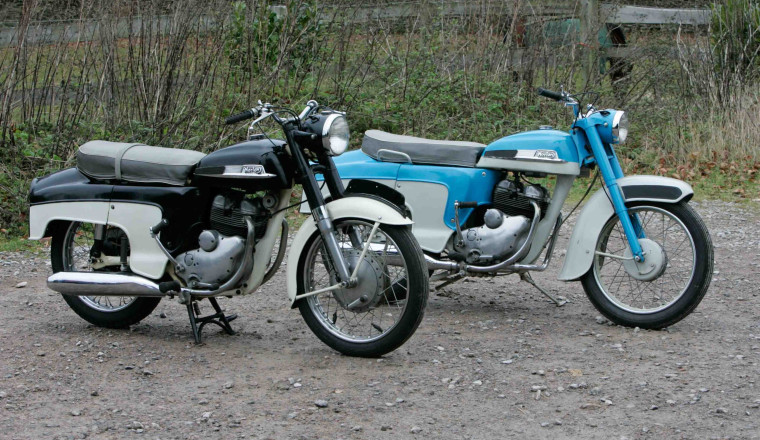

Parked side by side on a spring afternoon, Norton’s Navigator 350 and Jubilee 250 looked attractive and practical, with their two-tone paintwork and enclosed rear wheels. But the sight of these near-identical twins from the ’60s was enough to send a shudder down my spine—they instantly brought back memories from a long time ago.
When I was a schoolboy in the late ’70s, a friend had made the mistake of assuming that because I owned a Triumph twin, I was good at fixing old British motorbikes. So he’d asked if I’d mind coming ’round to help sort out the non-running Norton he’d just bought.
I arrived to find a 250cc Jubilee suffering from a variety of mechanical problems. Despite spending many hours working on the thing in Phil’s cold and poorly equipped shed, we never managed to get it going.
Back then, that particular Norton’s troubles seemed to sum up the decline of British bikes. This contrasted with the rising fortunes of the Japanese manufacturers, whose exciting two-strokes such as the Yamaha RD250 and Suzuki GT250 were being ridden by some of our more affluent and fortunate friends.
The current motorcycle scene is very different—and not just because learners in the U.K. are no longer allowed to ride 250-cc bikes. Triumph is a huge success, old rivals Norton and BSA are revived, and many classic British bikes are cherished and admired.
Even so, you’d be stretching the truth to describe the 250-cc Jubilee as a desirable British classic. But the two Norton middleweights are regarded very differently: The 350-cc Norton Navigator, despite its many similarities, has a much better reputation than its smaller-engined sibling.
That’s largely because by the time the Navigator was launched in 1961, two years after the Jubilee, Norton had managed to cure many of the mechanical problems that had plagued the original twin. The Navigator also had superior suspension and brakes, as well as extra engine performance and reliability.
Having finally had the chance to ride a Norton Navigator several decades after that frustrating experience with the Jubilee, I found it easy to understand why the larger model was well-liked by most people who rode one.
The story of both models starts with the Jubilee’s development in the late 1950s. Norton, by this time part of the Associated Motor Cycles (AMC) group, decided to add a small-capacity parallel twin to the marque’s traditional line-up of singles and big twins.
Bert Hopwood, one of the British industry’s leading engineers, designed an all-new 249-cc machine that incorporated advanced features including unit construction (one-piece engine and gearbox), narrow valve angles, and “oversquare” bore and stroke dimensions of 60 x 44mm.
The Jubilee, unveiled in 1958 and named to celebrate the 60th anniversary of late founder James Lansdowne Norton’s firm, was in many ways doomed before production began because Hopwood’s original design had been altered to cut costs.
The designer had intended the cylinder head and barrels to be cast in one piece; hence the oversquare dimensions and steep valves to facilitate assembly and maintenance. But that plan was abandoned, and instead the Jubilee followed convention with a separate cylinder head.
Norton also departed from the firm’s traditional high-quality chassis specification in order to save money by sharing design and parts with Francis-Barnett, another marque that was part of the AMC group. The Jubilee chassis was based around a frame very similar to that of Francis-Barnett’s Cruiser 80, combining a pressed steel front section and seat post with a tubular steel rear subframe.
Wheels, brakes, and the front fork were also borrowed from the “Franny-B”; surprisingly so, given that the Cruiser was significantly lighter than the 326-lb Jubilee.
The Norton’s styling, with its distinctive enclosed rear end, also received a mixed reception. Rival firm Triumph’s boss Edward Turner had introduced the striking and controversial 350-cc Twenty-one, with its enclosed rear end—soon nicknamed the “bathtub”—in 1957.
Norton aimed for similar visual impact and efficiency with the Jubilee’s pressed-steel enclosure, which also incorporated a fully enclosed drive chain. The Jubilee wasn’t as elegant as the rounded Twenty-one, and its styling alienated many Norton enthusiasts, but with its two-tone paintwork, it was nonetheless an eye-catching machine.
Unfortunately for Norton, it was also a very poor one. Top speed was a modest 75 mph, and the short-stroke motor was predictably revvy. This might not have been so bad if its gearbox had been better, and if the parallel twin powerplant had not vibrated so much at the high revs required for reasonable performance.
The powerplant also wore quickly, leaked oil, and developed a reputation for unreliability, with broken crankshafts and poor electrics being particular early problems. Lights, horn, switchgear, and ignition were notoriously bad, and some frames also cracked.
The Jubilee’s star turn was its habit of catching fire after a short-circuit in the wiring, when the powerful battery caused the wiring to glow red hot. Even when the bike was running, its mediocre suspension and brakes spoiled the ride.
Inevitably, the Jubilee had become a resounding failure by the time it was followed by the 349cc Norton Navigator in 1961. To cash-strapped Norton’s credit, the larger-engined model was a dramatic improvement. The Navigator gained its extra capacity by being bored and stroked to 63 x 56mm. It was offered with both the familiar Jubilee-style enclosed bodywork (like this black example), as the De-Luxe; or in stripped-down Standard specification. In either form, it was a superior motorcycle in every respect.
The engine had been redesigned to be more oil-tight, and also incorporated an improved gearbox and a stronger one-piece forged crankshaft. New camshafts and a larger carburetor combined with the extra capacity to give more midrange torque, as well as an increased maximum power output of 22 bhp at 7000rpm. As the Navigator was barely heavier at 335 kg, that gave a much better power-to-weight ratio, as well as a respectable top speed of 85mph.
Chassis improvements were equally important. The frame had a stiffer down member and steeper geometry that gave a shorter wheelbase. Norton’s famous Roadholder forks replaced the flimsy Francis-Barnett items, and the front mudguard was smaller and lighter. The front brake was a bigger eight-inch unit instead of a six-inch drum. The Navigator also had improved electrics, including a larger headlight.
All of which helps explain why this 1961 Navigator you see here was a very enjoyable bike to ride, at least for a short spin on a cold afternoon in the Cotswolds. Restored some time ago, it was in good and original condition, albeit lacking a side-stand and the handles originally fitted on both sides of its seat. As well as giving the pillion something to hold, the left handle helped when using the center-stand—so parking this Navigator was a back-straining exercise.
All that was forgotten when the bike was underway. My first pleasant surprise was how good it sounded, after I’d turned on the ignition switch on the headlight, ticked the carb using the small metal lever on the left bodywork section, then kicked lightly to bring the engine to life. The engine was mechanically quiet, but the note from the twin silencers was deeper and fruitier than I’d expected of a mere 349-cc twin.
The Norton Navigator accelerated with plenty of enthusiasm, too, its sensation of speed enhanced by the cold air rushing down the back of my neck, thanks to the upright riding position and lack of weather protection. Given the motor’s short-stroke dimensions and rev-happy reputation, I was expecting it to feel gutless and to require plenty of cog-swapping. But at low and medium engine speeds, the bike was quite responsive, and was also smooth enough to make gentle riding pleasant.
Inevitably, though, getting more performance from the Norton meant revving it harder, which resulted in typical parallel-twin shakes, especially through the handlebars. At least the four-speed gearbox was reasonably efficient. That 85-mph top speed meant that back in the early ’60s the Navigator was a good 5 mph faster than its Triumph Twenty-one rival, which had a lower claimed output of 18.5 bhp. Whether the Norton would have been faster than the smoother-running Triumph on a typical trip is another matter.
There’s little doubt that the Navigator had the edge on handling, though. This humble Norton might not have been equipped with the marque’s famous Featherbed frame, but its simple sheet-steel frame worked well enough in combination with the high-quality Roadholder forks. The Navigator also benefited from its swing-arm pivot being well supported at either side by frame gussets, in contrast to the Twenty-one’s flimsier location on a single vertical frame tube.
This elderly Norton Navigator certainly cornered securely enough to uphold the marque’s reputation for sound handling. It also slowed with reassuring efficiency thanks largely to its generously sized single-leading-shoe front brake, a huge improvement over the puny unit fitted to the Jubilee.
As it was, the Jubilee’s poor reputation ensured that the infinitely better Navigator also failed to attract many buyers, whereas its 350-cc rival the Twenty-one was yet another success for Triumph. Norton’s 1963 follow-up, the ES400 Electra, which featured a larger 384-cc capacity and an electric starter, also sold slowly.
Both the Navigator and Electra were dropped from Norton’s range in 1965, by which time the AMC group was in deep financial trouble. The Jubilee remained in production for another year before AMC suffered a collapse that saw the end of famous old marques Matchless, James, and Francis-Barnett. Norton, the most valuable name, survived under new ownership, but the middleweight twins had reached the end of the line.
And in case you were wondering about the performance of the blue-and-cream Jubilee in the photos… Well, that bike looked in good condition but was a non-runner, awaiting a delivery of spare parts before it could be put back on the road. Given the Jubilee’s reputation and my own previous experience, perhaps that’s just as well.