
- Do YOU know more about this incident, or any others involving Waymo cars? Email william.g.hallowell@dailymail.co.uk
Published: 19:29 EDT, 23 April 2026 | Updated: 18:50 EDT, 26 April 2026
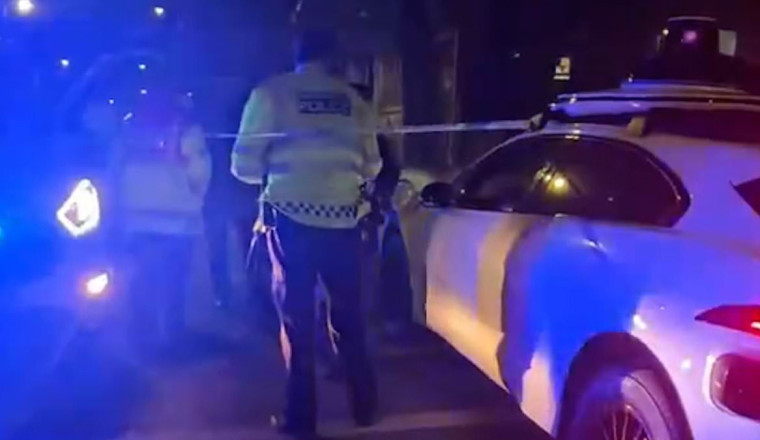
A driverless Waymo taxi being tested in London ploughed into a taped-off crime scene on Wednesday evening, but the firm insisted it was under human control at the time.
The incredible spectacle unfolded in Harlesden in the capital's north west, where a road was closed by Met Police officers following a double stabbing.
As bystanders filmed the police cordon, the white car – which is designed to be fully autonomous – sped into view, seemingly not noticing the police's flashing blue lights and the 'Do Not Cross' tape stretched across the carriageway at windscreen height.
In the footage, a number of loud beeps can be heard as the electric car comes to a halt.
Two police officers can be seen appearing to engage in conversation with a person sitting in the car before it reverses away.
The self-driving cars have been in London since last Autumn, mostly under the control of 'safety drivers'.
Now, some are being fully controlled by artificial intelligence, with a human sitting in the driver's seat in case of an emergency.
Last night Ethan Teicher, a New York-based spokesman for Waymo, told the Mail that regardless of how implausible it appeared, he was 100% certain the car was being manually driven at the time. He added the driver involved has been suspended.

This is the moment a Waymo car drives straight into crime scene tape, narrowly avoiding a police vehicle before coming to a standstill

Two police officers can be seen in conversation with the driver before it reverses away
Waymo said their 'initial analysis suggests' that if the car had been in automated mode, it would have identified the danger and stopped.
The firm added: 'We sincerely apologise for any disruption caused by this validation driver, who was operating the vehicle in manual mode. We take this matter seriously and are working with our operations partner to ensure appropriate actions are taken.'
There are significant concerns about the safety of unleashing driverless cars on Britain's streets, as well as keeping them secure from a host of modern threats such as cyberattacks.
The vehicles, designed to be fully autonomous with no one in the driver's seat, are currently being tested in London ahead of a targeted rollout by the fourth quarter of 2026.
The company, a unit of Google parent Alphabet, has grown slowly but steadily over the years in the US despite tough regulations and expensive technology, enabling it to look at scaling up its presence abroad.
Waymo has partnered with Jaguar and its fleet of white vehicles are easily spotted due to their large mounted camera equipment on the top and sides of each car.
The firm, which already operates a completely driverless service in American cities including San Francisco, Miami and Atlanta, has dozens of vehicles roaming London for testing and street mapping purposes.
The vehicles, currently being tested in 19 London boroughs, need still to overcome a host of challenges associated with British streets including roundabouts and zebra crossings.
Join the discussion
Should human error with driverless cars make us rethink if UK streets are ready for autonomous vehicles?

Dozens of cars are currently being tested in 19 boroughs in London, ahead of a rollout by the end of 2026
Read More
Outrage as Google-run driverless car flattens beloved tabby cat without stopping

A source told the Daily Mail in November: 'London has been our focus for some time. We are launching sooner in the UK than people think.
'There are still some regulatory hurdles to get around but we're very close to getting a deal.
'London will be first, then major cities like Manchester, Liverpool, Birmingham and Edinburgh.'
Once launched, customers will be able to hail the cabs through an app, although airport drop-offs will initially not be available.
Prices will be 'premium' but competitive, the firm has said, with rates rising during periods of high demand similarly to existing taxi firms such as Uber.