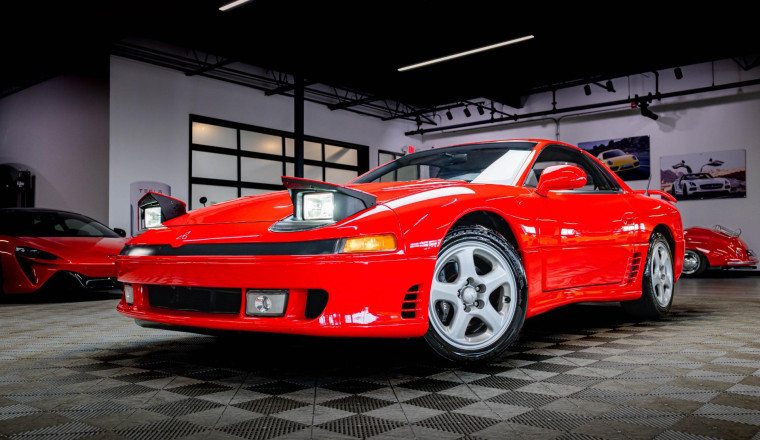

Back in 2017, Francis Amagasu, the owner of the 3000GT, was driving with his son Katutoshi in Bucks County, Pennsylvania. Amagasu went for a pass but lost control, causing his vehicle to leave the road, strike three trees and roll over. His son sustained minor injuries, but Francis shattered his cervical spine when his head hit the roof of the vehicle during the crash, rendering him quadriplegic.
In 2018, Amagasu's wife, acting on his behalf, filed a lawsuit against Mitsubishi Motors North America accusing the company of designing a vehicle that was unreasonably dangerous. The complaint alleged that the 3000GT's occupant restraint system was defective, specifically pointing to a so-called "rip-stitch" seat belt design that, according to experts for the plaintiff, allowed the belt to elongate by about four inches under duress.
The style of belt was designed to come apart upon impact and allow the driver's body to move forward into a deployed air bag. But the amount of slack the belt offered Amagasu was more than the amount of space between his head and the top of the car. And while that extra slack can offer safety in a singular collision, Amagasu's vehicle continued to roll after striking a tree while he wasn't fully restrained. His son's seat belt lacked the rip stitch design because the passenger seat had no airbag. The son walked away with minor injuries.
The Billion Dollar Verdict
A Court of Common Pleas jury reached a verdict in fall 2023, awarding Amagasu $176.5 million in damages for lost earnings and medical care and $800 million in punitive damages. Total: $1,009,969,395.32. Yes, over a billion dollars.
Before the accident, Amagasu was a master woodworker. They described their client's life as permanently changed. "Mr. Amagasu lives in a rehab facility now, but it may as well just be a prison cell," said Wes Ball, one of the attorneys representing Amagasu. "He's in a 10-by-12 room and has had to relearn how to speak".
The punitive damages sent a message. Eight hundred million dollars worth of message. Punitive damages, meant to punish offenders and deter future harm, can run 10 times the amount of damages for such things as medical bills and lost wages. The jury wanted Mitsubishi to feel this verdict. Mission accomplished. Temporarily.
The Legal Technicality That Changed Everything
The turning point came late in 2025 when the Superior Court of Pennsylvania reviewed the case. In a decision announced on December 22, 2025, the court found that the trial judge had failed to provide adequate legal instructions to the jury regarding crashworthiness and how to evaluate whether a safer alternative design might have prevented the plaintiff's injuries.
Appeal court documents go into great detail on why a new trial is necessary, explaining that the jury was not provided adequate instruction on how to consider crashworthiness. The jury was also not asked to consider what injuries Mr. Amagasu could have sustained if a safer alternative design was used.
Appeals documents explain this: "In a crashworthiness case, the fact finder must consider whether the plaintiff bore his or her burden of specifically identifying the injury that a safer alternative design would have prevented, as well as the compensable injury that was ultimately caused by the alleged design defect".
The distinction matters legally even if it sounds like splitting hairs. Superior Court Judge Judith Olson, who wrote the court's opinion, said Amagasu's attorneys never argued that a defect within the Mitsubishi 3000GT caused the crash itself. The car didn't malfunction. Amagasu lost control attempting to pass. The defect allegations concerned what happened after the crash, during the rollover, when his body moved despite wearing a seat belt.
The appeal's court opinion chastises Judge Thomas Street, saying the trial court "abdicated its duty" to instruct the jury on correct legal principles. And the judge's decision to deny Mitsubishi's proposed jury instructions "was not a logical and dispassionate determination" based on the law and evidence, Olson said.
The 1992 Standards Defense
There were no safety scores from the National Highway Transportation Safety Administration or the Insurance Institute for Highway Safety back in 1992, but the Mitsubishi 3000GT was in compliance with the Federal Motor Vehicle Safety Standards at the time. Mitsubishi built a car that met every requirement the government imposed. Thirty three years later, a jury decided those standards weren't good enough.
The case raises broader questions about how responsibility should be assigned for vehicles designed in earlier regulatory eras that later collision science finds lacking. At what point does compliance with contemporary standards protect manufacturers from future liability? If a car met 1992 safety requirements, can a 2023 jury retroactively determine those requirements were inadequate?
The crashworthiness doctrine addresses exactly this problem. It doesn't ask whether a car met standards. It asks whether a car's design made injuries worse than they would have been in an alternative design. That's why jury instructions mattered. The jury needed to compare Amagasu's actual injuries with hypothetical injuries in a hypothetically safer design. Without that comparison, the verdict lacks legal foundation.
The Pattern: Ford Faces Similar Battles
This isn't the first big verdict against an automaker that met the standards of the time a vehicle was built. In 2022, a jury ordered Ford to pay $1.7 billion after a claim that a roof crush was the result of defective design and materials. Ford saw a similar $2.5 billion judgment in 2025 over another rollover of a 2015 Super Duty truck. The $1.7 billion award was later thrown out and Ford is currently appealing the $2.5 billion verdict.
Billion dollar verdicts against automakers over rollover crashes have become a pattern. Juries sympathize with catastrophically injured plaintiffs. They see massive corporations with deep pockets. They award staggering sums intended to compensate and punish. Then appeals courts review jury instructions, find technical errors, and reset everything.
What Happens Next
Consequently, the court vacated the entire verdict and ordered a new trial on all claims. Mitsubishi Motors Corporation publicly acknowledged receipt of the appellate decision in its latest investor relations disclosure. Mitsubishi released a diplomatic statement: "Mitsubishi has always believed that the jury was not properly instructed on the applicable law".
Chip Becker, a Kline & Specter attorney who led Amagasu's representation throughout the appeal, said in a statement that the court's decision to vacate the verdict and order a new trial was wrong for multiple reasons. The jury instructions were consistent with past Pennsylvania Supreme Court precedent, Becker said. Plus, the jury found that Mitsubishi was liable because the car manufacturer failed to warn of the defect, making any other issue with the jury's instructions "harmless".
"The Superior Court's sharp criticism of Judge Street was unwarranted," Becker said. "Mr. and Mrs. Amagasu look forward to vindicating Judge Street's decisions in the appellate courts". They're appealing the appeal. The case continues.
With the verdict overturned and the case sent back for a new trial, the legal battle is far from over. Expect Mitsubishi to be back in court over this one, but as it has already been eight years, don't expect the case to be resolved anytime soon.
The Uncomfortable Reality
"This amount of money was in part to send him home, to make sure he gets the care he wants," Sherry said of Amagasu. "His wife testified that it was her hope that they could breathe the same air again". Francis Amagasu remains quadriplegic. He still lives in a rehabilitation facility. The billion dollars he won no longer exists. The injuries remain permanent regardless of legal outcomes.
For the Amagasu family, the judge's decision represents a setback and a continuation of a long fight for accountability and compensation. Legal analysts say the next trial could revisit many of the same technical and emotional arguments while also recalibrating how jurors are instructed about complex safety concepts.
The second trial starts from zero. New jury. New instructions. Same evidence of a 1992 sports car with limited headroom and a rip stitch seat belt that met every safety standard in effect when it was built. Same quadriplegic plaintiff who lost control while passing another vehicle and rolled into trees. The facts haven't changed. The legal framework has. Whether that produces a different outcome depends on whether proper crashworthiness instructions lead jurors to different conclusions about alternative designs and preventable injuries.
Mitsubishi won its appeal. The Amagasus lost a billion dollar verdict. Neither side won anything meaningful. One gets another expensive trial. The other gets more years fighting in court for compensation that might vanish again on technicalities. And somewhere in Pennsylvania, a master woodworker who hasn't held a chisel in eight years waits to see if the legal system eventually delivers justice or just more procedure.