
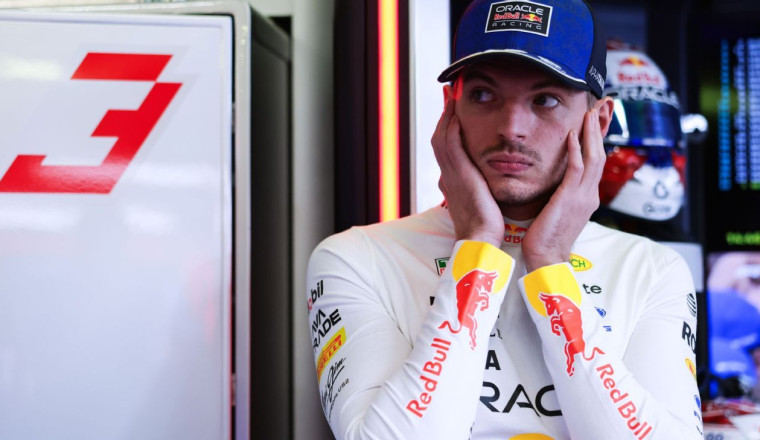

Max Verstappen has become the face of the anti-electrification movement in Formula 1 as the most vocal critic of the sport's controversial new cars.
F1's new hybrid engines feature a 50-50 split between combustion power and electrification, which has shifted a huge amount of focus at the opening two races of 2026 onto energy harvesting and battery power deployment -- something unprecedented for the series. F1 cars are now fitted with power boost systems that drivers can utilize around a lap at the push of a button.
The new cars have split opinion. Four-time world champion Verstappen -- widely regarded as the sport's best driver right now -- has been the loudest in his criticism from the get-go, and his comments on the cars have repeatedly generated headlines this year. Other drivers share some of his dislike of the new formula, especially over one lap. Still, while some have cooled their criticism since actual racing resumed at the Australian Grand Prix, Verstappen has remained as resolute in his criticism as ever.
His hatred of the new cars has created an odd paradox. After the Chinese Grand Prix, Lewis Hamilton, the only driver on the grid more accomplished than Verstappen, gave the cars a glowing review, saying they had produced the best racing he could remember in his career.
So what should we make of Verstappen, one of F1's greatest ever drivers, being so outspoken? Are his criticisms vindicated? Is he just frustrated because Red Bull does not look like a title contender? And should F1 really be worried that the best driver of his generation might simply decide enough is enough and walk away?
Here's a look at everything Verstappen has said about the new cars so far and what we make of them.
- Max Verstappen considering retiring from F1 at end of 2026 - reports
Verstappen's first impressions of the cars
The quotes
"Not a lot of fun, to be honest. I would say the right word is management. As a driver, the feeling is not very Formula 1-like. It feels a bit more like Formula E on steroids.
"A lot of what you do as a driver, in terms of inputs, has a massive effect on the energy side of things. For me, that's just not Formula 1. Maybe it's better to drive Formula E, right? Because that's all about energy efficiency and management. That's what they stand for. Driving-wise, it's not so fun."
The context
Verstappen, who had voiced concerns about F1's new regulations long before they rolled out this year, wasted no time launching a full-on broadside at the new cars at his first media session at Bahrain's preseason test in February.
By this point, the drivers had experienced them for three days at F1's private "Shakedown" event in Barcelona and then again at the desert circuit. It was at the latter that the Red Bull driver launched his first scathing attack and gave the first memorable soundbite about the new generation of cars.
Our verdict
It's hard to disagree with the "Formula E on steroids" label, and it is perhaps the best sweeping assessment you can give F1's new generation of hybrid engines.
Since its debut in 2014, the all-electric series has been defined by the battery power available to its drivers and the narrative of every race centers around that fact. This has become the same with Formula 1 since the start of the year, too, with TV commentators now having to give lengthy explanations about things like "super clipping," megajoules and battery harvesting just to give the proper context of qualifying sessions and races.
F1's cars are still significantly quicker and louder than Formula E, and the series remains more popular by an order of magnitude, so the idea of F1 being a steroid-boosted equivalent feels appropriate.
Verstappen is unlikely to add to his four world titles this season. Marcel van Dorst/EYE4IMAGES/NurPhoto via Getty Images
Real or artificial racing?
The quotes
In preseason, Verstappen said: "The car looks great -- honestly, the proportion of the car looks good, I think. That's not the problem. It's just everything else that is a bit, for me, anti-racing."
After the Chinese Grand Prix, he said: "It's still terrible. I don't know, if someone likes this, then you really don't know what racing is about. It's not fun at all. It's playing Mario Kart. This is not racing. Look at the racing. You are boosting past, then you run out of battery the next straight. They boost past you again. For me, it's just a joke."
The context
Verstappen's most cutting criticism -- and one that seemed to resonate most with the hardcore haters of the new cars -- was that the racing it has produced is simply not real and that anyone enjoying it is clueless about what they're viewing. It seemingly draws a line in the sand between the sport's hardcore and more casual fan base.
The back-and-forth spectacles at the front of the first two races have been topsy-turvy duels for victory (something F1 has been sorely lacking in previous eras) largely because of something Charles Leclerc called the "yo-yo effect." That new phenomenon has given F1 an easy highlight-reel package for each of the events so far, as cars swap positions endlessly in duels for position. Verstappen has not been impressed.
The Dutchman believes traditional overtaking -- outbraking a rival -- has been replaced by whoever deploys their battery most effectively. Coming from the sport's most thoroughbred racer -- a man who competes at the Nurburgring in his spare time and has had to be told by Red Bull management to stop racing online late into the night before grand prix Sundays -- any comment he makes on the nature of racing carries significant weight.
Our verdict
Verstappen is entitled to his opinion, of course, but this statement felt quite flippant and smacked a little of gatekeeping. After all, who really has the right to say what is and isn't "real" racing? That's an incredibly subjective topic, especially at a time when Formula 1 has welcomed an entirely new fan base into the sport in this decade.
Plenty of those won't have watched Ayrton Senna, or Michael Schumacher, or maybe even Sebastian Vettel in their prime, but still enjoy the sport as it is today. To suggest people don't understand racing just because you don't like something feels a little wrong, even for one of the best to ever do it.
What Verstappen is really getting at is that the fundamentals have shifted. Race craft is now as much about energy deployment and timing as it is pure braking skill. Both Russell and Leclerc have spoken about the strategic layer this adds -- deciding when to deploy battery power rather than relying purely on braking.
That doesn't necessarily make the racing better or worse, but it undeniably makes it different.
Is the new F1 really competitive?
The quotes
"It's just Kimi [Antonelli] or George [Russell] that is winning, right? It's not really back and forth. They're miles ahead of the field. It's just that Ferrari sometimes has these good starts that they push themselves in front, and then it takes a few laps to sort it all out. Like I said, this has nothing to do with racing."
The context
Much of the praise about the new cars has come thanks to on-track battles produced by the Mercedes and Ferrari drivers out in front. Leclerc and George Russell had a great fight for victory in Australia, while Leclerc and Hamilton went wheel-to-wheel in both the sprint and grand prix in China. The fighting has been back and forth and, remarkably, has so far been clean, albeit for a minor brush between the Ferrari drivers in the sprint.
Our verdict
Verstappen is correct that the three races -- two grands prix and a sprint -- have followed the same pattern, with Ferrari challenging early thanks to their great starts, and then fading as Mercedes' superior power management and deployment comes into play.
There's something to be said for the unpredictable nature of the opening stints of races so far in terms of how the new cars are being perceived. The fun spectacles out in front have helped to quiet two of the prevailing narratives that we came into the season with: (a) that the cars were dreadful and overtaking would be impossible; and (B) that Mercedes would win every race at a canter. Seeing Ferrari in the mix -- and with a rejuvenated Hamilton to boot -- has been a feel-good story few were predicting on Jan. 1.
A good judgement of the new cars might come after we have a more normal race. There will be one occasion soon when Ferrari does not get a mega launch into the lead at Turn 1, allowing Mercedes to control the pace out in front. Positions swapping back and forth might be less exciting and feel less formulaic if it is not happening for the lead. Plenty of other things could happen too -- the Ferrari drivers might well tangle next time they race, for example, meaning the focus is more on the internal drama rather than a brilliant wheel-to-wheel fight.
Here Verstappen is right -- for all the good wheel-to-wheel moments so far, it has felt like window dressing in what is otherwise a slightly lopsided competitive order so far.
Max Verstappen isn't concerned about how his Red Bull will perform, while Lewis Hamilton says he is "happier" at Ferrari.
The 'Mario Kart' training
The quotes
"I found a cheaper solution ... I swapped the simulator for my Nintendo Switch. I'm practicing with Mario Kart, actually. Finding the mushrooms is going quite well, the blue shells is a bit more difficult. I'm working on it. The rocket is still not there; it's coming!"
The context
One of Verstappen's many one-liners about the new cars.
Our verdict
10/10 zinger. Headline writers loved it. Nothing else to add, other than -- how good do you think Max is at Mario Kart?
Is Verstappen just bitter he's not competitive?
The quotes
"I love racing, but we can only take so much, right? I think they are willing to listen, FIA and F1, I just hope of course that there is some action. I mean it's not that I'm the only one saying it, I think a lot are saying it, if it's drivers, fans, we just want the best for the sport. It's not like we are critical just to be critical, we are critical for a reason, we want it to be F1, proper F1 on steroids. Today that of course was again not the case.
"I would say the same if I would be winning races, because I care about the racing product. It's not about being upset of where I am, because I'm actually fighting even more now, of course."
The context
There has become a clear split in the positive and negative comments over the first weeks of the season. The loudest cheerleaders have been the drivers in the most competitive cars, Mercedes and Ferrari, while the world champion trio of Verstappen, Lando Norris and Fernando Alonso -- all experiencing nightmarish starts to the new regulation cycle -- have been the loudest critics.
Norris has said F1 went from the best cars to the worst in one regulation change and that the new machines are nothing like what he and his rivals dreamed of racing when they were kids go-karting, while Alonso labelled Formula 1 the "battery world championship" after a difficult Chinese Grand Prix weekend. All very memorable quotes, but it is easy to look at the context around those three men's seasons and suggest it is just sour grapes.
Mercedes boss Toto Wolff, who spent a considerable chunk of last year courting the Red Bull driver over a contract, suggested Verstappen's comments are down to his current competitiveness. Verstappen complained to Red Bull that his car was the worst it has ever been after sprint qualifying in China, and Wolff alluded to that when the Dutchman's criticisms were put to him. "Max is really, I think, in a horror show," Wolff said. "When you look at the onboard that he has in qualifying yesterday, this is just horrendous to drive. You can see that."
Wolff added: "I'm sure for someone like Max, who is a full-attack guy, it's difficult to cope and digest. But it's more, I would say, a car-specific issue that magnifies the problem that it is. Because if you sit in front of a TV or in front of a screen, even Max would say that was interesting racing in the front."
Our verdict
We believe Verstappen's criticisms come from a good place. Two things here can be true at the same time: His comments can be sincere, and also magnified because he's upset about Red Bull's current position in the competitive order.
It should be pointed out that Verstappen was voicing his concerns about this current set of regulations from the first moment he understood what they were going to be in 2023. Verstappen is a man who lives and breathes racing, as his late-night sim races and forays into sportscar racing have demonstrated time and time again. Verstappen predicted he would not enjoy the cars and that it might severely impact his desire to continue from the beginning, even when he had a contractual offramp to Mercedes -- the team everyone assumed for a while would be the dominant force coming into the new regulation cycle.
So he was saying those things while knowing he could, in theory, jump over to the best team in time for the new regulation cycle, or one year into it. He has not flip-flopped on his views, either, as Norris bizarrely did when he defended the new cars in response to Verstappen's initial criticism in February, only to immediately backtrack later that same week and say he only said those negative things "to see what the reaction of everyone was."
Would these cars really make Max walk?
The quotes
In reply to whether he might walk away at the end of 2026: "That's what I'm saying ... Privately I'm very happy. You also wait for 24 races. And you just think about is it worth it? Or do I enjoy being more at home with my family? Seeing my friends more when you're not enjoying your sport?"
The context
Verstappen's bombshell quotes to BBC Radio Five Live after the Japanese Grand Prix are the closest he's ever come to an admission that the idea of retirement (or a brief time away from F1) is on his mind. The quotes were picked up around the world and resonated far beyond traditional F1 media, even though his state of mind is so closely linked to the sport's complicated new hybrid engines. Ahead of the four-week break from racing, caused by the cancellation of races in Bahrain and Saudi Arabia, it made Verstappen's immediate future the number one talking point.
Our verdict
As we wrote after the story broke, Verstappen seems deadly serious that this is a possible outcome for him. His demeanour over the first two races was deflated, but his mood appeared to have worsened even further in Suzuka, a week which started with him kicking a British journalist out of his media day session and later him admit he had no words to describe how he felt about F1 after being eliminated in Q2 on Saturday.
By Sunday afternoon, his mood seemed to be one of complete despair - he did not sound like a man enamoured with Formula 1 and the uncompetitiveness of his team must have felt like rubbing salt on the wounds. If anyone doubted Verstappen's seriousness about quitting F1 early, those should have disappeared.
The quotes
"I can easily accept to be in P7 or P8 where I am. Because I also know that you can't be dominating or be first or second or whatever, fighting for a podium every time. I'm very realistic in that and I've been there before. I've not only been winning in F1.
"But at the same time when you are in P7 or P8 and you are not enjoying the whole formula behind it, it doesn't feel natural to a racing driver. Of course I try to adapt to it, but it's not nice the way you have to race. It's really anti-driving. Then at one point, yeah, it's just not what I want to do. "And of course you can look at it and make a lot of money. Great. But at the end of the day it's not about money any more because this has always been my passion."
The context
Verstappen's increasingly negative view on F1's new cars has also come at a time he has completely disappeared from the competitive end of the grid. Red Bull appeared to be in good shape with its newly-built engine during preseason, but the first three rounds of the season have been a brutal reality check. Verstappen finished sixth in Barcelona, did not finish in China, and then laboured to eighth in Japan, finishing behind Alpine's Pierre Gasly. Here, he was insisting that current state of affairs is not the main reason he has been so willing to sound off about F1's new cars.
Our verdict
Both of these things can be true. Verstappen's complaints about the new cars seem genuine, but Red Bull's current situation probably turned the frustration dial up fully. It's worth pointing out that Verstappen was warning about bad times ahead in 2023 whenever he was asked about this current rules set. He always feared they would be bad for racing. But we can't completely overlook the Red Bull situation -- the once-great team looks to be in dire straits currently and ESPN understands there is a growing feeling within the team that the F1 operation is worse off since the shock removal of old boss Christian Horner last year.
It seems like the hated new cars and Red Bull's new status as anonymous midfielders are a brutal double-whammy for Verstappen and his state of mind.