
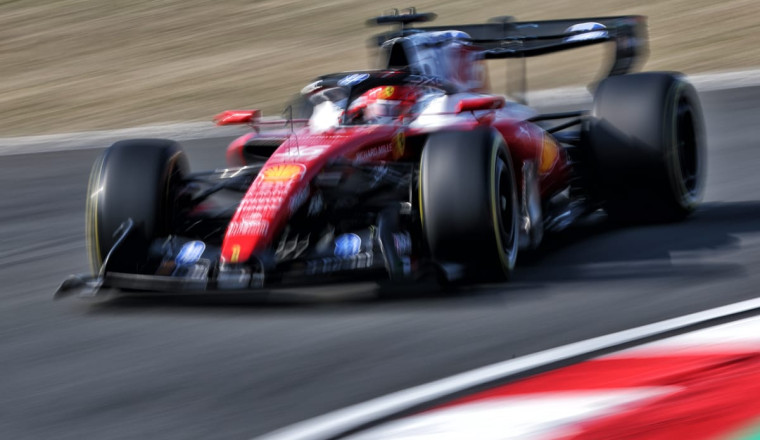

Odd. Strange. Counterintuitive.
These are a few of the words that Formula 1 drivers have used to describe what the new 2026 cars are like in qualifying.
With two events now complete, learnings have accelerated rapidly and everyone is starting to see the good and the bad of the regulations, even if opinions remain very divided.
But there is a growing consensus on two themes, and they are partly linked to each other.
The first is that qualifying, and the level of energy management needed on a lap, is perhaps a step too-far removed from the traditional flat-out approach.
On top of that, the cars and rules have a degree of overcomplexity, which makes them ridiculously sensitive to the smallest of regulatory quirks, and requires a driving approach that was not normal in the past.
Add these things together, and it is why a lot of drivers and teams have talked about things being counterintuitive if you want to deliver the perfect laptime.
As Charles Leclerc, renowned as one of the finest qualifiers on the grid, lamented in China about the new cars: "They are very strange in qualifying.
"I felt in the past one of my strengths was that, come Q3, I was just taking massive risks to get something out more, and now when you do that you start confusing the engine side of things.
"You start losing a lot more than what you gained. So, consistency pays off more…which is a little bit less exciting inside the car for Q3, because you cannot push as much as you would want."
Going slower to be faster
Leclerc's lament about the loss of "crazy" efforts in final qualifying comes off the back of a number of drivers hinting that the way to go quicker in qualifying is to drive slower.
That is because there are areas of the track where it is better to harvest more energy on the way into a corner and sacrifice speed there, because that then gives them a lot more power on the way out, which equates to easy laptime.
There are also some very weird elements, with McLaren team principal Andrea Stella saying he's had repeated comments from his drivers of occasions where they have lifted off because of a problem, only to find that this has given them more power.
"Once they make a mistake, this actually saves some energy," said Stella.
"Therefore, you go faster overall in a sector because the energy you saved with the delay in the throttle, because you had a problem, is going to reward you at the end of the straight."
But things run deeper than this phenomenon because, as Leclerc pointed out, the way that the systems work in F1 is that the power unit can end up "confusing" itself by not doing what the driver expects.
This results in brilliant qualifying efforts getting derailed by the tiniest of inputs, triggering software code that is completely removed from what the driver expects to happen.
And the Chinese GP weekend has given us an amazing example of the kind of oddness that drivers are dealing with.
The China case study
Leclerc's reference to having experienced his engine confuse itself is related to what happened to him in sprint qualifying in China.
In the final effort of that session, Leclerc had been on a lap that looked set to comfortably beat his first effort and put him within striking range of the Mercedes drivers.
But, as he blasted down the back straight, he ran out of deployment much earlier than he expected and all the gains he had made earlier in the lap were wiped away.
The final Q3 run of 1m32.528s was an improvement on his earlier 1m32.732s effort. But after winding up seventh on the grid as others made bigger steps forward, he understood that it should have been so much better.
And he knew instantly on that back straight before the lap was complete that things had gone wrong.
"What the hell is happening?" he said over the team radio. "This deployment, my god."
The answer only came up after some deeper analysis of telemetry.
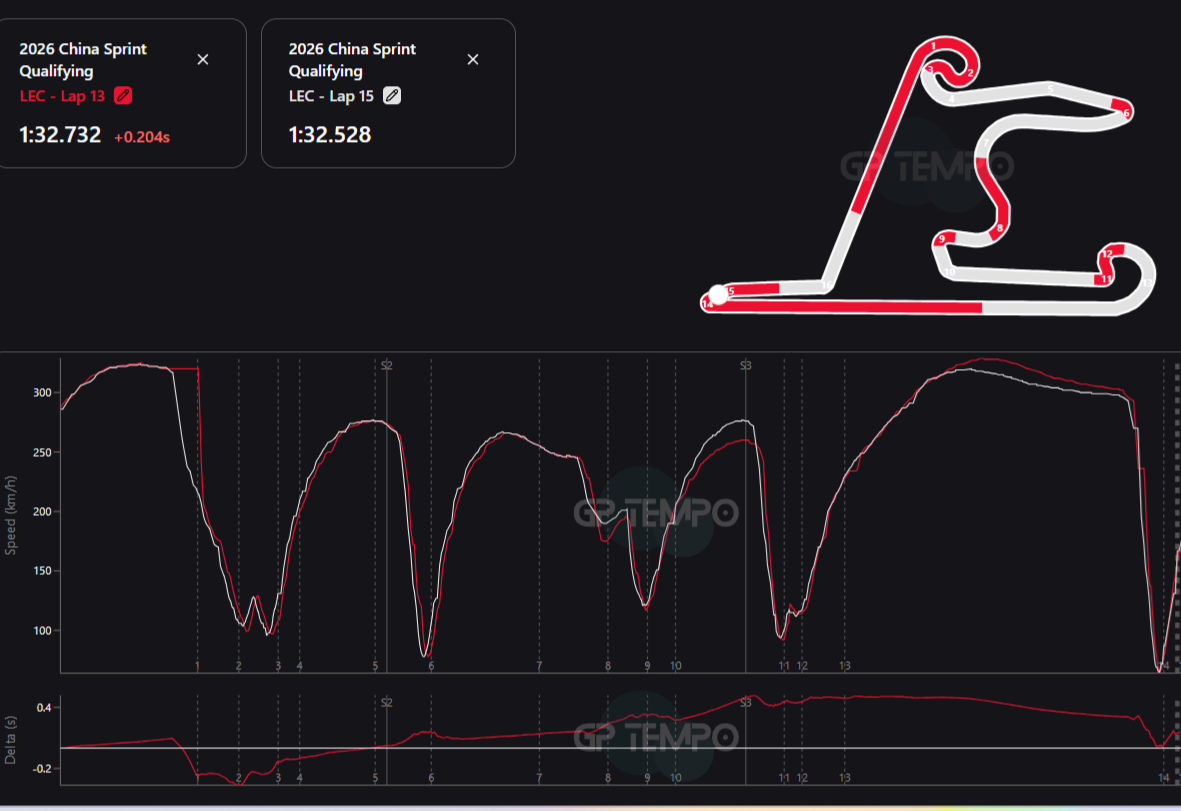
Looking at data comparisons from GP Tempo of Leclerc's first run in SQ3 (red trace) versus his final one (white trace), it is obvious that the deployment on the back straight is much worse at the end of his final lap.
He hits a peak of 320km/h before the speed drops away, which is less than the 329km/h he reached before.
It means he is travelling up to 15km/h slower for much of the straight, bleeding laptime in the process.
Having taken the previous corner onto the straight pretty much identically each time, it was not obvious at the time where this disparity had come from.
But the answer comes not from Leclerc's handling of Turns 11/12/13 in harvesting as much as possible on to the back straight; it was actually his exit from Turn 10 that had unknowingly sealed his fate.
As can be seen from onboards, coming out of that quick left-hander, Leclerc has a brief slide and an oversteer moment - which is not unusual for a final qualifying effort where drivers put everything on the line.
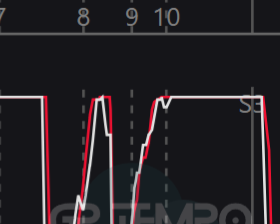
But in correcting it, as can be seen in the graphic above, he briefly reduces his throttle input.
According to Ferrari's own telemetry data, this was down to 95% before the car settled and he got back on full power.
The reduction in throttle input to that level was critical because it triggered something in the regulations that is now proving to have a massive impact on laptime.
With F1 cars being energy-starved, teams know that the best way around the lap is not to burn at the full 350kW on every straight.
Instead, it's about managing it for places where it offers the biggest advantage - such as coming out of slow corners onto long, flat-out sections.
But the rules do not allow teams to switch on and off the deployment at their whim; they are forced to use electrical power at times, and are limited in terms of how quickly it can be shut down.
As part of an effort to stop cars suddenly derating (going from the full 350kW to zero output) and causing safety issues, there are ramp down rates where the output can only be reduced by a certain amount.
In China, based on the layout of the track with a power-limited distance of 3125m, this was set at a maximum of 100kW reduction per second.
So for those areas of the track where using too much energy is not beneficial to laptime, teams set their engine maps to minimise deployment here to save energy so it can be used in places where full deployment delivers more benefit.
Areas where these maps are deployed are agreed beforehand and referred to, in the regulations, as 'power-limited' periods.
However, to activate a power-limited map, the regulations demand that the throttle needs to be registered as having been at 98% or greater for at least one second.
This is a level that has been in the rules for years as a safety measure. However, because such power-limited periods never really impacted performance before, it never really registered as a problem.
During the one second that the throttle is at 98% or above, the car is in a mode known as 'power-limited pending' - which then needs to comply with another regulation that has been introduced both as a safety measure and a means of preventing traction control tricks.
Article 5.12.4 of the technical regulations states: "The driver maximum power demand cannot be reduced by more than 150kW at the start of any power-limited pending period, and the power reduction will remain fixed for a minimum of 1s."
So the scenario that Ferrari had planned for was Leclerc to come out of Turn 10 on full throttle.
After hitting the 98% throttle threshold, this would have triggered the power-limited pending period where battery deployment can get cut to a minimum of 200kW but then stay at this level for the duration.
Then, once the one second is up, the car will switch to full power limit mode, where it can then further reduce its battery power output by up to 100kW per second.
Looking for even more insight from our team of F1 experts? The Race Members' Club is the place to find it - join now to claim 90% off your first month!
However, the whole algorithm was thrown out of the window by that small moment Leclerc had on his way out of the turn.
In lifting off the throttle to 95%, the car automatically reset its engine mode sequence as outlined in the rules.
So when he got back on the accelerator, rather than his power unit being in a phase like the lap before where his battery deployment had been reducing to conserve energy for the main straight, the whole procedure started from scratch.
Getting back to full throttle (above the 98% threshold), he will then have had to go through another second of burning 200kW in power-limited pending mode, with the ramp down rate starting only after that.
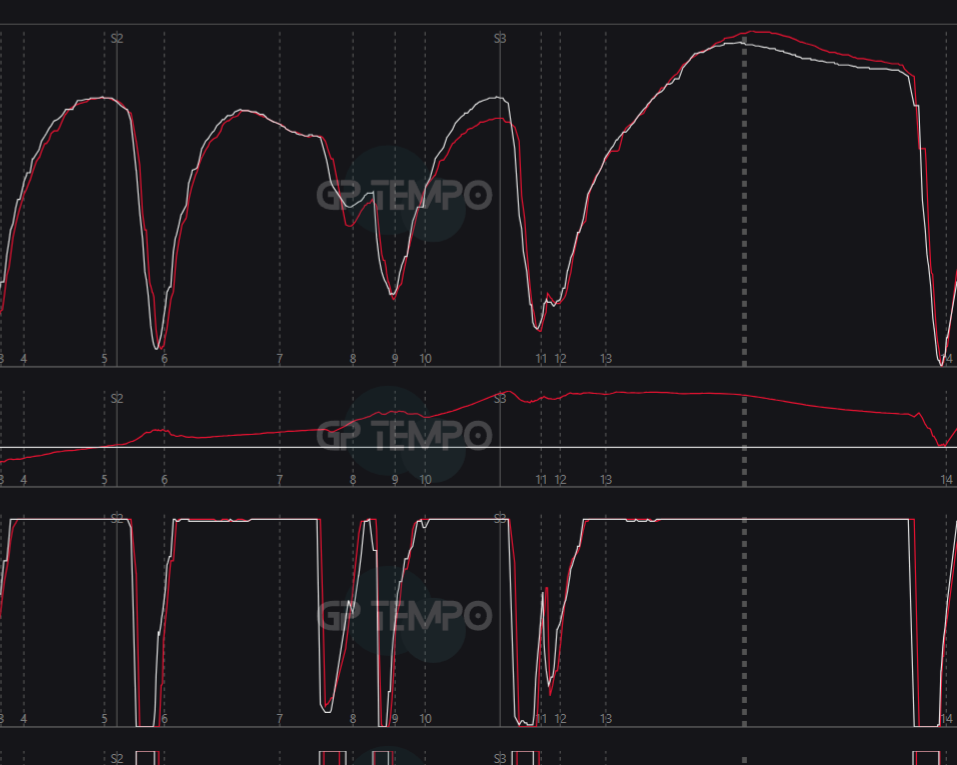
Compared to his previous lap (shown in graphic above), this left him running at a higher power level for longer than intended.
This boosted his top speed in a place where it was less beneficial, but he knew nothing about it because it was not in his control.
The consequences for it were only felt many seconds later when he ran out of power coming down the back straight.
We've taken a closer look at Leclerc's laps in our latest YouTube video.
Other instances
Leclerc is not the only driver to have experienced weird rule quirks like this.
Haas driver Esteban Ocon had a moment through Turn 13 in sprint qualifying in China where, rather than being full on the throttle, he had the smallest of lifts - even more minor than Leclerc but, critically, to less than 98% as well.
This again meant he restarted the power-limited pending procedure, and resulted in him burning through too much power early on.
"I did a very good lap, the corners were all very well-optimised, but for some reason because I was not at 100% throttle at the right place, I was at 97%, I lost three tenths on the back straight," Ocon said. "That's where that shouldn't happen."
These situations have left drivers feeling a bit powerless to the system, in that they are executing software code rather than driving a racing car on the edge of adhesion.
As McLaren driver Oscar Piastri said: "The difficult part is that even if there's something we want to do differently, we can't do anything.
"It has to be programmed in or there has to be a code changed, so it's complex."
A philosophical debate
With no rule changes happening in the short term, the quirks that have been highlighted in qualifying with these cars mean that drivers simply have to put up with what is happening right now.
From Leclerc's perspective, his response to the lesson of sprint qualifying in China was that he now needs to be more cautious in corners and super-smooth on the throttle to not risk any moments where he comes off it when exiting a corner.
But with teams set to sit down after the Japanese Grand Prix to discuss potential rules tweaks, there are some fundamental questions that need asking about whether this is what F1 should be about.
As Stella asked: "Do we want to be faithful to the DNA of racing in a traditional sense?
"Do we accept that this counterintuitive situation belongs to the business or not? I think this is more of a high-level philosophical question.
"I think fans are a part of this in finding the answer.
"But above all, drivers are a part of this in finding the answer. So I think it's for F1 and the FIA now to collect the feedback, and create a picture."
Context:
F1's 2026 cars force drivers to go slower to achieve faster lap times due to complex energy management systems.
Context:
This counterintuitive approach removes the traditional flat-out qualifying excitement that fans and drivers expect.
Context:
Leclerc lost a strong qualifying lap when his power unit ran out of deployment earlier than anticipated on the back stra